
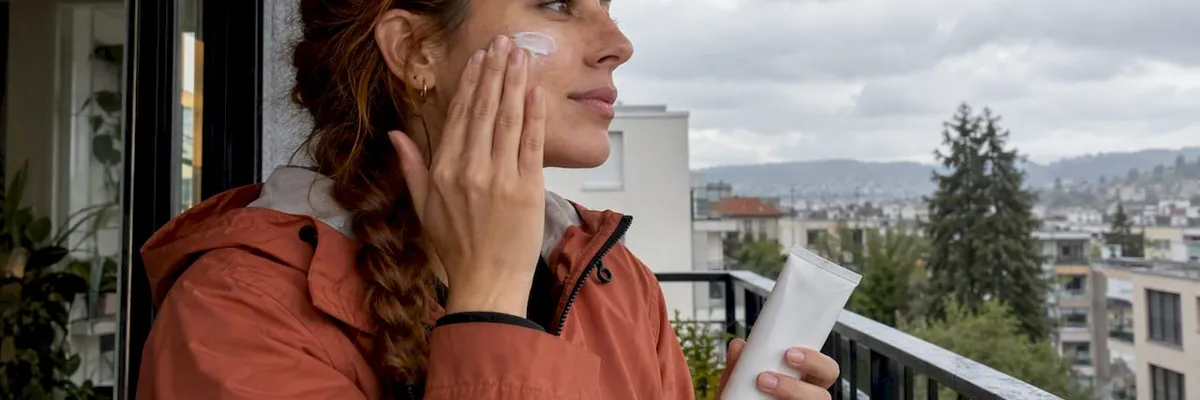
Yes, you need sunscreen even on cloudy days. Clouds mainly block the heat, but only partially the UV radiation. According to the Swiss Cancer League, up to 80 percent of UV rays penetrate the cloud cover even on overcast days. Whether you should apply sunscreen does not depend on how gray the sky looks, but on how high the UV index is. In this guide, we show you what clouds do to radiation, why Switzerland with its mountains is a special case, and how to protect yourself on gloomy days without overdoing it.
In Short
- Clouds filter the heat but not most of the UV radiation. Light cloud cover only slightly reduces it.
- The UV index is decisive: From a value of 3, the Cancer League recommends active sun protection, even if it is cloudy.
- In the mountains and on snow, the exposure is significantly higher, even at cool temperatures.
- Sunscreen complements shade, clothing, hats, and sunglasses but does not replace them. A generous amount and regular reapplication are important.
- MeteoSwiss will discontinue UV forecasts at the end of 2026. Plan now where you will check the UV index in the future.
Table of Contents
- What Clouds Do to UV Radiation
- Why a Gray Day is So Deceptive
- The UV Index Decides, Not the Sky
- Swiss Special Case: Mountains, Snow, and Sea of Fog
- How Much Sunscreen You Really Need
- More Than Cream: Shade, Clothing, and Sunglasses
- Which Sunscreen is Suitable for Gloomy Days
- Our View: Sun Protection as a Calm Habit
- Frequently Asked Questions
- Sources
What Clouds Do to UV Radiation
Sunlight consists of visible light, heat radiation (infrared), and ultraviolet radiation. For the skin, the UV component is crucial. According to the Federal Office of Public Health, 95 percent of the UV rays reaching the Earth's surface are UVA rays, the remaining 5 percent are UVB rays. UVC is completely absorbed by the atmosphere.
UVB is mainly responsible for sunburn. UVA penetrates deeper into the skin and contributes to premature skin aging, such as wrinkles and pigmentation spots. Both types of radiation can damage cells, and you do not feel either directly on the skin.
How much clouds weaken the radiation depends on their type and density:
- Light, thin cloud cover: According to the FOPH, it only reduces UV radiation by about 5 to 10 percent. For the skin, this makes little difference.
- Denser cloud cover: Even here, a large part, up to 80 percent, of the radiation reaches the ground.
- Closed, thick rain clouds: They dampen the radiation significantly more. On such days, the UV index often drops noticeably.
There are even situations where clouds increase the exposure. Loose cumulus clouds can scatter and reflect the radiation at their edges. ÖKO-TEST points out that under unfavorable conditions, the radiation exposure can even increase. A changeable summer day with sun between bright clouds is therefore no reason to forgo protection.
Why a Gray Day is So Deceptive
The problem on cloudy days is not the radiation alone, but our perception. We feel the sun through its heat, that is, through infrared radiation. Clouds hold back exactly this heat well. It feels cool and harmless, while the UV radiation largely passes through unimpeded.
The Cancer League describes in its brochure on sun protection that UV rays are neither visible nor felt and are therefore easily underestimated. Many people get sunburned not on hot beach days, when they are already cautious, but on overcast days while hiking, cycling, or gardening. You stay outside longer because it is pleasant and do not think about reapplying sunscreen.
There is also a second effect: Sunburn often only shows up a few hours later. When the skin feels tight and turns red in the evening, the damage has already occurred. Therefore, it is worth making the decision not based on feeling, but on an objective value.
The UV Index Decides, Not the Sky
The UV index is an internationally standardized value for the strength of UV radiation. The World Health Organization explains: The higher the index, the greater the potential for damage to skin and eyes, and the faster damage occurs. The Swiss Cancer League derives clear recommendations from this depending on the value:
| UV Index | Exposure | What You Should Do |
|---|---|---|
| 1 to 2 | low | No special protection needed |
| 3 to 7 | moderate to high | Seek shade, wear clothing, hat, sunglasses, apply sunscreen on uncovered skin |
| 8 to 11+ | very high to extreme | Avoid sun exposure as much as possible, protect consistently |
The advantage: The index already takes cloud cover into account. If the forecast for an overcast June day shows a value of 5, then this value applies, no matter how gray it looks.
Where to Check the UV Index in Switzerland
Until now, the MeteoSwiss app and website have been the first address for many. This is changing: As reported by 20 Minuten, MeteoSwiss will stop publishing the UV index as of December 31, 2026, due to federal budget cuts. According to Blick, users will have to rely on external apps like SunSmart Global UV in the future.
For the transition period and beyond, there are other options. The UV index map from SRF Meteo shows the daily maximum value for various locations in Switzerland. Our tip: Set up a reliable source on your phone before the next spring season so you don't have to search on hiking day.
When the Radiation is Strongest
Even on cloudy days, midday is critical. The WHO states that UV rays are strongest two hours before to two hours after the sun's zenith. In Switzerland, this corresponds to the period the Cancer League mentions: stay in the shade as much as possible between 11 a.m. and 3 p.m. during daylight saving time.
Swiss Special Case: Mountains, Snow, and Sea of Fog
Living in Switzerland means dealing with a unique situation. UV radiation increases with altitude, according to the Cancer League, by about 10 percent per 1000 meters. Snow reflects up to 90 percent of the radiation. Together, the effect on the skin can almost double, even if the air is cold and clouds are in the sky.
A few typical situations:
- Ski day in high fog or light cloud cover: Cold air, little sun in sight, but altitude and snow amplify the radiation. Face, ears, nose, and lips are particularly exposed.
- Above the sea of fog: In autumn and winter, the Swiss plateau often sits under a gray blanket, while the sun shines on Rigi, Pilatus, or in the Jura. Those who travel by train above the fog switch from UV-poor to UV-intensive within minutes.
- Mountain hike in summer: When clouds gather, you often stay out longer than planned. That's when the protection of the morning sunscreen fades.
If you work in the Swiss plateau, the exposure in late autumn and winter is usually low. In higher altitudes, it looks different. More on when sun protection is worthwhile in the cold season can be found in our guide to sunscreen in winter.
How Much Sunscreen You Really Need
The most common mistake is not forgetting, but applying too sparingly. The stated sun protection factor is determined in the lab with a significantly larger amount than most people use in everyday life. Applying only a thin layer achieves a much lower protection than stated on the package.
The Cancer League recommends a product with a sun protection factor of 30 or higher, containing UVA and UVB filters, applied generously. For the entire body of an adult, about three to four heaped tablespoons are considered a guideline. You should reapply every two hours and after swimming or heavy sweating.
For the face, a simple rule has proven effective in practice:
- Apply sunscreen as the last step of your morning routine, after serum and moisturizer.
- Use an amount equivalent to two finger lengths for the face and neck.
- Don't forget ears, neck, hairline, and the backs of your hands.
- Let the cream absorb briefly before applying makeup.
- Renew the protection if you are outside for a long time, even if it remains cloudy.
Especially on long days outdoors, a well-thought-out sequence helps. A good overview of an outdoor skincare routine shows how amount and application work together throughout the day. How to reapply most easily in everyday life is explained in our article on reapplying sunscreen. If you wear makeup, find tips in the article on applying SPF over makeup.
More Than Cream: Shade, Clothing, and Sunglasses
Sunscreen is important, but it is not the first line of defense. The WHO emphasizes that shade, clothing, wide-brimmed hats, and sunglasses are more effective than sunscreen alone. The cream is intended for skin areas you cannot cover. The FOPH also names clothing and headgear as the best and simplest protection, complemented by sunglasses with effective UV protection.
For cloudy days, this means specifically:
- Headgear: A cap or hat protects the forehead, scalp, and depending on the brim, also ears and neck.
- Clothing: Long-sleeved, tightly woven fabrics block more radiation than thin, loose weaves.
- Sunglasses: Eyes are also sensitive to UV radiation, especially on snow or water. Look for a declared UV protection. What the labels mean is explained in this overview of category 3 sunglasses.
- Shade: It does not protect completely, as radiation is reflected from bright surfaces, but it significantly reduces exposure.
And one more point that is often overlooked: Sunscreen should not extend the time in the sun indefinitely. It reduces the risk but does not eliminate it.
Which Sunscreen is Suitable for Gloomy Days
On cloudy days, many are reluctant to use sunscreen because it feels heavy, sticky, or whitish. This is one reason why Korean sun protection products have become so popular: Many are designed with a light texture that fits into the morning routine like a moisturizer. If you enjoy applying a cream, you will use it even on gray days.
What to look for when choosing:
- Sun Protection Factor: For everyday use, SPF 30 is a solid base, for mountains, snow, and long days outdoors, SPF 50 is sensible. The difference is explained in our guide SPF 30 or 50.
- UVA Protection: Since UVA makes up the majority of the radiation, it is particularly relevant on cloudy days. In Korean products, the PA rating indicates the strength of UVA protection, with PA++++ being the highest level. More on this can be read in the article on SPF in K-Beauty.
- Skin Type: Dry skin benefits from nourishing, creamy textures. Tips on this can be found under sun protection for dry skin.
- Form: A stick fits in any jacket pocket and is great for reapplying on the go, such as on the nose, cheeks, and ears.
Our Selection for Cloudy and Sunny Days
In our range, you will find sun protection that fits well into everyday life. The Enough Collagen 3x Moisture Sun Cream SPF50+ PA++++ is an option if you want to combine high protection with moisture. The Skin1004 Madagascar Centella Air-Fit Sun Cream Plus SPF 50+ PA++++ in Beige Tinted offers a light tint for those who want to save time in the morning. For on the go, there is the Tocobo Cotton Soft Sun Stick SPF50+ PA++++ with 19g, practical for reapplying on hikes or in ski areas. All products are sourced directly from verified suppliers, delivery in Switzerland usually takes 2 to 3 days, and shipping is free for orders over 80 CHF. Our entire sun protection and the appropriate care can be found in the Rammilav catalog.
Our View: Sun Protection as a Calm Habit
We often find that customers consider sun protection as something for summer vacations. However, the topic of cloudiness shows that protection works best when it is not dependent on the weather but is part of a routine. Those who automatically reach for sunscreen after moisturizing in the morning do not have to think twice on a gray April day.
At the same time, we do not believe in scaremongering. In the Swiss plateau, UV exposure on a gloomy November day is low, and no one needs to reapply constantly. A glance at the UV index is enough to make a sensible decision. More important to us is that you know the situations where cloud cover is deceptive: spring and summer, midday hours, mountains, and snow.
That's why we select sun protection for our range that people like to use: light textures, high UVA protection, and forms that are easy to reapply on the go. A sunscreen that is pleasant does not stay in the drawer. And skin that is regularly protected thanks you over the years with a calmer, more even complexion.
— Aleksejs
Frequently Asked Questions
Can You Tan Despite Cloudiness?
Yes, because a large part of the UV radiation penetrates the clouds. However, a tan is not a sign of healthy skin: According to the European Code Against Cancer, it is a protective reaction of the skin to UV damage. So if you tan on cloudy days, you have also been exposed to UV radiation.
Do I Need Sunscreen in the Rain?
With dense rain clouds, the UV index often drops significantly, often below 3. Then, in the lowlands, no additional protection is usually needed. Still, check the index, especially in summer and in the mountains, where it can clear up quickly between showers.
Do I Get Enough Vitamin D Without Sun?
For vitamin D production, you do not need to lie unprotected in the sun for long. According to IARC, short stays of about 10 to 15 minutes daily around midday with uncovered face, arms, and legs are sufficient in spring and summer. If you suspect a deficiency, have your level determined by your doctor instead of seeking more sun.
Is Morning Sunscreen Enough for the Whole Day?
Not if you are outdoors for a long time. Sunscreen is worn off by sweating, rubbing, and touching, so the WHO recommends reapplying every two hours and after swimming. For an office day with short walks, morning protection is usually sufficient.
Are People with Dark Skin Protected on Cloudy Days?
Darker skin has a higher natural protection but is not immune to sunburn or UV damage. The risk is higher for very fair skin types, but from a UV index of 3, all skin types should protect themselves. This also applies on cloudy days.
Sources
- Swiss Cancer League: Regional and Seasonal Sun Protection Recommendations
- Swiss Cancer League: Protecting from the Sun
- Swiss Cancer League: The UV Index Shows When Sun Protection is Particularly Important
- Swiss Cancer League: Sun Protection Brochure
- FOPH: UV Radiation
- FOPH: Sun and UV Radiation
- WHO: The Ultraviolet (UV) Index
- WHO: Protecting Against Skin Cancer
- WHO: Ultraviolet Radiation
- IARC: European Code Against Cancer, Sun Protection
- ÖKO-TEST: Do Clouds Protect Against UV Radiation and Sunburn?
- 20 Minuten: MeteoSwiss Discontinues UV Index Forecasts
- Blick: MeteoSwiss Abolishes UV Forecast
- SRF Meteo: UV Index Map


