
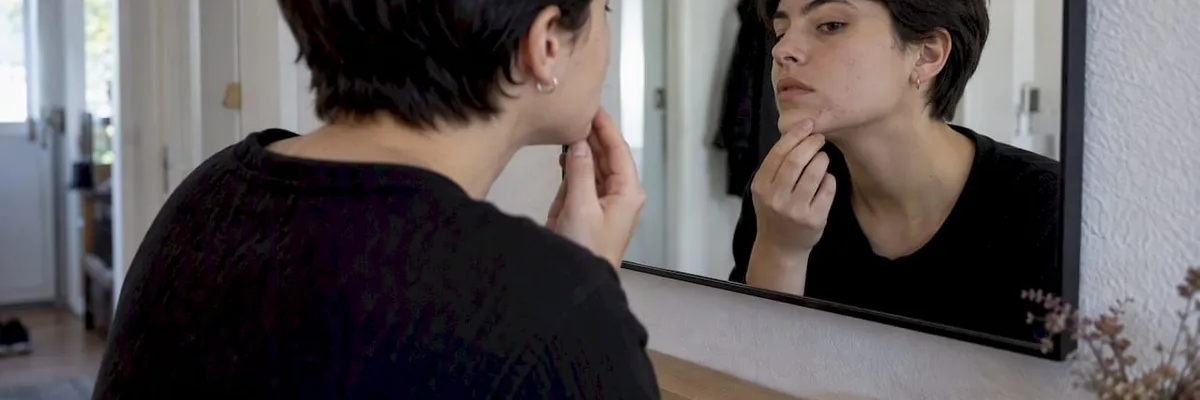
It's likely purging if the new blemishes appear exactly where you've had impurities before, and if you've recently introduced a new active ingredient product. Your next step: don't interrupt your routine, but observe for four to eight weeks while reducing everything else. If you experience severe pain or widespread redness, you should pause immediately.
In short:
- During purging, you should maintain the routine for four to eight weeks and only reduce everything else to avoid further stressing the skin.
- Usually, within the first weeks after starting treatment, small pimples or blackheads appear in the known problem area, which quickly subside.
- Severe burning, widespread redness, or swelling indicate irritation or allergy, not normal purging.
- Beginners should introduce active ingredients slowly and test only one new product at a time to recognize contact reactions early.
- If persistent, severe discomfort or worsening occurs, a specialist should be consulted.
Table of Contents
- What is Skin Purging (Initial Worsening)?
- Distinguishing Skin Purging from Acne, Irritation, or Allergy
- Timing and Duration: When Does Purging Start and How Long Does It Last?
- How to Adjust Your Skincare During Purging
- Avoiding Purging: Gradual Introduction, Patch Test, and Reduced Set
- When a Specialist is Necessary
- Patience Instead of Panic: An Honest Assessment
- Gentle Care Options for the Purging Phase
- FAQ
- Sources
What is Skin Purging (Initial Worsening)?
Skin purging, also known as initial worsening, describes a temporary phase where the skin initially worsens after using certain active ingredients before it improves. The mechanism behind it is simple: ingredients like retinoids or acid peels accelerate cell turnover and bring already existing, usually invisible blockages to the skin's surface faster. What was under the skin now appears as pimples, blackheads, or small impurities, actually a sign that the active ingredient is doing its job.
Active ingredient classes known for purging risk include retinoids, AHA, and BHA, as well as chemical peels in general. Anyone incorporating a BHA peel into their routine for the first time shouldn't be alarmed if more appears after a few days than before.
However, not every deterioration is automatically purging. Some products simply irritate the skin without triggering a deeper cleansing process, and this irritation often looks different from classic purging. It's worth taking a closer look at this difference.
Distinguishing Skin Purging from Acne, Irritation, or Allergy
The location reveals a lot. Purging appears in areas where you are already prone to impurities, rarely in completely new skin areas. The type of skin change also differs: with purging, you usually see small comedones, blackheads, or fine pimples that heal within a few days, much faster than a regular acne episode.
Irritations or allergic reactions look different. Severe burning, widespread redness, swelling, or itchy welts are more indicative of a contact reaction to fragrances, preservatives, or an overly aggressive ingredient. Irritations from cosmetics are even more common than true allergies according to dermatological sources, and a simple patch test can provide clarity here.
A short checklist helps with classification:
- Does the change occur in already known problem areas?
- Have you recently introduced a new active ingredient product?
- Do the pimples heal within days instead of weeks?
- Is there an absence of severe burning, swelling, or widespread redness?
- Does the reaction remain localized instead of spreading?
The more of these points apply, the more likely it is purging rather than irritation.
Timing and Duration: When Does Purging Start and How Long Does It Last?
Purging usually begins within the first few days to weeks after starting a new active ingredient, especially with retinoids and acid peels. The phase often lasts four to eight weeks, sometimes longer with certain treatments. Clinical guidelines for acne treatment recommend assessing treatment effects only after about twelve weeks, as short-term deteriorations are often part of the normal course during this initial period.
Typically, purging appears in the T-zone, on the chin, along the jawline, and sometimes on the back, precisely where sebum production is more pronounced. Those who knew these zones beforehand usually recognize the pattern quickly.
How to Adjust Your Skincare During Purging
Less is almost always better during this phase. A minimal routine of a gentle cleanser, a non-comedogenic moisturizer, and a broad-spectrum sunscreen is enough to stabilize the skin without further stressing it.
It's best to introduce retinoids and benzoyl peroxide slowly, for example, using an alternate-day method or as a short-contact application where the product is applied briefly and then washed off. According to guidelines for topical acne preparations, this approach significantly reduces the risk of irritation.
A few things should be avoided during this phase:
- Introducing multiple active ingredients at the same time.
- Using aggressive physical peels or brushes.
- Picking or squeezing pimples or blackheads.
Pro Tip: Switch to a reduced routine with a maximum of three products for a few weeks, giving the skin space to adjust to the new active ingredient.
Stop the application immediately if severe pain, widespread redness, or swelling occurs. This is no longer normal purging but a warning signal. How to rebuild an already irritated skin barrier is often the more important next step in such cases.
Avoiding Purging: Gradual Introduction, Patch Test, and Reduced Set
With the right introduction, purging can often be mitigated, although it can never be completely ruled out. Here's the safest approach:
- Start with the new active ingredient only once a week and observe your skin's reaction.
- Increase to two applications per week after one to two weeks without severe irritation.
- Gradually increase to three applications after further weeks if the skin tolerates it well.
- Test each new product first on the inside of the forearm and observe the area for 24 to 48 hours.
- Always introduce only one new active product at a time, never multiple at once.
This patch test method is also recommended by dermatological sources to recognize contact reactions early before they affect the entire face.
When a Specialist is Necessary
Severe pain, fever, widespread blistering, or a deterioration that does not improve after six to eight weeks are clear warning signals. Acne treatments usually run in twelve-week cycles according to guidelines, and after this period, a specialist review is worthwhile. Photograph the progress weekly, as this makes it easier to assess later whether anything has really changed.
Patience Instead of Panic: An Honest Assessment
I often see how quickly people completely change their routine at the first sign of pimples, but purging primarily needs one thing: time and a steady hand. A reduced routine with a few, well-tolerated products usually gets the skin through this phase more reliably than constantly trying new remedies. If uncertainty remains high, consulting dermatology is always a better decision than guessing on your own.
— Aleksejs
Gentle Care Options for the Purging Phase
During purging, it is worthwhile to reduce to a few, well-tolerated products, and this is exactly where our range comes in. A mild cleansing balm like the Purito From Green Avocado Cleansing Balm removes makeup and sunscreen without further irritating the skin. For moisture, a soothing, non-comedogenic serum like the Tocobo Cica Calming Serum is suitable, and for the day, a mineral sunscreen like the Tocobo Cotton Soft Sun Stick belongs in every minimal routine.
We offer these and other Korean skincare products in the entire catalog, sourced directly from verified suppliers, with fast delivery and free shipping from 80 CHF. These products soothe irritation and support the skin barrier, but they do not replace medical treatment. Browse the catalog at your leisure and find the care that suits your current skin situation.
This article contains general information and does not replace consultation with a qualified doctor. Contact a qualified medical professional regarding your personal situation before acting based on this content.
FAQ
How long can skin purging last?
Purging usually lasts several weeks to a few months, depending on the active ingredient. Clinical guidelines recommend assessing the full treatment effect only after about twelve weeks.
How does over-cared-for skin manifest?
Over-cared-for skin usually shows through widespread redness, a feeling of tightness, burning, or an overall irritated, sensitive skin surface. This differs from purging, which occurs locally in known problem areas and heals faster.
Why has my skin worsened after a cleansing?
If the skin temporarily worsens after a new active ingredient, it is often purging, triggered by faster cell turnover. If the deterioration persists for more than six to eight weeks or worsens, a specialist examination is advisable.
How long does the retinol purge last?
The purging phase with retinol usually lasts four to eight weeks, with a slow introduction, such as the alternate-day method, reducing irritation. Retinoids also increase sun sensitivity, so consistent sun protection during the day is important.
Sources
- SKIN AND SOFT TISSUE INFECTIONS Acne (Acne vulgaris: management NICE NG198)
- Topical preparations for acne — North & East devon formulary guidance
- Cosmetics Allergy: Causes, Symptoms, and Treatment — DermNet
- Retinoid or retinol? — American Academy of Dermatology


