

This is how you safely apply a BHA peeling: Cleanse your face, pat dry, apply a product with 1 to 2% salicylic acid thinly in the evening, starting with just 1×, and later 2 to 3× per week if well tolerated. Always follow with sunscreen in the morning with SPF 30 or higher. Before the first application, test the product on a small area of skin, such as the forearm, for 24 to 48 hours.
BHA stands for salicylic acid. It penetrates the pore, dissolves clumped skin cells, and also has an anti-inflammatory effect, making it particularly interesting for blackheads and blemished skin. Those starting with BHA should keep three things in mind:
- Avoid the eye area and corners of the mouth.
- Do not combine with retinol, other acids, or strong vitamin C on the same evening.
- If the skin burns, wash off immediately and pause the next application.
Pro Tip: Never apply BHA to damp skin. Moisture increases the penetration of the active ingredient, which can quickly lead to irritation in sensitive skin that can be avoided.
Key Insights
BHA peeling application works most reliably with low concentration, gradually increasing frequency, and consistent sunscreen the following morning.
| Topic | Details |
|---|---|
| Choose concentration | For beginners, products with 1 to 2% salicylic acid are suitable, as found in most over-the-counter formulas. |
| Increase frequency | Start with 1× per week, increase to 2 to 3× after 2 to 4 weeks if well tolerated. |
| Conduct patch test | Test on the forearm or jawline 24 to 48 hours before the first application. |
| Separate combinations | Use retinol, AHA, and high-dose vitamin C on separate evenings, never simultaneously with BHA. |
| Find suitable products | Rammilav offers tested BHA toners, serums, and suitable sunscreen from Korean brands for a safe start at home. |
Table of Contents
- What is BHA (Salicylic Acid) and How Does It Affect the Skin?
- Which Skin Types Are Suitable for a BHA Peeling?
- Which Concentration and Product Form Suits You?
- How Do You Apply a BHA Peeling Step by Step?
- How Often Should You Use BHA and How Long Should It Be Left On?
- What Should You Not Combine with BHA?
- Which Side Effects Are Normal and When Should You React?
- How Do You Sensibly Integrate BHA into Your Skincare Routine?
- What Do Studies Say About the Effectiveness of Salicylic Acid?
- When Should You See a Dermatologist?
- Why BHA Is Often the First Choice for Blemished Skin
- Find Suitable BHA Products for Your Routine
- Sources
What is BHA (Salicylic Acid) and How Does It Affect the Skin?
BHA is the common abbreviation for salicylic acid, a fat-soluble active ingredient that behaves differently from the water-soluble AHA family. Because it is lipophilic, it penetrates through the sebum directly into the pore, reaching exactly the spots where blackheads form. Salicylic acid acts keratolytically, dissolving the connection between dead skin cells and making the stratum corneum more permeable to care active ingredients that follow.
The second effect is as important as the first. Reviews confirm an anti-inflammatory effect that noticeably contributes to calming the skin in comedones and mild to moderate acne. In practice, this is evident on several fronts simultaneously:
- Finer, visibly smaller pores after a few weeks.
- Fewer new blackheads because sebum and skin cells clog less often.
- Calmer, less irritated skin with inflammatory blemishes.
- A smoother texture because dead skin cells are removed more regularly.
Which Skin Types Are Suitable for a BHA Peeling?
Oily and combination skin benefit most from salicylic acid, as well as skin prone to blackheads and inflammatory blemishes. Even mature skin with clogged pores often responds well because BHA loosens the stratum corneum without mechanically stressing the skin.
Caution is advised with active rosacea, highly sensitive skin, and open wounds. Those with a known intolerance to salicylates should completely avoid BHA. During pregnancy and breastfeeding, for high-dose or large-area applications: First clarify with a gynecologist or dermatologist whether a low-concentration application is acceptable.
- Well-suited: oily skin, combination skin, acne-prone, clogged pores.
- Caution: rosacea, high sensitivity, salicylate allergy.
- Clarify beforehand: pregnancy, breastfeeding, existing skin conditions.
If in doubt, a medical consultation is worthwhile before more intensive peelings, especially if the skin is already reacting irritated.
Which Concentration and Product Form Suits You?
Most over-the-counter products work with around 1 to 2% salicylic acid, a concentration that has proven effective for daily care. Professional peelings in practice work with higher doses but belong in expert hands.
The form determines practical handling:
- Toners and exfoliants usually remain as leave-on on the skin and continue to work for hours.
- Serums absorb similarly to toners and can be well combined with other care.
- Masks are wash-off or leave-on depending on the formulation, as stated on the packaging.
- Cleansing products with BHA have only short skin contact and are correspondingly milder.
Leave-on products work longer, so a lower frequency is sufficient here. Wash-off products can be used more frequently, but they remain overall gentler. A BHA serum with multiple acids differs significantly in effect from a classic toner with AHA and BHA, especially in terms of exposure time and intensity.
How Do You Apply a BHA Peeling Step by Step?
The application follows a fixed procedure that can be completed in a few minutes. Those who adhere to the sequence significantly reduce the risk of irritation from the start.
- Remove makeup and gently cleanse. A cleansing oil or balm thoroughly dissolves makeup and sunscreen before the actual cleansing follows.
- Pat face dry. Damp skin allows active ingredients to penetrate deeper, lowering the irritation threshold, so wait until the skin is dry.
- Patch test before the first application. Apply the product 24 to 48 hours beforehand on the forearm or jawline and observe the reaction.
- Apply thinly. A small amount is sufficient, avoiding the eye area and corners of the mouth. With toners, work sparingly with the pad, following this principle of cleansing, short waiting time, and targeted application.
- Observe exposure time. Leave-on products usually remain on the skin without rinsing, wash-off variants follow the manufacturer's instructions, often 5 to 10 minutes.
- Use aftercare. Soothing moisture with hyaluronic acid or niacinamide balances the skin. No further active ingredients on the same evening.
If burning persists, a clear rule applies: wash off immediately and pause the application until the skin has fully recovered.
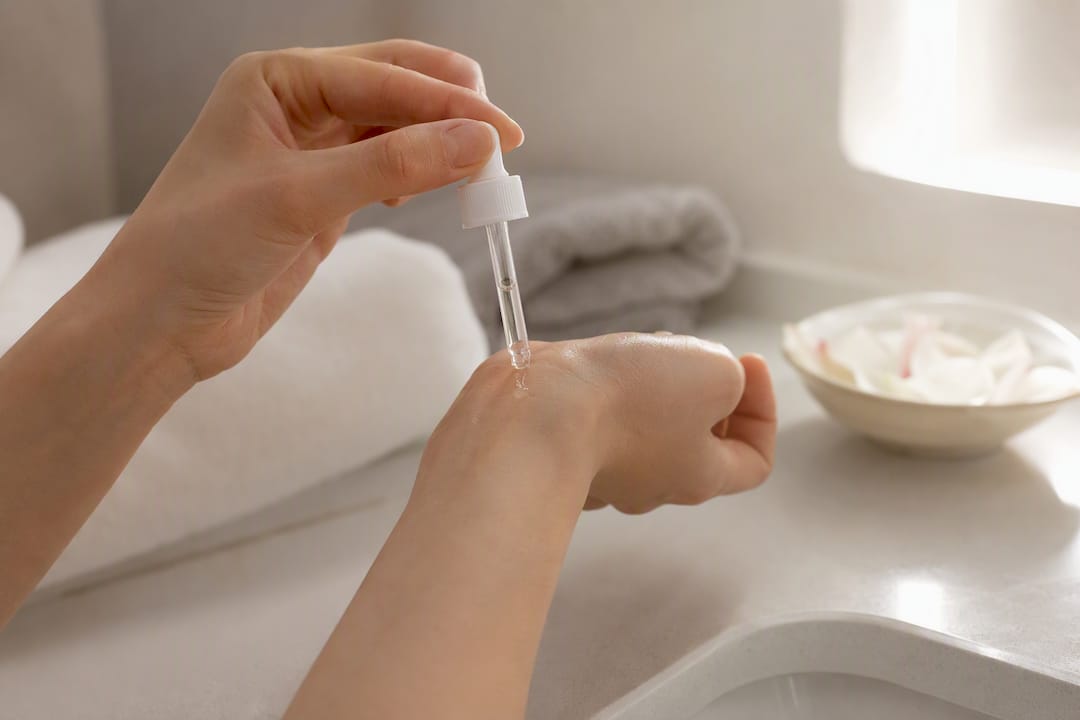
Pro Tip: Keep a pipette handy if your product doesn't have one. This allows for more precise dosing and avoids accidentally applying too much.
How Often Should You Use BHA and How Long Should It Be Left On?
The start is gradual, not a leap. Begin with 1× per week, observe the skin for two to four weeks, and then gradually increase to 2× per week. With good tolerance, a third application per week is possible, but the skin generally doesn't need more.
The exposure time depends on the product form. Leave-on toners often remain active for hours, while many instructions for the visible effect phase mention 5 to 10 minutes. This stair-step principle consciously increases frequency and not immediately concentration, significantly reducing the risk of a damaged skin barrier.
- Week 1 to 2: 1× per week, closely observe skin reaction.
- Week 3 to 4: increase to 2× per week if well tolerated.
- From week 5: maximum 3× per week, never daily.
- Warning signs like redness or flaking are a cue to step back.
What Should You Not Combine with BHA?
Some active ingredients amplify each other in a way that harms the skin more than it helps. On the same evening, avoid strong retinoids, intensive AHA peelings, high-dose vitamin C, and physical scrubs.
After professional treatments like microneedling or laser, a pause of 7 to 14 days is recommended before using BHA again. A sensible weekly plan clearly separates acid evenings from retinol evenings, so both active ingredients never overlap. Sunscreen remains mandatory every morning, regardless of which active ingredient was used the previous evening.
- Do not combine: strong retinol, AHA acids, high-dose vitamin C, mechanical scrubs.
- After professional treatments: plan a 7 to 14-day pause.
- Always: SPF 30 or higher the next morning.
Which Side Effects Are Normal and When Should You React?
A brief stinging or tingling in the first few minutes after application is normal and usually disappears quickly. A slight flaking in the first weeks also merely shows that the skin is getting used to the active ingredient.
It's different with persistent burning, intense redness, or severe flaking. Here, pause the application, soothe the skin, and if there's no improvement, consult a dermatologist. A proven approach to irritation looks like this:
- 7 to 10 days complete pause from active ingredients.
- Mild care with ceramides and panthenol for soothing.
- Restart with half the frequency, i.e., only one application per week.
A soothing cream helps in this phase to rebuild the skin barrier before cautiously continuing the BHA application.
How Do You Sensibly Integrate BHA into Your Skincare Routine?
On acid evenings, the routine follows a fixed order: cleansing, then BHA, then wait 5 to 10 minutes, followed by niacinamide or hyaluronic acid, and finally a richer moisturizer. This order prevents active ingredients from diluting or neutralizing each other.
When storing, one thing counts above all: store cool, closed, and protected from light, otherwise salicylic acid loses effectiveness over time. Never take the product with wet fingers, as this promotes germ growth in the packaging.
- Order: Cleansing → BHA → wait → Niacinamide/Hyaluron → Moisturizer.
- Storage: cool, dark, tightly closed.
- Sunscreen in the morning with SPF 30 or higher, keep lip care handy.
Pro Tip: Do not place your BHA product on the bathroom shelf above the shower. Heat and humidity there affect the formula faster than a cool, dry cabinet.
What Do Studies Say About the Effectiveness of Salicylic Acid?
The scientific basis for BHA is solid, even though studies vary in concentration and setting. Clinical studies confirm the keratolytic effect of salicylic acid, while reviews additionally confirm the anti-inflammatory effects in acne and comedones.
Important for practice: Most studies work with higher concentrations than over-the-counter cosmetics. Commercial products usually range between 1 and 2%, professional applications are significantly higher. The basic mechanisms described in the research align with what many observe in daily use: finer pores, fewer blackheads, calmer skin.
When Should You See a Dermatologist?
For severe acne, open wounds, or unexplained skin changes, clarification belongs immediately in the hands of a specialist, a home peeling does not replace this consultation. Even after a severe irritation that does not improve despite a pause, visiting the practice is the right next step.
For deeper scars, stubborn keratoses, or pigmentation disorders, professional treatment often brings more than the home product. Health guidelines explicitly recommend seeking professional advice before more intensive peelings in the presence of existing skin conditions. If unsure whether a higher concentration or frequency is sensible, it's best to clarify this beforehand rather than react afterward.
Why BHA Is Often the First Choice for Blemished Skin
In my experience with Korean skincare, it repeatedly shows: BHA is often more effective for the T-zone and skin prone to blackheads than more aggressive alternatives, precisely because it works specifically in the pore instead of burdening the entire skin surface. The key is less the product itself than the patience in introduction. Those who gradually increase frequency and consistently adhere to sunscreen get more out of salicylic acid than any leap to higher concentrations.
Find Suitable BHA Products for Your Routine
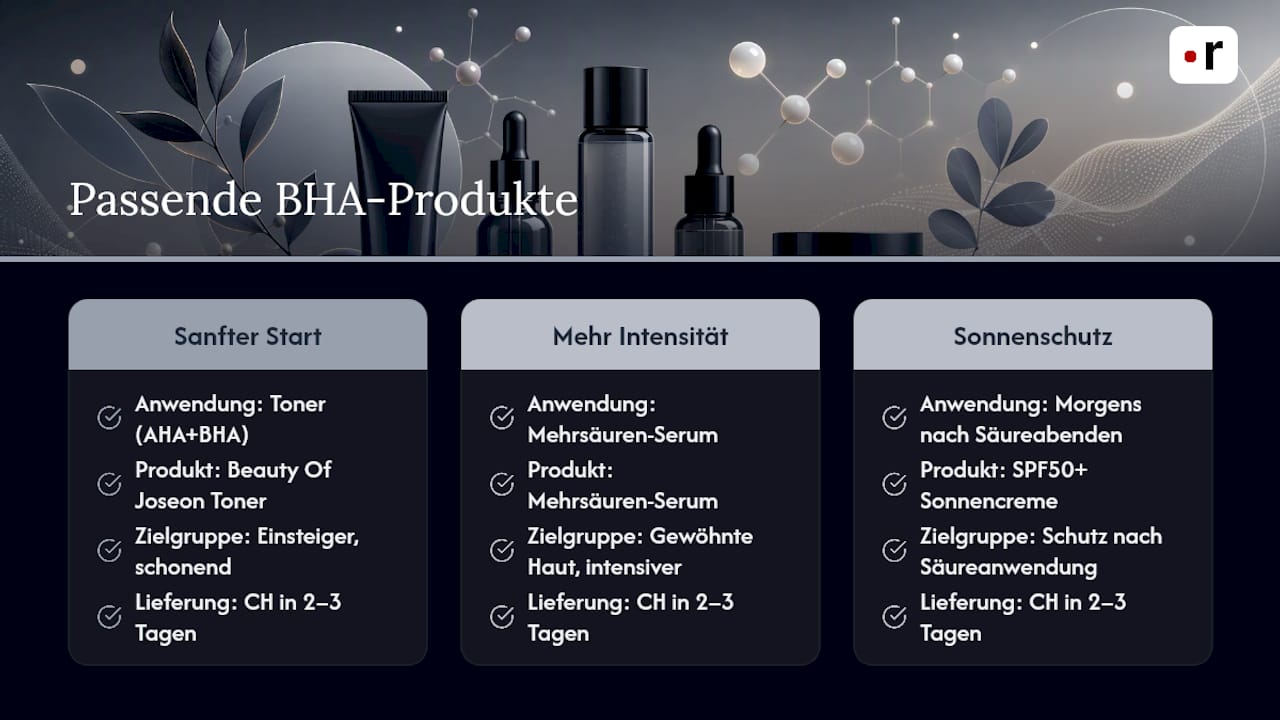
There are many other ways to achieve clearer skin, from cosmetic practice to professional fruit acid peeling. However, those who want to start at home in peace and without an appointment will find a selection of tested Korean skincare products at Rammilav, which are precisely tailored for this entry. The toner with AHA and BHA from Beauty Of Joseon is suitable for a gentle start, while a multi-acid serum offers more intensity for already accustomed skin. This always includes suitable sunscreen, such as the sunscreen with SPF50+ from Beauty Of Joseon, which completes the morning step after every acid evening. All products come directly from tested suppliers and are usually delivered within Switzerland within 2 to 3 days. A home peeling does not replace a medical diagnosis. For severe or inflammatory acne, a professional assessment is always worthwhile beforehand. Browse the Rammilav Shop and put together your suitable BHA routine.
Sources
For scientific classification, it is worth looking at the review on salicylic acid, which summarizes anti-inflammatory effects and benefits in acne. The AOK overview of chemical peelings helps with the question of when professional clarification is more sensible than the home product.
For practical implementation, the step-by-step guide to peeling application provides concrete time specifications and the stair-step principle for frequency increase. Check each source for author and publication date, especially with medical topics, the classification occasionally changes with new findings.
This article contains general information and does not replace consultation with a qualified doctor. Consult a qualified medical professional regarding your personal situation before acting based on this content.
- Pubmed
- Pmc
- Chemical Peelings: What You Should Know About Acid Treatment | AOK
- Salicylic Acid (BHA) – Active Ingredient Profile • FORMEL SKIN
- AHA BHA Peeling Application Guide: Step by Step – VitalNavi


