
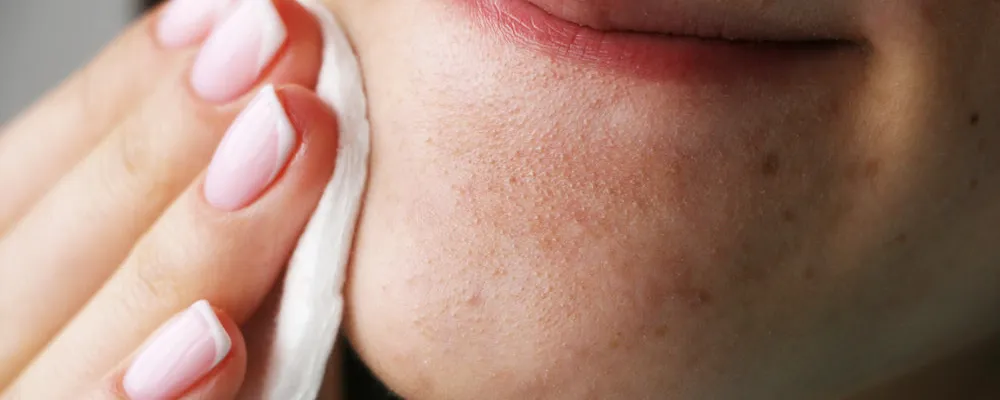
Forehead shiny. Cheeks tight. Nose oily. Chin doing its own thing. Welcome to the club.
If you have combination skin, you're in the majority. Studies show combination skin is the most common skin type worldwide. Not an exception, not a special case. Just normal.
Yet most skincare advice treats combination skin like a puzzle that needs solving. That's nonsense. Combination skin isn't a problem. It's just how skin works.
What's actually going on
Your T-zone (forehead, nose, chin) has significantly more sebaceous glands than the rest of your face. That's genetic. Can't change it. Your cheeks have fewer glands and tend toward dryness.
Two different skin conditions in one face. Sounds complicated, but the logic is simple: different zones need different care.
Why it gets worse sometimes
Hormones play a big part. Before your period? More sebum in the T-zone. Stressed at work? Cortisol kicks oil production into gear. Thyroid issues? Can throw everything off.
Then there are seasons. In summer, your skin produces more oil. The T-zone gets shinier while the cheeks might be fine. In winter, it flips: cheeks get really dry, T-zone calms down somewhat. Spring and fall? Unpredictable.
That's why a rigid routine doesn't work for combination skin. What works in January can be completely wrong in July.
The biggest mistake: treating the whole face the same
This is where most people go wrong. Two versions of the same mistake:
Mistake 1: Treating the entire face like oily skin. Harsh cleansers, stripping toners, no moisturizer. Result? The cheeks dry out completely. And the T-zone? Produces even more oil because the skin tries to compensate for the dehydration. The exact opposite of what you want.
Mistake 2: Treating the entire face like dry skin. Rich creams everywhere, heavy oils, thick layers. The cheeks are happy. The T-zone? Clogged pores, blackheads, breakouts.
Both approaches fail because they ignore what combination skin actually is: different.
Multi-masking: not a trend, just logic
Korean skincare has had the multi-masking concept for years. The idea: different masks on different facial zones. Clay mask on the T-zone, hydrating mask on the cheeks. At the same time.
This isn't a marketing gimmick. It's just consistent thinking. If your face has two different needs, you give it two different answers.
And this principle doesn't only apply to masks. It applies to your entire routine.
What actually works: lightweight hydration
The key with combination skin is light but effective hydration. Heavy creams are too much for the T-zone. No moisture at all is too little for the cheeks. The answer is in the middle.
Three ingredients that work particularly well for combination skin:
Niacinamide (Vitamin B3): Regulates sebum production in the T-zone while strengthening the skin barrier on the cheeks. One ingredient that helps both zones. Look for concentrations of 2% or higher.
Low molecular weight hyaluronic acid: Absorbs quickly, leaves no film. Delivers moisture without weighing down the T-zone. Apply to slightly damp skin. That part matters.
Lightweight ceramides: Strengthen the skin barrier without heaviness. Look for gel textures or light emulsions rather than thick creams.
A realistic routine
Morning: Gentle cleanser. Niacinamide serum. Lightweight moisturizer (gel texture or light emulsion). Sunscreen.
Evening: Double cleanse (cleansing balm or oil, then water-based cleanser). Hyaluronic acid on damp skin. If needed: richer cream on the cheeks only.
Once or twice a week: Multi-masking. BHA mask (salicylic acid) on the T-zone, hyaluronic or honey mask on the cheeks.
That's it. No ten-step program. No miracle products. Just the right care in the right place.
The honest truth
Combination skin won't transform into one uniform skin type. The T-zone will always be a bit oilier, the cheeks always a bit drier. That's fine. The goal isn't perfection. It's balance.
Watch your skin. Adjust when the seasons change. Stay flexible. And stop treating your face like one single thing. It's at least two.


