
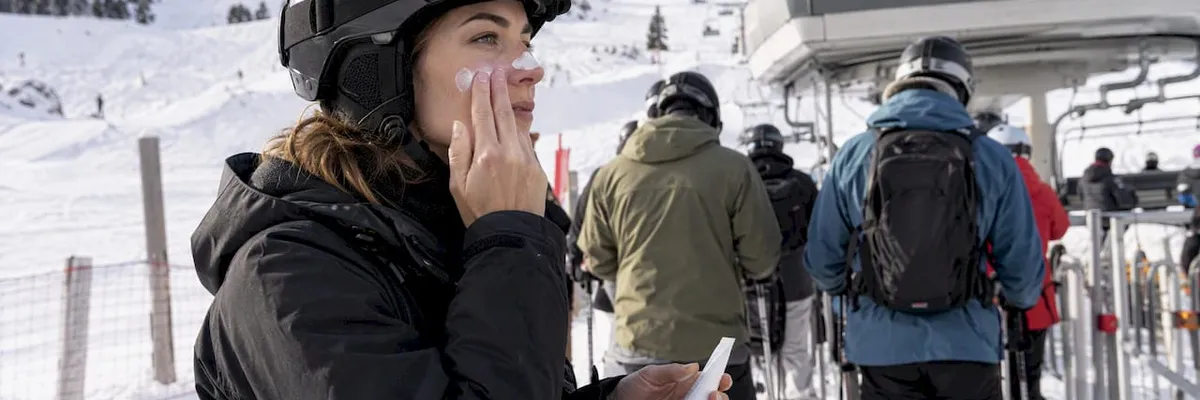
Yes, sunscreen in winter is useful in many situations, not just when skiing. The UV index is crucial: If it is 3 or higher, the WHO recommends protection, regardless of the season. In everyday life, SPF 30 is usually sufficient, but in snow, at high altitudes, or during winter sports, SPF 50+ and UV-protected glasses are recommended.
In short:
- Protection is recommended year-round from an index value of 3; light cloud cover only reduces ultraviolet radiation exposure by 5 to 10 percent.
- In everyday life, SPF 30 is usually enough; in snow, at high altitudes, or with extended outdoor exposure, SPF 50+ with broad-spectrum protection is recommended.
- Sunglasses with filter protection up to 400 nanometers and the CE mark protect the eyes from snow blindness.
- Apply sunscreen 20 to 30 minutes before going outside and reapply every two hours and after sweating.
Table of Contents
- When and Why Sunscreen is Necessary in Winter
- Special Risks in Winter Sports: Snow, Altitude, and Snow Blindness
- Which Sunscreen is Suitable in Winter?
- Proper Application and Reapplication in Winter
- Additional Protective Measures and a Brief Note on Vitamin D
- Why We as a Cosmetics Shop Write About Winter Sunscreen
- Suitable Sunscreen from Our Range
- FAQ
- Sources
When and Why Sunscreen is Necessary in Winter
The UV index indicates how strong the ultraviolet radiation is at a specific location and day. In Switzerland, it is calculated daily by MeteoSchweiz, taking into account the sun's position, altitude, and cloud cover. The protection recommendation starts at a value of 3, which applies year-round according to the BAG, even in January or February when many find this idea absurd.
Two effects make winter trickier than it seems. Snow reflects UV radiation extremely strongly, with 80 to 90 percent hitting the skin a second time, this time from below, according to MeteoSchweiz. Additionally, altitude plays a role: UV intensity increases by about ten to twelve percent per 1000 meters of altitude. So, standing at 2500 meters in the snow is a completely different radiation regime than being in the valley.
Practitioners therefore rely not on gut feeling but on the MeteoSchweiz app, which provides daily values and already factors in altitude, cloud cover, and reflection.
A common misconception concerns clouds. Many think overcast skies make sunscreen unnecessary. According to the BAG, light cloud cover only reduces UV exposure by 5 to 10 percent, and in some cases, scattered radiation can even locally increase exposure. So, moving on a gray winter day on the summit or ski slope is hardly better protected than on a clear day.
Three factors determine whether you should reach for sunscreen in winter:
- The current UV index is 3 or above.
- Snow or reflective surfaces are nearby.
- You are at a higher altitude, such as skiing or hiking.
Special Risks in Winter Sports: Snow, Altitude, and Snow Blindness
Snow and altitude together create a combination that many underestimate. On a sunny day at 2000 to 3000 meters, the effective UV dose can correspond to that of a sunny spring day in the lowlands, according to MeteoSchweiz. The risk of sunburn increases significantly, often faster than noticed when skiing or touring, because the cold air masks the heat sensation that usually warns of too much sun.
A second danger concerns the eyes: snow blindness, medically known as photokeratitis. It occurs when unprotected eyes are exposed to strongly reflected UV light for a long time and manifests as pain, tearing, and a feeling of sand in the eyes, usually a few hours after exposure, according to the WHO. Sunglasses with UV400 marking and CE mark reliably prevent this.
For a day on the slopes or in the winter high mountains, clear rules apply:
- Wear SPF 50+ with broad-spectrum protection, preferably a water- and sweat-resistant formula.
- Put on sunglasses with UV400 protection and CE marking before setting off.
- Reapply every two hours, especially on the nose, ears, and lips.
- Take breaks in the shade during strong sun, even if it's cold.
Pro Tip: Apply sunscreen under ski gloves and on the neck, as these areas are often forgotten in the morning and are directly exposed to reflection.
Which Sunscreen is Suitable in Winter?
The basic rule remains simple: In everyday life, SPF 30 is usually sufficient, but in snow, at high altitudes, or with longer exposure, SPF 50+ is recommended. In both cases, broad-spectrum protection is important, covering both UV-A and UVB rays, as according to the BAG, a pure UVB filter is not enough to fully protect the skin.
When choosing between mineral and chemical filters, the cold does play a role. Mineral filters like zinc oxide sit as a protective layer on the skin and are suitable for sensitive or redness-prone skin, although they may leave a lighter film in some formulations, which is more noticeable in sub-zero temperatures and dry winter air. Chemical filters usually absorb more easily and feel more comfortable under gloves or ski masks, but they require the known 20 to 30 minutes of absorption time before they work.
For practical purposes, a small product selection is worthwhile:
- A Sun Stick for quick reapplication on the go, without having to cream hands or smudge makeup.
- A tinted sunscreen for everyday use, combining sun protection and light coverage in one step.
- A lip balm with SPF, as lips are often forgotten during winter sports and quickly become chapped and sore.
Proper Application and Reapplication in Winter
The amount often decides more about the protection than the product itself. For the whole body, the WHO recommends about 3 to 4 heaped tablespoons of sunscreen for an adult, and for the face, the finger-length rule has proven effective: a strip of cream along the index finger per half of the face.
Timing and frequency are as important as the amount:
- Apply sunscreen 20 to 30 minutes before going outside, so it can absorb and build its protective effect.
- Reapply every two hours during prolonged outdoor exposure, even if the skin is not yet red.
- After sweating or wiping off sweat, you should reapply as a rule, even if the formula is labeled as water-resistant.
Pro Tip: Over finished makeup, a Sun Stick or SPF powder is much easier to apply than liquid cream, making reapplication realistic even on the go.
In the evening, thorough cleansing is worthwhile: Sunscreen should be washed off before sleeping, so the skin can regenerate overnight without residues burdening the pores.
Additional Protective Measures and a Brief Note on Vitamin D
Sunscreen is only one component of the winter protection concept. Sunglasses with CE marking and UV400 protection are practically mandatory in snow, according to the BAG, a tint category between 2 and 4 is recommended depending on brightness, at the upper end for bright snow. Especially for children, a well-fitting, side-closing pair of glasses should be ensured.
Clothing, hats, and shade remain the most effective protective measures, sunscreen is used where skin remains uncovered: face, ears, neck, and hands.
A brief look at Vitamin D is part of this topic, as the body's own production is already reduced in winter due to the low sun position and less daylight. Therefore, those who briefly expose themselves to the sun on sunny winter days need not worry about further deteriorating their Vitamin D balance through sunscreen; in case of persistent deficiency, however, a consultation with medical advice is recommended instead of speculation.
Why We as a Cosmetics Shop Write About Winter Sunscreen
At Rammilav, we sell authentic Korean cosmetics, sunscreen is not a side product for us but a fixed part of the range. Especially in winter, we receive many questions about whether SPF is still necessary, and we wanted to clearly present what matters here, with official sources instead of gut feeling.
This article is by Aleksejs, who deals with skincare and Korean formulations with us. Those who want to delve deeper into the subject will find further backgrounds on filter types and texture in our guide to SPF in K-Beauty.
— Aleksejs
Suitable Sunscreen from Our Range
For those who want to take action directly after reading: In our catalog, we offer a selection of sunscreen products, from face SPF to Sun Stick. For snow and winter sports, the Enough Collagen 3x Moisture Sun Cream SPF50+ is suitable, combining high protection with additional moisture care, a plus in cold, dry winter air.
For everyday use under makeup, the Skin1004 Madagascar Centella Air-Fit Sun Cream Plus SPF50+ Tinted is recommended, providing light coverage and protection at the same time. For on the go, such as on the slopes or in the office, the Tocobo Cotton Soft Sun Stick SPF50+ is suitable for quick reapplication without finger contact.
We offer fast delivery within Switzerland and provide information on shipping costs and delivery times on our website. Those who want to support their skin after sun exposure will find complementary tips for caring for stressed skin in this partner article on skin regeneration.
This article contains general information and does not replace consultation with a qualified doctor. Contact a qualified medical professional regarding your personal situation before acting based on this content.
FAQ
Is Sunscreen Useful in Winter?
Yes, sunscreen is useful in winter as soon as the UV index is 3 or higher, according to the WHO, regardless of the season. Especially in snow, at high altitudes, or during winter sports, UV exposure increases significantly due to reflection and thinner atmosphere.
Should You Wash Off Sunscreen in the Evening?
Yes, sunscreen should be thoroughly washed off in the evening so the skin can recover overnight. Residues of filters and embedded dirt can otherwise burden the pores and impair nightly regeneration.
Can You Still Tan After 4 PM?
UV intensity noticeably decreases in the late afternoon, and tanning is significantly less than during midday hours. In winter, the effect is even more pronounced due to the already low sun position, but a relevant sunburn risk still exists with a high UV index.
How High is the UV Index in Winter?
The UV index in winter is often below 3 in low areas but can increase significantly in the mountains due to altitude and snow reflection, as explained by MeteoSchweiz. From a value of 3, the BAG and WHO recommend specific protective measures, even in winter.
Sources
- UV Index - MeteoSchweiz
- Sun and UV Radiation — BAG
- Ultraviolet Radiation — WHO


