

K-Beauty can visibly reduce melasma, but in severe cases, it does not replace dermatological therapy. Three factors determine success: ingredients like tranexamic acid, niacinamide, and thiamidol, comprehensive sun protection, and realistic patience. According to studies, initial improvements appear no earlier than eight to twelve weeks, and relapses remain a constant possibility.
In short:
- In severe cases of melasma, even K-Beauty care is usually not enough, and dermatological treatment is necessary.
- Ingredients like tranexamic acid, niacinamide, and thiamidol need at least eight to twelve weeks to show visible improvements.
- Consistent sun protection with mineral filters and iron oxides is essential to minimize the risk of relapses and exacerbations.
- New ingredients should be introduced slowly, using only one product per week to better control skin irritation.
- If reactions persist or pigment is deep in the dermis, a doctor should be consulted for systemic or device-based therapies.
Table of Contents
- Melasma K-Beauty Routine: Your AM and PM Routine
- Ingredients Against Melasma: TXA, Niacinamide, Thiamidol, and Retinoids Compared
- Why Visible Light is Underestimated in Melasma
- When Should You See a Dermatologist for Melasma?
- mMASI Values Overview: When Real Improvement Shows
- Your Weekly Plan for Starting a Melasma Routine
- Why Rammilav is a Reliable Source for K-Beauty
- Melasma is a Long-Term Task, Not a Sprint
- Finding the Right Products for Your Melasma Routine
- Sources
- FAQ
Melasma K-Beauty Routine: Your AM and PM Routine
A Korean skincare routine against melasma works on a simple principle: protect in the morning, repair in the evening. The order of products is not a detail but determines whether ingredients can penetrate the skin.
Your Morning Routine (AM):
- Gentle cleansing with lukewarm water, without stressing the skin barrier.
- A serum with tranexamic acid or niacinamide, applied to slightly damp skin.
- A moisturizer that seals the layer of active ingredients.
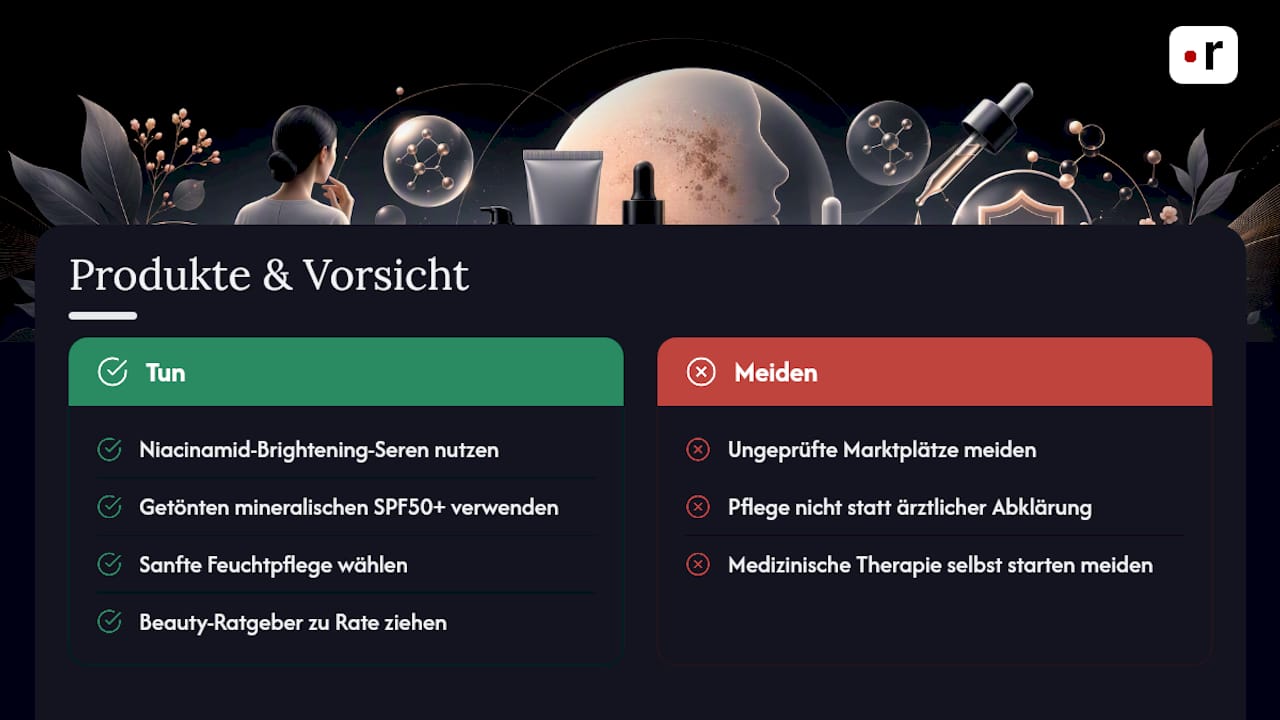
- A tinted mineral sunscreen with SPF 50+, applied generously as the last step.
Sunscreen is not an optional extra here. It is the most important step in the entire routine for melasma, even before any brightening serum.
Your Evening Routine (PM):
- Double cleansing if you wore makeup or sunscreen during the day.
- A toner or essence to prepare the skin.
- A targeted brightening serum, such as with arbutin or niacinamide.
- A retinoid, if the skin tolerates it, in increasing concentration.
- A rich moisturizer to finish.
New ingredients should always be applied first to a small skin area on the forearm for 24 to 48 hours. Only if no redness or irritation occurs should the product be used on the face. Introducing multiple active ingredients at once can quickly lead to confusion about which one caused a reaction. Therefore, always introduce only one new product per week.
Pro Tip: Apply new ingredients only every other evening initially, even if the package instructions suggest daily use. This way, your skin adjusts more slowly but more steadily to the irritation that brightening ingredients almost always bring.

A niacinamide serum is particularly suitable for beginners because it causes significantly fewer irritations compared to retinoids or hydroquinone.
Ingredients Against Melasma: TXA, Niacinamide, Thiamidol, and Retinoids Compared
Melasma is caused by overactive pigment cells that produce too much melanin and distribute it unevenly in the skin. The effective ingredients target different points in this process; some directly inhibit melanin production, others block the transport of pigment or have anti-inflammatory effects, as inflammation further fuels pigment formation.
- Tranexamic Acid (TXA): Slows down the signal transmission between skin cells and pigment cells. Well-tolerated in topical form, significantly more effective in oral form, but medically more demanding.
- Niacinamide: Inhibits the transfer of melanin to the upper skin layers and simultaneously strengthens the skin barrier.
- Arbutin: A natural derivative that mimics the effect of hydroquinone but is milder and often better tolerated by sensitive skin.
- Thiamidol: Specifically blocks the enzyme tyrosinase, which is central to melanin production.
- Retinoids: Accelerate cell renewal and help to remove already deposited pigment faster.
- Hydroquinone: The strongest classic brightener, but associated with risks like ochronosis when used uncontrolled over the long term.
A randomized, double-blind, and vehicle-controlled study on 0.2% thiamidol showed a 36.1% mMASI reduction after twelve weeks compared to only 16.1% in the vehicle group, with good tolerability and no severe side effects.
Oral tranexamic acid performs even better in studies: Prospective studies report around 50% mMASI improvement after eight to twelve weeks, but only under medical supervision due to the theoretical risk of thrombosis. Hydroquinone remains a special case despite its strength. Systematic reviews confirm its effectiveness, especially in triple combination with retinoid and corticosteroid, but also warn of more frequent side effects with longer use without professional guidance. Retinoids, in turn, almost always cause irritation initially, which is why a slow acclimatization over weeks is more sensible than an immediate full start.
Why Visible Light is Underestimated in Melasma
Classic UV protection is not enough for melasma. Visible light, the part of sunlight that window glass does not filter, can further stimulate pigment formation. This is one of the most overlooked points in melasma care.
- A broad-spectrum sunscreen with SPF 50+ should be part of the routine every morning without exception, even on cloudy days.
- Mineral filters based on zinc oxide or titanium dioxide form the basis because they physically reflect UV radiation instead of chemically converting it.
- Iron oxides in tinted formulations additionally absorb visible light, an effect that purely white mineral creams do not offer.
- Tinted sunscreen formulas are therefore demonstrably more reliable for melasma than untinted variants, as expert reviews on melasma treatments highlight.
The amount makes a big difference. Most people apply far too little; a fingertip full of sunscreen is considered a guideline for the entire face. Reapplying every two to three hours is mandatory with direct sun exposure, but can easily be integrated into the existing makeup routine with a tinted powder or sunscreen foundation.
Pro Tip: Keep a compact tinted sunscreen like the Beauty Of Joseon Relief Sun Rice + Probiotics in your handbag. Details on the correct reapplication amount can be found in the Beauty Guide.
When Should You See a Dermatologist for Melasma?
Medical clarification becomes sensible if melasma does not respond despite consistent care over several months, if the pigment is deep in the dermis rather than superficially in the epidermis, or if the psychological burden of the spots is significant. In these cases, K-Beauty alone is no longer sufficient.
- Oral Tranexamic Acid: Studies use dosages of 250 to 500 mg twice daily. The effect is strong, but the risk of thrombosis makes medical supervision mandatory.
- Laser Procedures: Low-fluence Nd:YAG lasers and picosecond lasers are considered relatively gentle but carry a risk of post-inflammatory hyperpigmentation if set incorrectly.
- Fractional Procedures: Non-ablative fractional lasers and radiofrequency microneedling complement topical therapy and also address deeper pigment.
- Chemical Peels: Can accelerate exfoliation but should be used with increased caution on darker skin types.
Especially for Fitzpatrick skin types III to V, the risk of post-inflammatory hyperpigmentation after device-based procedures is higher. Careful patient selection and gentle protocols are not a side issue here but a prerequisite for a procedure not to do more harm than good.
mMASI Values Overview: When Real Improvement Shows
Patience is not a cliché with melasma but a measurable factor. Most studies set the first evaluation point at eight to twelve weeks, not earlier.
The thiamidol study documented a 36.1% mMASI reduction after twelve weeks compared to 16.1% under the vehicle. Oral tranexamic acid achieved around 50% improvement in comparable periods with moderate to severe melasma.
These figures show two things at once: Topical ingredients work, but slower and more moderately than systemic therapies. Melasma also tends to relapse strongly, especially with hormonal fluctuations, heat, or reduced sun protection. Therefore, long-term maintenance care with consistent light protection is not an add-on but the actual core of any successful strategy.
Your Weekly Plan for Starting a Melasma Routine
A realistic start is spread over seven days, not a single evening full of new products.
- Day 1 to 3: Only cleansing, moisturizer, and sunscreen. No active ingredients; the skin should stabilize first.
- Day 4: Introduce a niacinamide or TXA serum in the morning after a successful patch test.
- Day 7: First application of a retinoid in the evening, only every third day and in low concentration.
- Week 3 to 4: Increase retinoid to twice a week if no irritation occurs.
- From Week 6: If well-tolerated, add a second brightening ingredient, such as arbutin in the evening.
- If redness or burning occurs, immediately avoid AHA or BHA acids, as they significantly increase irritation from TXA or retinoids.
- Never introduce new ingredients simultaneously with a retinoid, but always at least one week apart.
- Sunscreen remains mandatory in every phase of the plan, regardless of which ingredients are currently being tested.
If you notice that the skin continues to react irritated after this introduction phase, you should reduce the concentration instead of discontinuing the product completely. Often it is the amount, not the ingredient itself.
Why Rammilav is a Reliable Source for K-Beauty
Rammilav is a Swiss online shop for authentic Korean cosmetics, with brands like Cosrx, Beauty Of Joseon, and Purito in the range. Each product comes directly from verified suppliers, which is not a side issue in melasma care: Incorrectly declared concentrations or diluted formulations can completely prevent the effect of an ingredient.
Before buying a new product, it is worth looking at the ingredient list and the stated concentration of active ingredients, not just the marketing promise on the packaging. Shipping within Switzerland is usually fast, and free above a certain order value. This makes it easier to build a routine step by step, instead of ordering everything at once and overwhelming the skin.
Melasma is a Long-Term Task, Not a Sprint
The biggest misconception about melasma is treating it like a pimple that disappears after two weeks. It does not. Those who stop as soon as the skin looks calmer almost always experience a relapse, often stronger than before.
What actually works is a permanent maintenance routine with realistic expectations and open communication with a specialist once topical care reaches its limits. Document your progress with photos under the same light; this shows changes more honestly than looking in the mirror.
— Aleksejs
Finding the Right Products for Your Melasma Routine
Those who want to try the ingredients described here will find suitable categories in the Rammilav range: brightening serums with niacinamide, tinted mineral sunscreens, and gentle moisturizers for sensitive, irritated skin. Unlike many confusing marketplaces, the products come directly from verified suppliers, which builds trust, especially in ingredient-based care. Delivery within Switzerland usually takes two to three days, and shipping is free from 80 CHF.
Starting with a tinted sunscreen like the Enough Collagen 3x Moisture Sunscreen SPF50+ already covers the most important building block of the entire routine. In cases of severe or therapy-resistant melasma, no care replaces medical clarification by a specialist, especially before oral tranexamic acid or device-based procedures. Browse the Beauty Guide to specifically complement your routine.
Sources
The key studies behind this article: the randomized thiamidol study with mMASI results after twelve weeks, the overview of therapeutic approaches to melasma, and the systematic analysis of topical interventions. Additionally, the patient information from USZ provides a practical classification of sun protection and standard therapies.
This article contains general information and does not replace consultation with a qualified doctor. Consult a qualified medical professional about your personal situation before acting based on this content.
- Efficacy and Tolerability of 0.2% Thiamidol Cream for Facial Hyperpigmentation: A Randomized, Double-Blind, and Vehicle-Controlled Study | Dermatology and Therapy | Springer Nature
- Melasma: Challenges and Current Therapeutic Approaches | PMC
- Systematic review/meta-analysis on topical interventions for melasma (refubium)
- Melasma Treatments — Overview (Hautwerk PDF)
FAQ
What Do Koreans Use Against Melasma?
Korean skincare for melasma primarily relies on niacinamide, tranexamic acid, arbutin, and thiamidol in light serums, combined with consistent, often tinted mineral sunscreen. Aggressive single ingredients like high-dose hydroquinone play a smaller role in K-Beauty routines than in Western dermatology protocols.
How Long Does It Take for a K-Beauty Routine to Work on Melasma?
According to studies, the first visible effects usually appear after eight to twelve weeks of consistent use, such as with topical thiamidol showing a 36.1% mMASI reduction after twelve weeks. Faster results are unrealistic and suggest overly aggressive ingredient concentrations.
Is Tranexamic Acid in Creams as Effective as in Tablet Form?
No, topical tranexamic acid is well-tolerated but milder than the oral form, which achieves around 50% mMASI improvement in studies. Oral tranexamic acid should only be handled by a doctor due to the potential risk of thrombosis.
Can Sunscreen Alone Improve Melasma?
Sunscreen alone hardly lightens existing spots but prevents melasma from worsening due to UV radiation and visible light. Tinted mineral formulas with iron oxides are considered more effective than untinted variants.
When is a Laser Useful for Melasma?
Laser procedures like low-fluence Nd:YAG or picosecond lasers are an option when topical care does not bring sufficient improvement over several months or the pigment is deep in the dermis. For darker skin types, careful patient selection is required due to the risk of post-inflammatory hyperpigmentation.


