
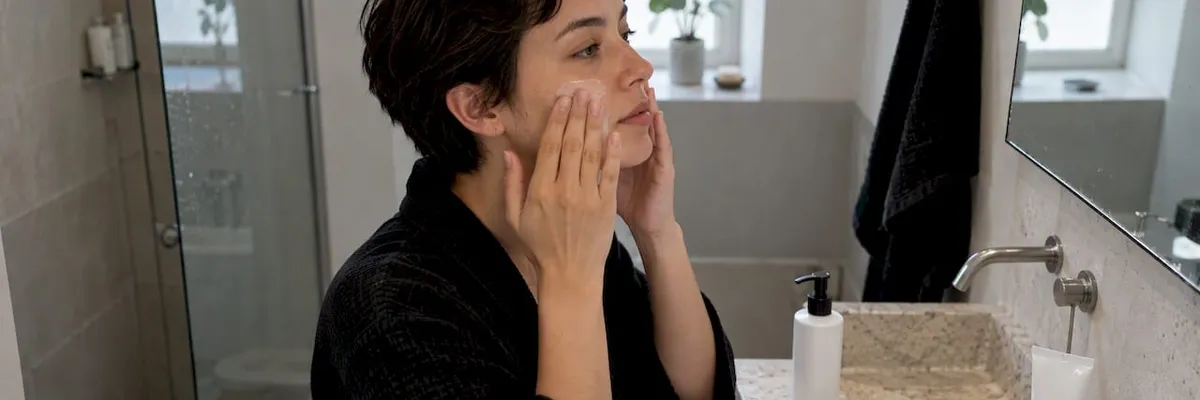
The most effective Korean-inspired acne routine is short: gentle cleansing, a single targeted active product, moisturizer, and sunscreen. Fewer products mean less potential for irritation, which is exactly what already irritated skin needs. In the morning, a light moisturizer and a non-comedogenic sunscreen with SPF 30 or higher are sufficient, while in the evening, a gentle cleanse followed by an active ingredient and moisturizer is usually enough. For severe acne, a dermatological assessment is necessary, as cosmetics cannot replace medical treatment.
In short:
- A reduced acne routine with gentle cleansing, a targeted active ingredient, and moisturizing is sufficient and gentle for irritated skin.
- For severe acne, a dermatological assessment is necessary, as cosmetics only provide support and cannot replace medical treatment.
- For acne-prone skin, avoid heavy oils, alcoholic toners, harsh scrubs, and fragrance-rich products.
- Introduce new products individually, test for at least 4 to 8 weeks, and document reactions carefully to avoid irritation.
Table of Contents
- The Reduced Routine for Morning and Evening
- Active Ingredients for Acne: Effects, Application, and Side Effects
- Product Selection: Textures, Ingredients, and What to Avoid
- Safely Introducing Products and Avoiding Common Mistakes
- When You Absolutely Need a Dermatological Assessment
- Recommended Korean Masks and Their Active Ingredients for Acne
- Regular Peelings: Chemical, Mechanical, and How to Use Them Safely
- Strengthening the Skin Barrier During Acne Treatment
- Diet and Lifestyle in Korean Acne Care
- Why We Recommend a Reduced K-Beauty Version
- Where to Find Suitable Korean Care for Blemished Skin
- FAQ
- Sources
The Reduced Routine for Morning and Evening
We have deliberately condensed the classic ten-step Korean care routine. For blemished, irritated skin, the number of steps doesn't matter as much as whether each step actually has an effect.
In the morning, the routine looks like this:
- For oily skin or night sweating: gentle, soap-free cleansing, otherwise water alone is sufficient.
- Light, non-comedogenic moisturizer, preferably a gel-cream instead of a heavy lotion.
- Broad-spectrum sunscreen with at least SPF 30, explicitly labeled as non-comedogenic.
In the evening, the first step depends on what was on the skin during the day:
- Wearing makeup or sunscreen: Double Cleansing, meaning first an oil cleanser or cleansing balm, then a gentle, water-based cleanser.
- No makeup, no sunscreen: a single gentle cleansing step is enough.
- After cleansing: apply at most one targeted active ingredient product, such as salicylic acid or benzoyl peroxide, never multiple at once.
- To finish: moisturizer to prevent the skin barrier from drying out.
For sensitive skin, it's worth swapping acids for azelaic acid, which is usually tolerated more gently, combined with a richer but still non-comedogenic cream. More on adapting to combination skin can be found in our guide. For oily skin, the cleanser can be a bit more thorough, but moisturizing is still essential, as dried-out skin often produces even more sebum. For combination skin, it helps to treat the T-zone specifically with the active ingredient product and only moisturize the cheeks. Why this reduced approach is particularly sensible now is also explained in our article on gentle routines in spring.
Active Ingredients for Acne: Effects, Application, and Side Effects
The AWMF guideline for acne therapy categorizes treatment by acne type and severity, recommending topical retinoids, benzoyl peroxide, and combination therapies depending on the case. Cosmetic products do not replace these medical recommendations; they can only complement them.
- Benzoyl peroxide is available in concentrations of 2.5%, 5%, and 10%, with a higher concentration not automatically being more effective but potentially more irritating. A low concentration at the start reduces the risk of redness and flaking.
- Salicylic acid unclogs pores and is usually well tolerated in low concentrations, but can feel drying and tight on sensitive skin.
- Azelaic acid is considered a comparatively mild option with anti-inflammatory effects; its tolerability strongly depends on the specific formulation, as described by Gesundheitsinformation.
- Retinoids are medications and are prescription-only in effective concentrations. They often show effects only after several weeks and should be used only under medical supervision.
Four to twelve weeks is the realistic timeframe for seeing the first effects of a new active ingredient. According to the American Academy of Dermatology, initial improvement is usually visible after 4 to 8 weeks, with complete clearing potentially taking 3 to 4 months. Switching products after just two weeks doesn't give the active ingredient a chance to work at all.
The guideline also recommends starting with a single product when combining multiple active ingredients and adding a second one only after 4 to 8 weeks to keep cumulative irritation low. For a deeper look at azelaic acid in Korean cosmetics, check out our guide to azelaic acid.
Product Selection: Textures, Ingredients, and What to Avoid
“Non-comedogenic” means a product is formulated to clog pores less frequently, a term explicitly stated on many Korean products. Prefer gels, light lotions, and emulsions over heavy ointments or balms with a high oil content.
The skin's natural pH is around 5.5, while traditional soaps have a pH of 8 to 10, as Gesundheitsinformation explains. A pH-balanced, soap-free cleanser disrupts the skin barrier significantly less and is the better choice for acne.
The following ingredients and textures should be avoided for acne-prone skin:
- Heavy oils and ointments with a strong comedogenic reputation, such as high-concentration coconut oil.
- Alcoholic toners marketed as “astringents” that dry out the skin.
- Harsh, mechanical scrubs with sharp particles that can cause micro-injuries.
- Fragranced products with high fragrance concentrations on already inflamed skin.
Pro Tip: Order a small product size or sample first and apply a new cream only to the jawline before using it on the entire face.
A patch test over two to three days on an inconspicuous area shows whether a product is generally tolerable before it becomes part of the daily routine.
Safely Introducing Products and Avoiding Common Mistakes
New products should be introduced individually and with patience into the routine. The following order has proven effective:
- Introduce a new product and observe it for at least 4 to 8 weeks before adding another.
- Briefly note skin reactions: redness, burning, new pimples, improvement, preferably with a date.
- Distinguish between purging, a temporary worsening due to faster cell turnover, and true irritation from irritation. Persistent redness or burning skin is more indicative of irritation than purging.
- If irritation persists, reduce the frequency of use, such as every other day, instead of stopping the product immediately.
- Only discontinue the product after 8 weeks without improvement.
The most common mistakes, according to AAD, are constant product switching, washing too frequently, and using too many acids or peels simultaneously. Each of these habits further weakens the skin barrier instead of improving acne. Those who consistently document and don't switch prematurely in the first eight weeks after starting a product are more likely to recognize what truly works.
When You Absolutely Need a Dermatological Assessment
Some warning signs should not be treated with cosmetics alone. Painful, deep-seated nodules, beginning scarring, or no improvement after three months of consistent care are clear signals for an appointment with a dermatologist.
Medical options include topical retinoids, systemic therapies, and newer active ingredients. Since October 2025, Clascoteron (Winlevi) has been approved for adolescents and adults with acne vulgaris, providing another topical option.
For the appointment, it is helpful to bring a list of all currently used products and medications, as well as a few recent photos of the affected skin areas. This makes it easier to assess how the skin condition has changed over weeks.
Recommended Korean Masks and Their Active Ingredients for Acne
Sheet masks and sleeping masks are popular in Korean care, but with acne, it's worth taking a closer look at the ingredients. Centella Asiatica is considered a soothing active ingredient and is well-suited for irritated, inflamed skin after active treatment. Niacinamide in mask form can help make the skin appear more even, but it doesn't react equally well with every skin type.
Pure moisturizing masks based on hyaluronic acid are a sensible addition when the skin dries out from active ingredients like benzoyl peroxide or salicylic acid. They provide moisture without additional active ingredients that could further irritate the skin.
Masks with alcohol, strong fragrances, or high acid content should be avoided during active acne, especially during ongoing treatment with prescription preparations. A mask never replaces the daily cleansing and moisturizing step; it only complements it once or twice a week.
Regular Peelings: Chemical, Mechanical, and How to Use Them Safely
Peelings are roughly divided into two groups: chemical peels with acids like salicylic acid or lactic acid, and mechanical peels with grains, brushes, or cloths. For acne-prone skin, chemical variants in low concentrations are usually the gentler choice because they don't mechanically abrade the skin surface.
Mechanical peels with coarse particles can cause small injuries, allowing bacteria to enter inflamed areas more easily. Those who still want to peel mechanically should choose fine-grained products and use them no more than once a week.
Chemical peels, like other active ingredients, should be introduced individually and not combined with an ongoing retinoid or benzoyl peroxide treatment. An application every seven to fourteen days is sufficient for most acne-prone skin types, and more frequent peeling mainly increases the risk of irritation without additional benefit.
Strengthening the Skin Barrier During Acne Treatment
An acne treatment almost always weakens the skin barrier a little, especially when active ingredients like benzoyl peroxide or retinoids are used. A weakened barrier is indicated by a feeling of tightness, redness, or increased sensitivity to products that were previously well tolerated.
Moisturizing is not an optional luxury in this phase but part of the treatment itself: even oily, acne-prone skin needs it, as dried-out skin otherwise worsens the tolerability of the actual active ingredients. A light, non-comedogenic cream after each active ingredient step is usually sufficient.
Those who additionally incorporate a soothing ceramide or centella care give the barrier time to recover between active steps. On days with more irritation, it's perfectly fine to skip the active ingredient and just cleanse and moisturize.
Diet and Lifestyle in Korean Acne Care
The Korean care philosophy often considers skin in connection with sleep, diet, and stress, not just creams. Adequate sleep and a stable daily routine have been shown to positively affect the skin, even if this cannot be quantified in a single number.
A diet high in sugar and heavily processed foods is often associated with worsening acne, but a clear, universal connection cannot be generalized for everyone. It's more sensible to observe your own skin over several weeks rather than prematurely demonizing individual foods.
Stress management is also part of this view: stress is often described as a trigger for flare-ups, regardless of how well the external care otherwise works. A reduced care routine removes at least part of the daily stress factor, as fewer steps mean fewer sources of error.
Why We Recommend a Reduced K-Beauty Version
We understand “Korean” primarily as an inspiration for texture and layering, not as a substitute for medical treatment. Ten steps are not a quality feature if three of them irritate and none contain an effective active ingredient.
Our line at Rammilav: Original products from verified suppliers, fast delivery, and a focus on compatibility rather than the number of products. When putting together a routine, you should ask yourself whether a step really has an effect, not how many steps look sensible overall.
— Aleksejs
Where to Find Suitable Korean Care for Blemished Skin
For a reduced, skin-friendly routine, we exclusively source original products from verified suppliers, with brands like Cosrx, Beauty Of Joseon, and Purito being a firm part of our range. Orders from Switzerland usually arrive within a few days, and we offer free shipping above a certain order value.
Based on the criteria from this article, you can find gentle cleansers, light moisturizers, and non-comedogenic sunscreens in our product catalog. A specific example of a suitable, non-comedogenic sunscreen is the Beauty Of Joseon Relief Sun Rice + Probiotics SPF50. We promise no blanket results, only original goods and reliable delivery; the selection by skin type remains with you.
This article contains general information and does not replace consultation with a qualified doctor. Consult a qualified medical professional regarding your personal situation before acting based on this content.
FAQ
Is Korean Skincare Really That Good for Acne?
Korean skincare is mainly known for its light textures and layering principle, which helps with acne when applied in a reduced manner. The origin of the products is not decisive, but whether gentle cleansing, suitable active ingredients, and non-comedogenic moisturizers are combined.
Which Skincare Routine is Best for Acne?
A short routine of gentle, pH-balanced cleansing, a single targeted active ingredient product like salicylic acid or benzoyl peroxide, light moisturizing, and SPF ≥30 in the morning is considered particularly tolerable. New products should be introduced individually and over several weeks.
Which Korean Skincare Products are Best for Acne?
Non-comedogenic, light formulations with soothing ingredients like Centella Asiatica or targeted active ingredients like azelaic acid are among the more tolerable options. We offer corresponding products from brands like Cosrx, Beauty Of Joseon, and Purito in our catalog.
What Do People in Korea Typically Use for Their Skin?
Double cleansing in the evening is often central, followed by light, hydrating textures instead of heavy creams. For blemished skin, this philosophy is best adopted in a reduced form: few but specifically selected steps instead of a long product chain.
Sources
- Therapy of Acne | AWMF Guideline (2026)
- Gesundheitsinformation
- Acne: Tips for Managing | American Academy of Dermatology


