
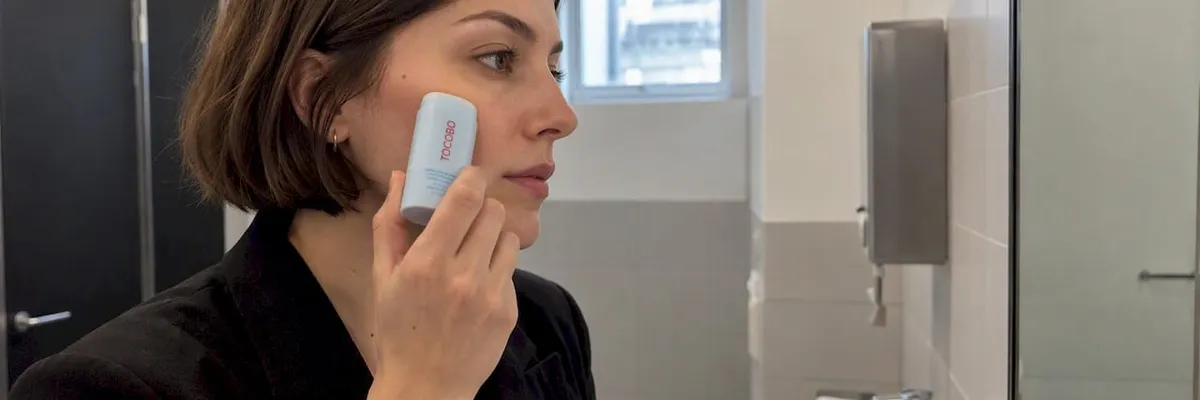
Yes, reapplying SPF over makeup works, and you can do it with sunscreen spray, powder with SPF, a sun stick, or a sponge for liquid formulas. The basic rule remains: apply generously and broadly in the morning, then reapply about every two hours when in contact with the sun. Makeup with SPF does not replace this step but merely complements it.
In short:
- Makeup with SPF does not fully replace sunscreen but only complements it, so regular reapplication is still necessary.
- When reapplying, a dosage of 2 milligrams per square centimeter is ideal, but in everyday life, much less is usually applied, reducing protection.
- Different methods, such as powder, spray, stick, or sponge, offer various advantages but require targeted application depending on skin type and situation.
- A waiting time of 15 to 30 minutes before applying makeup improves the adhesion of the sunscreen and increases its protective effect.
- Cautious, technical reapplication with dabbing and little product prevents smudging and clumping, especially on sensitive or blemished skin.
Table of Contents
- Spray, Powder, Stick, or Sponge: Which Method Suits Which Makeup?
- Guide: Reapplying SPF Without Ruining Makeup
- Amount, Waiting Time, and the Layering Effect: What Really Matters
- Formulation, Finish, and Skin Type: How to Choose the Right Product
- Which SPF Product Suits Which Skin Type and Makeup Style?
- How to Prevent Smudging and Clumping When Reapplying
- Sensitive and Blemished Skin: What to Pay Special Attention To?
- Our Perspective: Protection and Beauty Don't Have to Be Mutually Exclusive
- Practical Companions for Everyday: Stick, Serum, and Powder
- FAQ
- Sources
Spray, Powder, Stick, or Sponge: Which Method Suits Which Makeup?
Each reapplication method has its own logic, and none of them suits every skin type equally well.
SPF Powder is particularly suitable for skin that becomes shiny throughout the day. It is dabbed on in thin layers with a soft brush, never rubbed, otherwise the foundation underneath shifts. The downside: powder rarely covers as evenly as a liquid formula, providing hardly any truly seamless protection.
SPF Spray is the quickest option for on-the-go. The technique determines the result: hold the bottle about 20 to 30 centimeters away from the face, close eyes and mouth briefly, then let it dry for a few seconds before touching anything. In windy conditions, the spray distributes unevenly; it works much more reliably indoors or in the car.
Sun Stick is the tool of choice for small, clearly defined areas like the bridge of the nose, temples, or ears. It can be applied precisely but may leave streaks that can be gently blended with a clean finger or blender, not with rough rubbing.
Sponge or Brush with Liquid SPF is the most controlled method for those who prefer to continue using their usual formula. A small amount is applied to a slightly damp sponge and dabbed on spot by spot, rather than spread over a large area.
Liquid Reapplication with Hands directly over finished makeup is the method that harms the finish the most. It is only suitable for very light tints or a pure BB cream look; with dense foundation, it almost always smudges.
- SPF Powder: matte, good for oily skin, but limited coverage.
- SPF Spray: quick, hands-free, wind-sensitive.
- Sun Stick: precise for individual areas, requires gentle blending.
- Sponge Method: controlled, but more time-consuming.
Pro Tip: Apply powder first on an oily T-zone and use the stick only where direct sunlight actually hits the skin.
Guide: Reapplying SPF Without Ruining Makeup
On the go, in the office, or after sports, a slightly different approach is needed each time, but the basic principle remains the same: little pressure, little friction, short drying time.
- Prepare: have a sunscreen spray or stick ready, along with a clean sponge or powder brush that is not mixed with other products.
- On the go: apply the spray from a distance of 20 to 30 centimeters, close eyes and mouth, let it dry briefly, and mattify with a little powder if needed.
- In the office: spot touch-ups with powder are usually sufficient; apply a stick only to individual areas and gently press with a finger, do not rub.
- After sweating or swimming: if possible, rinse the face and reapply completely; otherwise, use powder or stick as a temporary solution until full reapplication is possible.
- Keep frequency in mind: reapply about every two hours in direct sun; indoors, check for visible shine or skin contact to see if a refresh is needed.
Pro Tip: Include a small setting powder step after each reapplication; this binds excess product and noticeably extends the foundation's hold.
Amount, Waiting Time, and the Layering Effect: What Really Matters
The official protection indication on the packaging is based on a laboratory amount of 2 milligrams per square centimeter of skin; in everyday life, most people apply significantly less, reducing the actual protection. The Federal Office of Public Health therefore recommends applying sunscreen with broad-spectrum protection, UVA sign, and at least SPF 30 generously and thoroughly.
A waiting time of about 15 to 30 minutes before applying makeup not only improves the adhesion of the formula to the skin but also the hold of the makeup on top. An interesting effect is that a study on layering sunscreen and makeup showed that the combination of both layers under realistic conditions improves the effective SPF compared to individual, too thinly applied products.
- Standard test amount: 2 mg/cm², often undercut in practice.
- Waiting time before makeup: about 15 to 30 minutes for better hold.
- Layering effect: sunscreen plus makeup can improve real protection compared to thin single layers.
Broad-spectrum protection with SPF30 or higher is considered the minimum recommendation by the Federal Office of Public Health; makeup with integrated SPF usually remains a supplement and not a full replacement.
Formulation, Finish, and Skin Type: How to Choose the Right Product
Mineral filters lie as a fine film on the skin and rarely react with products applied on top, but they can leave a slight gray cast on darker foundation. Chemical filters, on the other hand, absorb faster and often appear more transparent under makeup, but are more sensitive to friction and sweat.
The finish depends on the skin type: mattifying powder formulas suit oily or combination skin, while dry skin benefits from light gels or serums that provide additional moisture. Tinted sun serums are a practical combination of care, color, and protection in one step, such as a tinted sun serum with rice and probiotics or a tinted sunscreen with Centella Asiatica.
On the packaging, it's worth looking at three indications: broad-spectrum protection against UVA and UVB, the UVA sign, and a minimum SPF 30 label. Water resistance is only relevant if sweating or swimming actually occurs; for pure office days, it hardly matters.
- Mineral: more stable against interactions, sometimes visible film.
- Chemical: usually more transparent under foundation, more sensitive to abrasion.
- Tinted sun serums: care, color, and protection in one product.
Practical tools for exactly this routine, including a sun stick with SPF50+, can be found directly in our range, as well as further tips in the guide to reapplying sunscreen.
Which SPF Product Suits Which Skin Type and Makeup Style?
For oily or blemish-prone skin, a light, gel-like, or mattifying formula is worthwhile, which does not add extra shine under foundation. A sun stick is suitable here for spot refreshes because it does not add extra oil.
Dry skin, on the other hand, needs a creamy or serum-like product with a moisture component; otherwise, the makeup on top quickly looks dull or begins to settle into fine lines. A tinted sun serum fulfills two tasks here: it provides moisture and delivers color, so less foundation is needed.
For combination skin, a combination is recommended, such as a light fluid on the drier cheek areas and a mattifying powder in the T-zone. Those who wear a lot of foundation or concealer should opt for powder or stick when reapplying, as liquid formulas tend to slip on dense makeup.
With a natural, thin makeup finish, such as only with BB cream, light reapplication with fingertips also works, as long as you dab instead of rub. If unsure which formula suits your skin type, it's best to test on a small area before making the product part of your daily routine.
How to Prevent Smudging and Clumping When Reapplying
The biggest risk when reapplying is not the SPF itself, but the technique behind it. Rubbing movements detach the foundation from the skin and push it into small crumbs, exactly what is known as pilling.
The simplest countermeasure is pressure instead of movement: dab, tap, press briefly, never spread. A damp sponge absorbs excess product better than dry fingers and distributes it more evenly without shifting the underlying layers.
It is also important not to apply too much product at once. Several thin layers can be worked in better than one thick portion that immediately clumps with the foundation. A few seconds' pause between layers helps the product set briefly before the next layer follows.
Those who often struggle with pilling should also question the formulation itself: silicone-based primers do not always get along with water-based SEE formulas, and this combination often leads to small clumps. Switching to a formula with a similar texture to the existing makeup significantly reduces this risk.
Sensitive and Blemished Skin: What to Pay Special Attention To?
With sensitive or blemish-prone skin, extra caution is worthwhile when reapplying, as frequent touching and rubbing of the face can promote irritation. Mineral filters with zinc oxide are generally considered the more tolerable choice, as they are less likely to burn or cause redness than some chemical filters.
Tools play a bigger role here than with uncomplicated skin: sponges and brushes should be cleaned regularly, as residues of skin oil and old product can further promote blemishes. A fresh, dry fingerprint for small touch-ups is sometimes the gentler option for the skin than a repeatedly used sponge.
With active acne or inflamed skin, it is worth testing a new sunscreen stick or spray on a small area, ideally on the forearm or jawline, before applying the product extensively to the face. Fragrances and certain alcohols in sprays can additionally irritate, so it's worth looking at the ingredient list, especially with already irritated skin.
Those prone to acne often benefit from non-comedogenic, oil-free formulas that bind less sebum under makeup. In case of persistent irritation or uncertainty about a suitable formulation, the advice of a dermatologist remains the most reliable guidance.
Our Perspective: Protection and Beauty Don't Have to Be Mutually Exclusive
We see every day how many people choose between perfect makeup and real sun protection, as if both were not possible at the same time. That's not true: with the right technique, both can be combined if you start generously in the morning and reapply with powder, spray, or stick during the day.
Test new formulas first on a small area before they become part of your daily routine. And with long, intense sun exposure, cosmetic touch-ups should never be the only protection; shade and clothing remain just as important.
— Aleksejs
Practical Companions for Everyday: Stick, Serum, and Powder
A sun stick, a tinted sun serum, or a brush-on powder solve exactly the tasks that arise most frequently in everyday life: precise refreshment, care with color, and mattifying hold without friction. That's exactly why we have firmly included these product types in our range.
The Tocobo Cotton Soft Sun Stick with SPF50+ is suitable for spot areas like the nose and temples, while the Beauty Of Joseon Ginseng Sun Serum with SPF50 works as a care-protection combination in the morning. Our entire sunscreen range can be browsed directly, with delivery within Switzerland usually within two to three days and free shipping from 80 CHF.
This article contains general information and does not replace consultation with a qualified doctor. Consult a qualified medical professional regarding your personal situation before acting based on this content.
FAQ
How long should you wait between sunscreen and makeup?
A waiting time of about 15 to 30 minutes improves the adhesion of the sunscreen and thus also the hold of the makeup on top. Sunscreen works immediately but absorbs better during this time and reduces the risk of shifting or pilling.
Can you apply sunscreen directly over finished makeup?
Yes, this works with sprays, powders, or sun sticks that can be dabbed over the foundation without spreading it over a large area. Applying liquid formulas with hands is only suitable for very light makeup, as they otherwise easily smudge.
What comes first, sunscreen or makeup?
Sunscreen always goes on clean skin first, directly after care and before primer or foundation. Makeup with integrated SPF can complement this first step, but according to dermatological practice recommendations, it cannot fully replace it.
What does the SPF indication on makeup products mean?
The indication shows the sun protection factor that the product theoretically offers at the laboratory-used application amount of 2 milligrams per square centimeter. Since significantly less makeup is usually applied in everyday life, the actual protection in practice is often lower than recommended.
Sources
We are an online shop for Korean cosmetics and carry brands whose formulas are tailored to various skin needs such as moisture deficiency, skin firming, and blemishes. Our products come directly from suppliers, ensuring original goods and stable quality.
This origin security is especially important for sunscreen products, as the effect strongly depends on the actual formulation. We offer fast delivery and inform about our shipping conditions on our website.
- Sun and UV Radiation — BAG
- Exa
- How To Reapply Sunscreen Over Makeup — Self


