

When spending time outdoors, reapply sunscreen regularly, approximately every few hours, and immediately after swimming, heavy sweating, or towel drying. Even waterproof products require reapplication, as the label does not protect against abrasion. This rule applies regardless of the sun protection factor.
In short:
- Reapplying protects against mechanical removal by clothing, sweat, or contact, but does not extend the actual sun protection.
- For extended outdoor activities like hiking or gardening, reapply every two hours.
- Over makeup, sunscreen should be applied with a stick or powder to avoid smudging.
- For effective protection, at least SPF 30 is recommended for normal exposure, SPF 50+ and broad-spectrum UVA protection for intense sun.
- Sunscreen is only a supplement; shade and appropriate clothing remain essential for comprehensive sun protection.
Table of Contents
- Why Reapply Sunscreen: The Two-Hour Rule Explained
- After Swimming, Sweating, and Drying: What Matters Now
- Reapplying Sunscreen Over Makeup: How to Do It Without Smudging
- Sunscreen Before or After Cream: Amount and Order in the Routine
- Which Sun Protection Factor is Sensible When Reapplying?
- How Often Reapplying is Sensible for Opened Products
- What Experts Actually Recommend About Reapplying
- What I Really Advise Readers About Reapplying
- Sun Protection That Fits Daily Use
- Sources
Why Reapply Sunscreen: The Two-Hour Rule Explained
The reason for reapplying is not due to a diminishing chemical effect, but rather the simple everyday activities. Clothing rubs, towels wipe, sweat washes away the protective film on the skin. Each of these actions removes part of the sunscreen unnoticed, long before the formula itself loses strength.
This is exactly why reapplying does not extend the maximum self-protection time of the skin. It merely maintains the originally applied protective film, which has been thinned by friction. Anyone who believes that frequent reapplication allows them to stay in the sun longer is under a common misconception.
The reapplication rule is especially important for longer outdoor stays: hiking, gardening, a day at the lake. For a short ten-minute walk to the bakery, it is less relevant than for an entire afternoon outdoors.
- Clothing and backpack straps rub the protective film off shoulders and neck.
- Sweat dissolves the formula, especially on the forehead, nose, and décolleté.
- Towel drying after swimming removes a large portion of the cream mechanically.
- Sand and textile contact at the beach accelerate abrasion additionally.
Pro Tip: Set a timer for two hours during sunbathing. The reminder is more reliable than gut feeling, which notoriously underestimates UV radiation.
A study on UV protection in children shows how much individual measures are overlooked in everyday life: Among 120 children examined, clothing accounted for 37% of actual protective measures, sunscreen only 20%. Reapplying is thus just one component among many, not a sole protection.

After Swimming, Sweating, and Drying: What Matters Now
After swimming, follow a simple sequence: first gently pat dry, then reapply immediately. Do not rub with the towel, as this removes additional skin cells and unnecessarily irritates the skin.
“Waterproof” does not mean that the protection lasts indefinitely. The term merely describes that the formula withstands a certain time in water, usually tested over 40 or 80 minutes of bathing time. Reapplying immediately after swimming, sweating, or drying remains mandatory, waterproof or not.
- Reapply after every swim, even if the label promises “waterproof.”
- Check manufacturer’s instructions for the exact water resistance duration on the packaging.
- Use UV clothing on particularly exposed areas like shoulders additionally.
- Actively seek midday shade instead of relying solely on the cream.
Reapplying Sunscreen Over Makeup: How to Do It Without Smudging
Those who have applied foundation and concealer in the morning do not want to wipe off the makeup when reapplying sunscreen. There are practical solutions for this, focusing on targeted rather than widespread application.
- Use a sun stick with SPF that can be dabbed on specific areas, such as the forehead, nose, cheekbones, and neck.
- Alternatively, a mineral SPF powder can be patted over the makeup without smudging it.
- A fine sunscreen spray also works but should be gently patted in afterward instead of rubbed.
- Focus on areas with direct sun exposure instead of reapplying to the entire face.
Pro Tip: Keep a small sun stick in your handbag or jacket pocket. This way, reapplying over makeup is done in ten seconds, without a mirror and sink.
A makeup setting spray with SPF indication is almost never sufficient as a sole reapplication protection, as the sprayed amount is usually too small. Consider such sprays as a supplement, not a replacement.
Sunscreen Before or After Cream: Amount and Order in the Routine
The order in the skincare routine is simpler than many think: serum, then moisturizer, then sunscreen as the last step before makeup. Sunscreen forms the top layer, which must create a closed film on the skin.
Often, too little is used. For the face, about two finger lengths of cream are a guideline, for the entire body of adults around 30 to 40 milliliters, significantly more than most people intuitively apply.
Sunscreens work immediately after application, but a lead time of 20 to 30 minutes before going out is still recommended to allow an even protective film to form.
- Two finger lengths of cream for the entire face.
- 30 to 40 milliliters for an adult's body, about a shot glass full.
- Always apply sunscreen as the last step before makeup.
- For thin formulations, apply twice thinly rather than once too little.
Those who regularly apply too little noticeably fall short of the sun protection factor indicated on the packaging, even with a high-quality product.
Which Sun Protection Factor is Sensible When Reapplying?
For everyday use, a sun protection factor of at least 30 is a guideline, for high UV exposure outdoors or particularly sensitive skin, factor 50+ is recommended. Also, pay attention to the UVA logo on the packaging, indicating broad-spectrum protection against UVA and UVB radiation.
Regarding the type of filter, it is worth looking at the composition. Mineral filters like zinc oxide immediately form a physical barrier on the skin and work directly upon application. Chemical filters, on the other hand, absorb UV radiation and convert it, but usually absorb more easily and do not leave a visible white cast.
- At least SPF 30 for normal everyday outdoor activities.
- SPF 50+ for intense sun, near water, in the mountains, or for sun-sensitive skin.
- Check the UVA logo as a mandatory sign for adequate broad-spectrum protection.
- Mineral filters for sensitive skin, chemical filters for a lighter skin feel.
How Often Reapplying is Sensible for Opened Products
A common mistake runs through many sunscreen bottles in the bathroom cabinet: they are from the previous year. The small PAO symbol on the packaging, an open jar with a number like “12M,” indicates how many months the product is effective after opening. The safe usability after opening is usually within several months.
- Check the PAO symbol and the expiration date on each bottle before summer.
- Avoid the classic mistake of applying only once in the morning and not reapplying for the rest of the day.
- Use sprays correctly, with sufficient quantity and gentle distribution instead of a short spray burst.
- Store sunscreen cool and protected from light, never for extended periods in a heated car.
Heat permanently changes the consistency and effectiveness of many formulations. A bottle that spent a summer in the glove compartment belongs in the trash, not back in the towel.
What Experts Actually Recommend About Reapplying
The rules in this guide do not come from gut feeling but from the recommendations of recognized expert bodies. The Swiss Cancer League, the Federal Office of Public Health, and the Federal Food Safety and Veterinary Office form the basis for sun protection factor, application amount, and reapplication frequency.
Sun protection is a supplement to shade and clothing, not a standalone solution. Many people underestimate their actual UV exposure, especially because they feel safer with the cream than they actually are.
This assessment by the Federal Office of Public Health explains why no guide should sell sunscreen as the sole protection. Rammilav, as a Swiss online shop for Korean cosmetics, offers several sun protection products with different textures and sun protection factors, directly viewable at Rammilav, facilitating the practical implementation of these recommendations in everyday life.
What I Really Advise Readers About Reapplying
In summer, I always keep a sun stick in my wallet, not in the beach bag, which usually stays at home when you need it most. During a picnic, I set a reminder every two hours, which sounds exaggerated but quickly becomes a habit.
Clothing, shade, and cream belong together for me; none of them replace the other. Those looking for suitable textures for face and body on Rammilav will find a selection that fits into everyday life without becoming a burden.
— Aleksejs
Sun Protection That Fits Daily Use
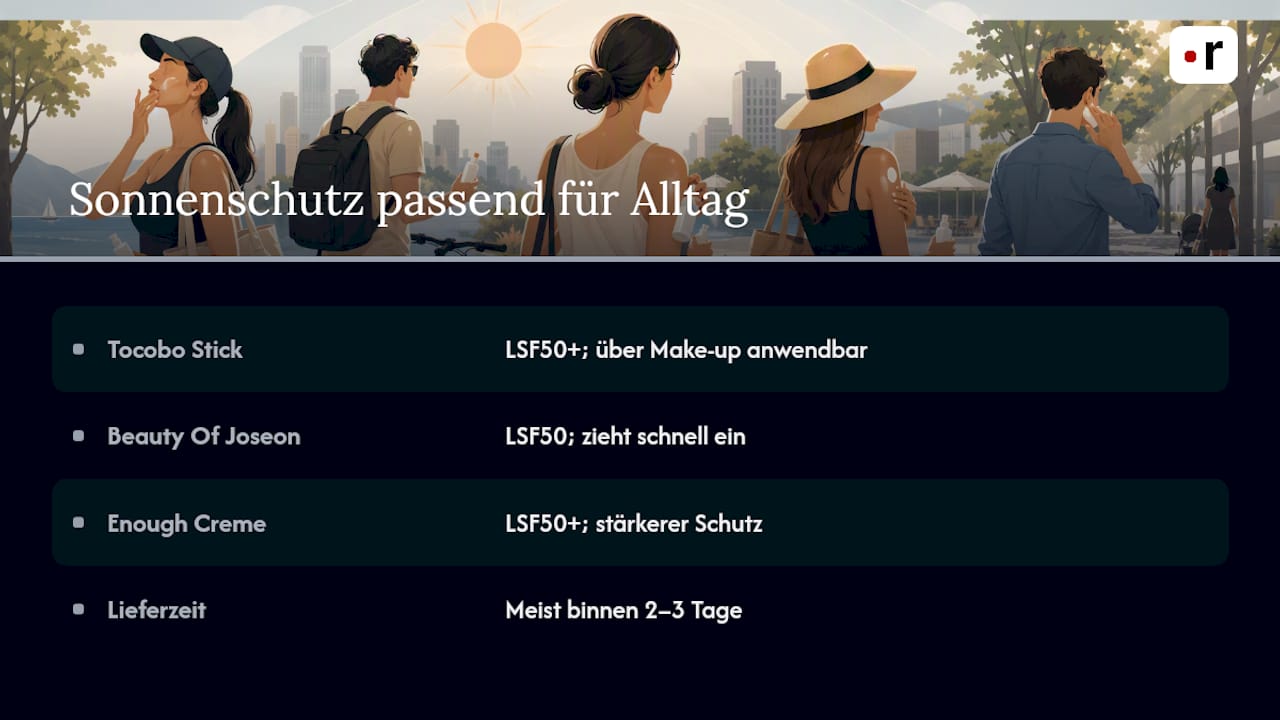
Rammilav offers sun protection products with textures specifically suitable for frequent reapplication in everyday life, without the greasy film of classic creams. The Tocobo Cotton Soft Sun Stick with SPF50+ can be applied over makeup without smudging the foundation, ideal for on the go. For face and décolleté, the Ginseng Sun Serum from Beauty Of Joseon with SPF50 is suitable, which absorbs easily and fits well into an existing skincare routine. Those expecting higher UV exposure or having particularly sensitive skin will find the Enough Sun Cream with SPF50+ an option with stronger protection. All products come directly from verified suppliers and are usually delivered within Switzerland within two to three days. Check out the range on Rammilav and choose the texture that suits your skin and daily life.
This article contains general information and does not replace consultation with a qualified doctor. Contact a qualified medical professional regarding your personal situation before acting based on this content.
Sources
- Sunscreens and Sun Cream — Swiss Cancer League
- Sun Protection, But Correctly! — Skin and Laser Center


