
Yes, serums can be layered, and it's worth it if you proceed based on texture and ingredient compatibility. The core rule is: apply from light to rich, using a maximum of one to two active serums per application. Additionally, pay attention to pH-dependent ingredients and plan short waiting times between layers if necessary.
In short:
- Layering serums is beneficial when textures are applied from light to rich and a maximum of two active ingredients are used per routine.
- Watery serums should always be applied before gel-like or oily formulations to ensure optimal absorption.
- Ingredients like Vitamin C or Retinol require specific pH levels and waiting times of at least 10 to 30 minutes to maintain their effectiveness.
- Guaranteed safe combinations are Hyaluronic Acid with Niacinamide or Vitamin C, and Niacinamide with Peptides, while Retinol should be avoided with AHAs or highly concentrated Vitamin C.
- New ingredients should be introduced gradually and with patch tests to avoid irritation and allow the skin to adapt sufficiently.
Table of Contents
- What is a Serum and What are the Benefits of Layering?
- In What Order Should You Apply Multiple Serums?
- Why Does pH Matter in Layering?
- Which Serum Combinations are Safe and Which are Not?
- How to Safely Introduce New Ingredients?
- What Do Finished Morning and Evening Routines Look Like?
- Who is Behind These Recommendations?
- Why Most Layering Guides Overcomplicate Things
- Finding the Right Serum Selection for Your Routine
- Selected Studies and Guidelines for Support
- Sources
- FAQ
What is a Serum and What are the Benefits of Layering?
A serum differs from a cream in its texture and concentration of active ingredients. While creams primarily bind moisture and seal the skin, serums deliver targeted active ingredients in higher concentrations to deeper skin layers. The texture ranges from watery-light to gel-like, with some formulations feeling almost like water, others more like a thin essence.
Layered serums allow you to address multiple skin needs simultaneously without needing a single overloaded product. For example, you can combine a hydrating serum with a soothing or brightening ingredient and adjust the routine to your skin type.
The advantages of serums in layering lie in this flexibility, but they also come with risks:
- Too many active layers can overwhelm the skin barrier, causing redness or burning.
- Some ingredients, like retinoids, significantly increase the skin's sensitivity to light.
- Certain combinations neutralize each other or exacerbate irritation instead of providing the desired effect.
Keeping these three points in mind allows for much safer layering than simply applying everything one after the other.
In What Order Should You Apply Multiple Serums?
The basic rule for layering skincare products is simple: thin before thick. Watery textures absorb the fastest and should therefore be applied to the skin first, followed by gel-like formulations, then serum-like emulsions, and only then oily or creamy products. Sunscreen always forms the last layer in the morning.
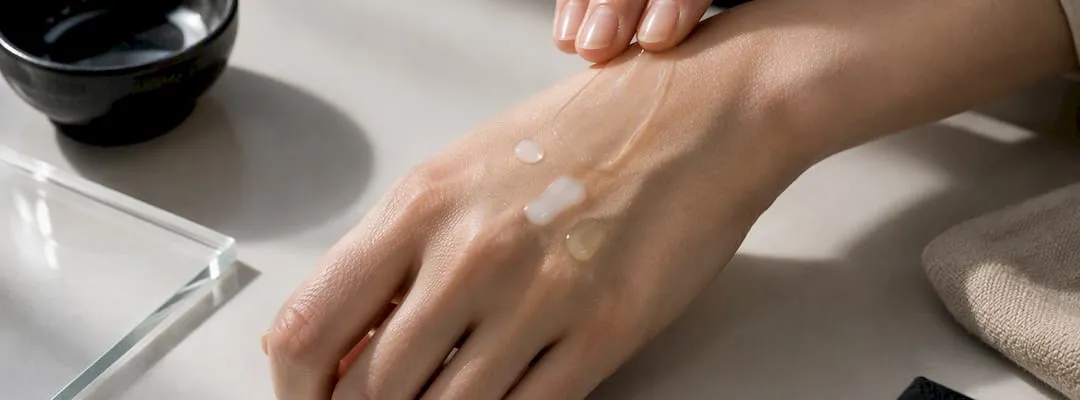
How do you recognize which texture you have in hand? A simple hand test helps: Place a drop on the back of your hand. If it runs immediately like water, it's a light, watery formula. If it stays as a drop and can be spread, it's usually a thicker emulsion.
Pro Tip: Never apply more than three to four drops per serum. More product does not bring better results but only increases the risk that the skin cannot absorb everything, and the layer above absorbs poorly.
For practical application, this order suffices:
- Cleanse the face and, if necessary, prepare with a toner.
- Apply the lightest, most watery serum first and let it absorb briefly.
- Follow with the next, slightly thicker serum.
- If needed, use a moisturizer or oily care as a final step.
- Always finish with sunscreen in the morning.
This sequence is important because an oily or occlusive formulation applied too early can block the absorption of lighter serums underneath. Applying a rich cream first and then a watery serum essentially wastes the serum, as it can hardly penetrate the skin.
Why Does pH Matter in Layering?
Some ingredients only function correctly within a specific pH range. L-Ascorbic Acid, the purest and most effective form of Vitamin C, needs a low pH to penetrate the skin. If applied directly after an alkaline cleanser or on still damp, neutralized skin, its effectiveness drops significantly.
Therefore, many users apply Vitamin C directly after cleansing on freshly cleaned skin before other products alter the skin's surface pH. Those with hard tap water can also use a pH-balancing toner between cleansing and serum to bring the skin back to a slightly acidic range where ingredients like Vitamin C or AHA work optimally.
Specific waiting time guidelines help prevent ingredients from counteracting each other:
- Between Vitamin C and a following serum, 10 to 15 minutes are usually sufficient for the skin's pH to stabilize again.
- After an AHA or BHA peel, you should wait 20 to 30 minutes before applying another active serum.
- With Retinol, it's advisable to take a whole break in the evening, where you don't use any other strong acids.
These waiting times may seem overly cautious at first glance, but they are the simplest way to prevent ingredients from neutralizing each other or unnecessarily stressing the skin.
Which Serum Combinations are Safe and Which are Not?
Some ingredient pairs complement each other, while others should be kept separate. An "active ingredient" is any substance that measurably intervenes in skin processes, such as Retinol, Vitamin C, AHA, BHA, or high-dose Niacinamide, as opposed to purely hydrating ingredients like Hyaluronic Acid.
Safe Combinations:
- Hyaluronic Acid and Niacinamide get along well because Niacinamide strengthens the barrier and significantly reduces redness according to placebo-controlled studies, while Hyaluronic Acid additionally binds moisture.
- Hyaluronic Acid and Vitamin C work as a duo because Hyaluronic Acid does not affect the pH and can simply be applied after Vitamin C.
- Niacinamide and Peptides are considered unproblematic, as both are more building than irritating.
Combinations to Avoid:
- Retinol and AHA or BHA simultaneously almost always overwhelm the skin. Both groups of ingredients promote cell renewal, and together they significantly increase the risk of irritation, which is why experts recommend not using Retinol simultaneously with highly concentrated peels.
- Highly concentrated Vitamin C and strong acids like Glycolic Acid should be applied separately, as both formulations require a low pH and can destabilize each other.
The rule of thumb is: a maximum of one to two active serums per application; everything else is purely hydrating or soothing additions.
How to Safely Introduce New Ingredients?
Before a new serum becomes part of the daily routine, a patch test is worthwhile. Apply a small amount to the inside of the forearm or behind the ear and observe the area for 24 to 48 hours for redness, itching, or burning.
If the test is uneventful, follow a gradual introduction scheme to allow the skin to adapt:
- In the first week, use the new serum only once, preferably in the evening.
- In the second week, increase to twice a week, provided no irritation occurs.
- From the third week, apply every other evening until the skin has fully adjusted.
- Only then, if desired, switch to daily use.
Even with well-introduced ingredients, one or two pause evenings per week without active serums are recommended, where only a moisturizer or a product for repairing the skin barrier is used. If the skin shows persistent redness or tightness despite careful introduction, it's a signal to reduce the frequency instead of persevering. Irritations almost always disappear faster when you take a step back rather than ignoring the reaction.
What Do Finished Morning and Evening Routines Look Like?
A morning routine with layered serums usually follows the same pattern: antioxidant first, then moisture, finally sunscreen. A Vitamin C serum directly after cleansing protects against environmental influences during the day, a Hyaluronic Serum on top provides moisture, and sunscreen with sufficient SPF completes the routine.
In the evening, regeneration and targeted active ingredients are the focus. On evenings without Retinol, a hydrating or Peptide Serum is suitable for building the skin. Retinol evenings should be consciously separated so that this ingredient does not compete with AHA, BHA, or highly concentrated Vitamin C.
For sensitive skin, a different order of priorities applies:
- First, strengthen the barrier, for example with Niacinamide or a soothing serum based on Centella or Cica.
- Only when the skin appears stable, slowly add a second active ingredient.
- If sensitivity persists, a minimal routine of just one hydrating serum and sunscreen is completely sufficient.
If you're unsure how many layers your skin can tolerate, it's best to start with this minimal version and expand only after a few weeks without irritation.
Who is Behind These Recommendations?
This guide is by Aleksejs, who regularly writes about active ingredients and application routines in the K-Beauty Blog of Rammilav. Rammilav itself is a Swiss specialist retailer for Korean cosmetics, sourcing brands like Cosrx, Beauty Of Joseon, and Purito directly from verified suppliers and delivering quickly in Switzerland.
The rules mentioned here are based on dermatological reviews and clinical studies on ingredients such as retinoids, niacinamide, and AHA. For persistent skin problems, severe irritations, or uncertainty about your own tolerance, this article does not replace a visit to a dermatologist.
Why Most Layering Guides Overcomplicate Things
Most guides on layering serums overwhelm readers with lists of active ingredients that hardly anyone can maintain in everyday life. My observation after many years of dealing with Korean skincare: The skin rarely benefits from the fifth layer; it benefits from consistency with two or three well-chosen products.
The widespread notion that more serums automatically mean more effect is simply wrong. The opposite often happens: The barrier is overwhelmed, and in the end, the skin takes weeks to recover from an overambitious routine. If you really want to see progress, you should first ensure tolerance and only then add new active ingredients, not the other way around.
What many also underestimate: Rest days are not a sign of negligence but an active part of a functioning routine. The skin needs these recovery phases to respond correctly to active ingredients.
— Aleksejs
Finding the Right Serum Selection for Your Routine
Those who want to layer according to the described rules need reliable basic products rather than a huge collection of active ingredients. Rammilav offers verified original products directly from controlled suppliers, which is especially important when starting with layering, as counterfeit or incorrectly labeled serums make any waiting time rule worthless.
For beginners, it's worth taking a look at the serum category of Rammilav, where hydrating and soothing options can be combined. A Hyaluronic Serum like the Purito Seoul Deep Sea Droplet Serum is suitable as a base layer, while the Tocobo Cica Calming Serum soothes sensitive skin between more active ingredients. Delivery within Switzerland usually takes place within two to three days, and there is a free shipping policy above a certain order value. Check out the category and put together your first two layers before adding the next active ingredient.
Selected Studies and Guidelines for Support
- The study on retinoids, acids, and benzoyl peroxide shows the irritation risk of combined active ingredient therapies.
- The clinical investigation on benzoyl peroxide and retinol demonstrates the benefits and limits of staged combinations.
- The review article on alpha-hydroxy acids explains the application and photosensitivity of AHAs.
- The guideline on niacinamide supports its role as a tolerable base ingredient.
Sources
- Prospective study on combination treatments for acne (PubMed)
- Clinical evidence on benzoylperoxide + retinol combination (PubMed)
- Studies and recommendations on niacinamide (GD Guidelines / Overview Source)
- Alpha Hydroxy Acid Facial Treatments (DermNet NZ)
FAQ
In What Order Should You Apply Serums?
Always apply serums from the lightest to the thickest texture: watery formulas first, then gels, then serum-like emulsions. Sunscreen always comes as the last layer in the morning.
What is a Serum Anyway?
A serum is a highly concentrated care formula with targeted active ingredients that is lighter than a cream and penetrates deeper into the skin. It does not replace a moisturizer but complements it with ingredient-specific effects.
In What Order Should You Apply Niacinamide and Retinol?
Niacinamide and Retinol can be combined on the same evening if the skin is accustomed to it: Niacinamide first, then Retinol. For sensitive skin, it is safer to use both ingredients on separate evenings, as Retinol, according to guidelines for topical retinoids, requires time to adjust.
In What Order Should You Apply Hyaluronic Acid and Retinol?
Hyaluronic Acid always absorbs before Retinol because it is watery and light. It also alleviates the dryness that Retinol often causes in the first weeks.
How Many Serums Can You Use at the Same Time?
Two to three serums per application are practical, with a maximum of one to two active ingredients included. Hydrating or soothing serums like a Hyaluronic or Cica Serum from Rammilav's range do not count as irritating actives and can be combined more flexibly.


