
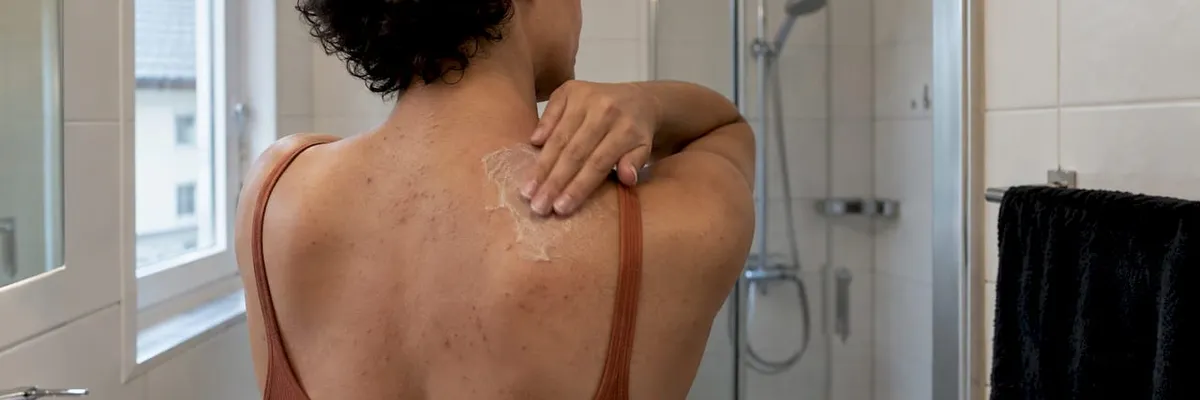
Back acne can be well-managed with Korean skincare if you choose the right active ingredients and use them gently. Salicylic acid (BHA) helps with clogged pores, niacinamide with inflammation and excess oil. Centella asiatica and ceramides ensure a calm, intact skin barrier. This includes gentle cleansing, light, non-comedogenic care, and sun protection on all areas exposed to the sun. For deep, painful nodules or cysts, the back should be in the hands of a dermatologist, and K-Beauty remains the care that complements treatment well. In this guide, we show you what this looks like in everyday life.
In Short
- The back, shoulders, and chest have particularly many sebaceous glands, which is why acne often flares up there.
- Proven active ingredients are salicylic acid 2–4% and niacinamide 2–5%, supplemented by centella, panthenol, zinc, and ceramides.
- Less is more: gentle cleansing, one active ingredient product, light care. Too many acids at once irritate the skin.
- Expect a few weeks before you see a change, and stick to your routine during this time.
- Nodules, cysts, severe itching, or scars are a case for dermatology, with care continuing alongside.
Table of Contents
- Why the Back?
- What Korean Care Can Do for Back Acne
- The Active Ingredients Proven on the Back
- Your Back Routine Step by Step
- Everyday Life: Clothing, Sports, and Bedding
- Typical Mistakes That Worsen Back Acne
- How Long Until You See Results
- When to Seek Medical Advice
- Our View on Back Acne
- Assemble Your Back Routine at Rammilav
- Frequently Asked Questions About Back Acne and K-Beauty
- Sources
Why the Back?
Acne primarily occurs on the face, chest, shoulders, and back because there are particularly many sebaceous glands there. During puberty, the body produces more androgens, which stimulate sebum production. The University Hospital Zurich describes the process as follows: androgens boost sebum production, increased keratinization clogs the sebaceous gland ducts, and bacteria can cause inflammation. Other influences mentioned by USZ include hereditary predisposition, certain medications, climate, and stress.
The back also has its own challenges. The skin there is thicker than on the face, you can hardly see it, and it is covered all day by clothing, backpack straps, or a sports bra. Sweat and friction remain on the skin, especially after training or on a warm summer day. And because we rarely consciously care for the back, it often ends up with what is left over in the shower: residues of shampoo, conditioner, or perfumed shower gel.
A common misconception is that lack of cleanliness is to blame. There is no evidence that insufficient hygiene triggers or worsens acne. Frequent, vigorous scrubbing does nothing, on the contrary: it further irritates the skin.
Hormones, Medications, and Age
Are pimples on the back hormonally related? Hormones often play a role, because without androgens there would be no acne. Usually, this is quite normal and not a sign of illness. For many, acne pimples are no longer an issue in their early twenties. It is different if a woman only gets acne after the age of 25 and at the same time notices an irregular cycle or increased male hair growth. Then USZ recommends determining hormone levels in the blood, as polycystic ovary syndrome may be behind it. Also, if you start new medications and shortly thereafter notice pimples on your back, it is best to discuss this with the prescribing doctor.
When It Itches Rather Than Hurts
Not every rash on the back is classic acne. Malassezia folliculitis, often called "Fungal Acne," is an inflammation of the hair follicles caused by yeast fungi. It mainly appears on the back and décolleté with small, uniform papules and pustules, and its main symptom is sometimes pronounced itching. Warm, humid climates and previous antibiotic therapy favor it. If your pimples mainly itch, all look the same, and do not respond to usual acne care, have it checked at the family doctor's office or by a dermatologist. The treatment is then different, and you can tailor your care routine accordingly.
What Korean Care Can Do for Back Acne
Is Korean skincare good against acne? It mainly depends on the active ingredients you choose and how consistently you use them. K-Beauty brings two strengths to the table. First, it relies on proven active ingredients in skin-friendly textures, such as light toners, essences, and gel creams instead of heavy body lotions. Second, the focus is on the skin barrier: soothing, providing moisture, not drying out.
This fits well with dermatology. The current German S2k guideline for acne therapy sees an additional benefit for dermocosmetic supportive care with salicylic acid 2–4% and nicotinamide 2–5%, i.e., niacinamide. A Korean review notes that for mild acne and maintenance, skincare alone is often sufficient and that supportive care can enhance the effect of medical therapy and improve adherence.
Experts from Korea themselves also see care as a key component. In the consensus report of the Korean Acne and Rosacea Society on truncal acne, the majority of the panel considers the selection of suitable skincare products important, and 91.7% are convinced that early treatment increases the success rate. For you, this means: for mild to moderate back acne, a good K-Beauty routine is the foundation, for severe acne, the daily accompaniment to medical therapy.
The Active Ingredients Proven on the Back
If you are looking for the right products in our range or on labels, these ingredients will help you orient yourself:
| Active Ingredient | What It Does | Typical Product Form |
|---|---|---|
| Salicylic Acid (BHA) | loosens keratinization in the pore, has anti-inflammatory effects | Toner, pads, cleanser, body spray |
| Niacinamide | regulates oil, soothes inflammation, strengthens the barrier | Serum, toner, light cream |
| Glycolic Acid, Lactic Acid (AHA) | remove dead skin cells on the surface | Toner, peeling pads |
| Centella Asiatica | soothes red, irritated skin | Toner, ampoule, cream |
| Zinc | supports oil control | Cleanser, cream |
| Panthenol and Ceramides | strengthen the skin barrier, alleviate tightness | Moisturizer |
Salicylic acid and niacinamide are the two active ingredients with the clearest data for supportive care. The review by Kim and colleagues also mentions AHA, zinc, panthenol, and ceramides as useful components of acne care. Centella asiatica, known as Cica in Korea, is a K-Beauty classic for stressed, red skin. It is particularly suitable if your back feels tight or burns in addition to pimples.
Pay attention to a light, non-comedogenic texture without an oily base for all products. The guideline explicitly advises care products without oily bases that match the skin type. If you want to delve deeper into the choice of active ingredients, you can find more background in our guide to K-Beauty against Blemishes.
Your Back Routine Step by Step
You don't need the famous ten-step routine for your back. Three to four steps are enough, and they can be easily integrated into the shower.
Evening or After Sports
- Gently cleanse. Wash your back with a mild, fragrance-free cleanser with a slightly acidic pH of around 5.5. The guideline recommends cleansing twice a day for acne, but for sensitive skin, once a day is often enough. Let the cleanser sit briefly instead of scrubbing.
- Hair care first. Rinse out shampoo and conditioner before washing your body. This way, you cleanse your back last and thoroughly rinse off product residues.
- Apply active ingredient. On dry skin, apply a toner or serum with BHA or niacinamide. A spray nozzle or cotton pad helps reach the middle of the back. Start with every second or third evening and increase only if your skin tolerates it well.
- Light care. A gel-cream or light moisturizer with ceramides, panthenol, or centella completes the routine. It keeps the barrier stable so that the active ingredients do not dry out the skin.
Morning
In the morning, water or a quick cleanse is usually enough, followed by light care. Anything exposed to the sun needs sun protection: shoulders in a tank top, the upper back at the pool or while hiking. The guideline mentions SPF 50+ in an oil-free base for acne-prone skin. This is especially important if you use acids. It also helps prevent red spots from healing pimples from becoming darker. You can read more about selection in our article on SPF in K-Beauty.
Sensitive Skin: Start Gently
If your skin turns red quickly, do not combine multiple acids at once. Choose one active ingredient product, test it for a few days on a small area, such as the shoulder, and then expand to the entire back. Washing too frequently with aggressive substances destroys the skin's protective microbiome and can worsen acne. How to distinguish and use toners and essences wisely is explained in Toner or Essence.
Everyday Life: Clothing, Sports, and Bedding
Care works best when everyday life cooperates. These habits relieve your back:
- Shower quickly after training. Do not sit in wet sports clothes, and change your shirt after cycling or jogging.
- Choose breathable fabrics. Cotton or linen lie looser than tight synthetic fibers and allow sweat to evaporate better.
- Reduce pressure and friction. Wide backpack straps and well-fitting sports bras reduce friction on shoulders and back.
- Check laundry detergent. Strongly perfumed detergents and fabric softeners can irritate sensitive skin. If pimples appear exactly where clothing lies, it is worth switching to a mild product.
- Change bedding regularly. The back lies on the sheet for hours every night.
And the diet? Experts are not entirely in agreement here. According to gesund.bund.de, studies have found no connection with dairy products or chocolate, while the role of carbohydrates is not conclusively clarified. The guideline still recommends reducing highly processed, high-glycemic foods, soft drinks, and whey products and preferring a balanced, Mediterranean diet. This never hurts and is good for the whole body.
Typical Mistakes That Worsen Back Acne
- Squeezing. The guideline explicitly advises against self-cleaning attempts, as scars can form. On the back, where you can hardly see, the risk is particularly high.
- Scrubbing with a brush or loofah. Mechanical friction on inflamed pimples worsens the redness.
- Too many active ingredients at once. BHA, AHA, and retinol all at once overwhelm the barrier.
- Heavy body butter. Rich, oily lotions can further burden the pores.
- Constant product changes. If you try something new every week, you can never assess what helps.
If red or dark spots remain after healing, it is not a sign that the care has failed. How to specifically care for these traces is explained in our articles on Redness After Acne and Brightening Acne Scars.
How Long Until You See Results
Patience is the most important active ingredient in acne. Improvement only shows after a few weeks, as care primarily prevents new pimples, while those already forming under the skin still need to heal. Therefore, plan at least two months with the same routine before taking stock. A photo of your back every two weeks, in the same light, makes progress visible that you hardly notice in the mirror. The guideline also recommends controls about every three months for treated acne.
When to Seek Medical Advice
Make an appointment at your family doctor's office or directly with a dermatologist if any of the following apply:
- You have deep, painful nodules or cysts under the skin.
- Scars form, or the acne spreads extensively.
- The rash itches severely, looks uniform, and does not respond to acne care.
- The area becomes increasingly painful, warm, and red, or you develop a fever.
- The acne occurs newly under a medication or hormone intake, or for the first time after the age of 25 with cycle disorders.
- You suffer psychologically from your skin and avoid, for example, the pool.
The Korean expert panel emphasizes that early treatment increases the success rate. An appointment is therefore not a failure of your routine but the fastest way to calm skin. Tell the practice which products you use. Then the care can be well coordinated with the therapy, for example with an extra mild cleanser and a barrier-strengthening cream if a medication dries out the skin.
Our View on Back Acne
We often find that the back is simply forgotten in the care routine. The face gets toner, serum, and sunscreen, the back gets the shower gel that is just there. Yet it needs the same attention, just in a simpler form.
Our experience: The products you love for your face often work just as well on the back. A BHA toner, a niacinamide serum, or a light Cica cream from Korean care are so popular precisely because they are effective and at the same time pleasantly light. These textures absorb quickly, do not stick under the T-shirt, and therefore fit so well on large skin areas.
It is important to us that you can rely on the quality. Therefore, we source every product directly from verified suppliers so that you receive original goods from brands like Cosrx, Beauty Of Joseon, or Purito. Choose a few products, give them time, and listen to your skin. This way, step by step, you will have a back that you like to show in summer.
Aleksejs
Assemble Your Back Routine at Rammilav
In our K-Beauty catalog, you will find all the building blocks for your back in one place: gentle cleansing, toners and serums with active ingredients, light moisturizers, and sun protection. For the final care, for example, a moisturizer like the Lebelage Super Aqua Moisture Cream is suitable, for sunny days the Enough Collagen Sun Cream SPF50+. We deliver throughout Switzerland usually within 2–3 days, and shipping is free for orders over 80 francs. If you want to build your facial routine at the same time, our guide to the Korean Acne Routine will help you.
Frequently Asked Questions About Back Acne and K-Beauty
Can I Use My Facial Products on My Back?
Yes, toners, serums, and light creams for blemished skin are also suitable for the back. Because the area is larger, you need more product, so larger bottles or toners that you apply with a cotton pad or spray nozzle are worthwhile. Introduce active ingredients on the back slowly nonetheless.
Are Pimples on the Back Hormonally Related?
Hormones are almost always involved because androgens stimulate sebum production, especially during puberty. This is usually normal. If acne occurs in women only after the age of 25 along with cycle disorders or increased hair growth, a medical examination of hormone levels is advisable.
Which Active Ingredient is Best Against Back Acne?
For care, salicylic acid and niacinamide have the best data. Salicylic acid keeps pores clear, niacinamide soothes and regulates oil. Many combine a BHA toner in the evening with a niacinamide-containing care, supplemented by centella for red skin.
Does a Scrub with Granules Help on the Back?
With inflamed pimples, granules and brushes further irritate the skin. Acids like BHA or AHA dissolve keratinization more gently, without mechanical friction. They are therefore usually the more pleasant choice on the back.
How Quickly Will My Back Improve?
Expect a few weeks to two months before you see a clear difference. Stick with the same products during this time. If nothing improves after about two months, or if nodules and scars form, a dermatology appointment is the right next step.
Sources
- gesund.bund.de: Acne, Causes and Treatment
- University Hospital Zurich: Acne
- S2k Guideline Therapy of Acne (2026)
- Consensus Report on Truncal Acne, Korean Acne and Rosacea Society
- Kim et al.: Addressing the Unmet Need in Acne Management (Cosmetics, 2024)
- DEXIMED: Malassezia Folliculitis
- Kaleido Ostbelgien: Acne, When Sebaceous Glands Go Crazy


