
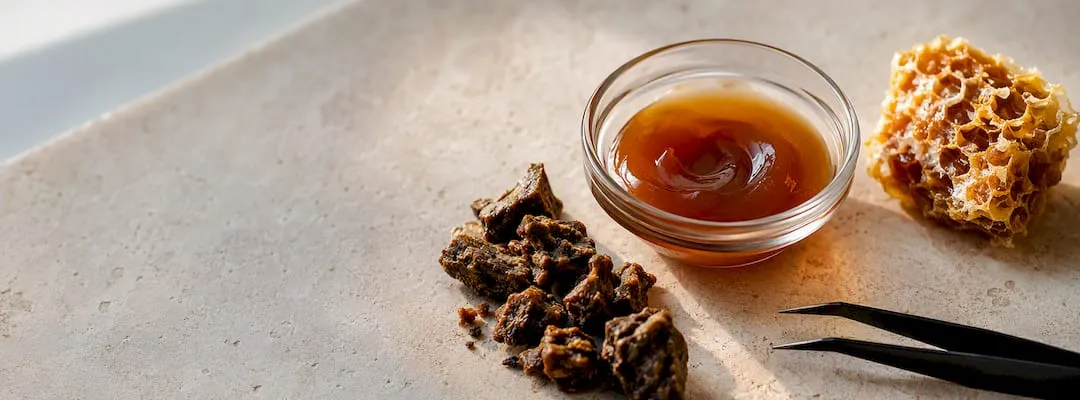
Propolis has been proven in laboratory and cell studies to have antibacterial, anti-inflammatory, and antioxidant effects. For impure, irritated, or slightly damaged skin, it can be a useful addition, but it does not replace medical treatment. Anyone using propolis-containing cosmetics for the first time should perform a patch test beforehand, as bee products are among the more common contact allergens.
In short:
- Propolis shows antibacterial, anti-inflammatory, and antioxidant effects in laboratory studies, although its actual effectiveness in humans is still insufficiently researched.
- The effect strongly depends on the origin, composition, and the contained ingredients such as phenolic acids, flavonoids, and CAPE.
- For impure, irritated, or small skin, propolis can be supportive, but it does not replace medical treatment and should be tested before first use.
- There is an increased risk of contact allergies, so a patch test is recommended, especially for known allergies to bee products.
- Consumers should pay attention to high-quality, light-protected products and integrate propolis with moisturizing substances into their skincare routine.
Table of Contents
- What is Propolis and Which Ingredients Work on the Skin?
- What Does Research Really Say About Propolis Skincare Effects?
- Which Skin Problems Can Propolis Really Help With?
- What Propolis Formulations Are Available in Cosmetics?
- How Safe is Propolis for Sensitive Skin?
- How to Incorporate Propolis Care into Your Routine
- Why We at Rammilav Rely on Natural Ingredients
- Discover Soothing Care at Rammilav
- Sources
- FAQ
What is Propolis and Which Ingredients Work on the Skin?
Propolis is the resinous substance that bees produce from tree resins, pollen, and their own secretions to seal their hive and protect it from germs. This protective function makes the substance interesting for skincare.
Chemically, propolis is a complex mixture of over 300 individual compounds. Three groups are particularly relevant for its effect on the skin:
- Phenolic acids such as caffeic acid and chlorogenic acid, which have antioxidant effects and capture free radicals.
- Flavonoids, which contribute to anti-inflammatory properties and can attack bacterial cell membranes.
- Caffeic acid phenethyl ester (CAPE), a derivative of caffeic acid, which influences inflammatory signaling pathways in studies.
It's important to know: The composition varies greatly depending on the region of origin, bee colony, and season. Brazilian red or green propolis differs chemically significantly from European propolis, which measurably changes its effect on skin inflammation and wound healing. This also explains why two propolis creams from different manufacturers do not automatically have the same effect.
What Does Research Really Say About Propolis Skincare Effects?
The data is divided. In the lab, propolis looks strong. In humans, the broad evidence needed for a clear medical recommendation is still lacking.
In-vitro studies demonstrate antibacterial effects mainly against gram-positive bacteria, as well as antifungal and antioxidant activity. The strength of the effect directly depends on the phenol and flavonoid content of the respective extract. A study from 2022 additionally showed wound-healing activity in propolis extracts, with individual phenols like chlorogenic acid identified as the main drivers.
A particularly relevant finding concerns atopic dermatitis: Propolis and its component CAPE influence the so-called MKK4 pathway, which plays a role in inflammatory skin reactions. These effects were observed in cell models, ex-vivo skin samples, and animal studies, not in large human studies.
This is exactly where the limitation lies that one should be aware of: Lab data is promising, but robust clinical studies with sufficient sample size in humans are largely lacking.
Regulatory consequences follow from this. In the EU, no specific health claims are currently approved for propolis in cosmetics, as shown by the EU Register for Health Claims. Propolis products are almost exclusively classified as cosmetic products, not as medicines. A manufacturer is therefore not allowed to claim that their cream "heals" eczema, even if lab data points in that direction.
Which Skin Problems Can Propolis Really Help With?
Four mechanisms of action are relevant for practice, with varying degrees of evidence.
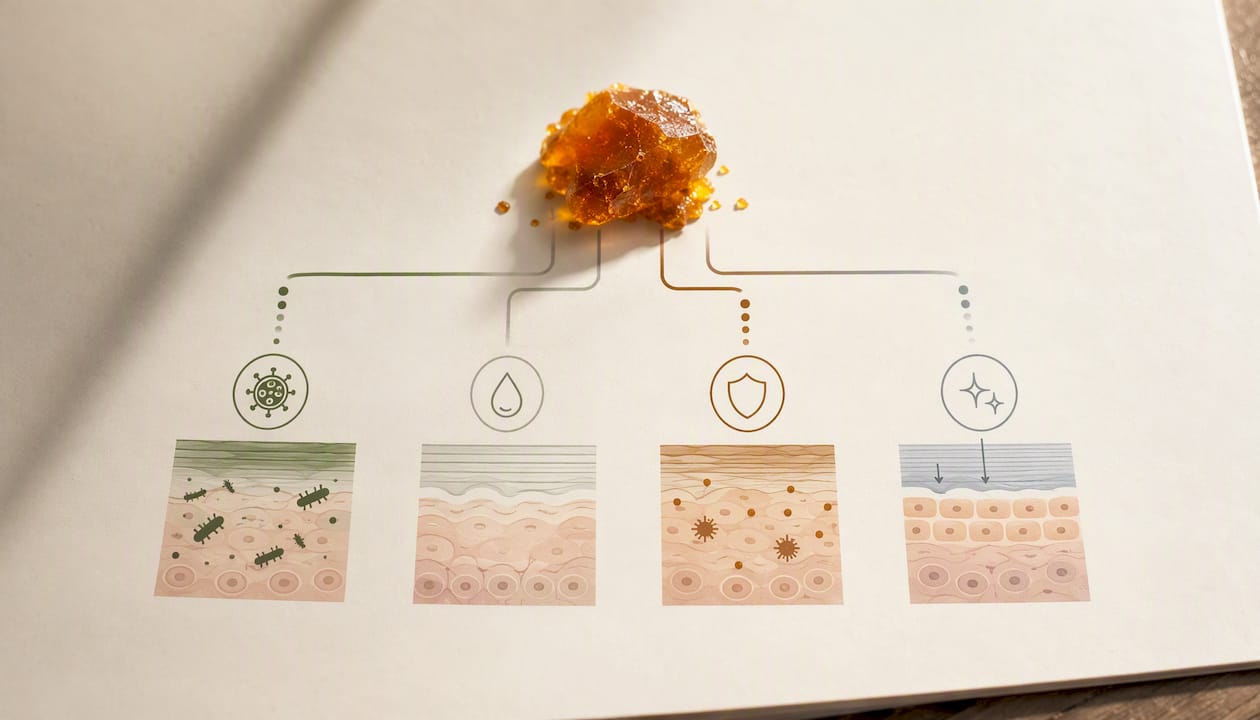
Antibacterial effect on impure skin. Propolis preferentially attacks gram-positive bacteria, which include certain acne pathogens. This explains why many propolis serums are specifically advertised for pimples and blackheads. However, it is not a miracle cure: For inflammatory acne with deep nodules, dermatological treatment remains the first choice.
Anti-inflammatory effect on irritated skin. Through flavonoids and CAPE, propolis slows down messengers that trigger redness and itching. This mechanism is behind the studies on atopic dermatitis.
Antioxidant protection. The phenolic acids capture free radicals generated by UV radiation and environmental stress. This supports the skin barrier but does not replace sun protection.
Wound healing and barrier strengthening. In cell models, propolis promoted the regeneration of skin tissue, making applications for small skin injuries or after microneedling appear plausible.
Pro Tip: For very dry or cracked skin, propolis works most reliably in combination with a moisturizing base like panthenol or hyaluronic acid, not as a standalone care.
What Propolis Formulations Are Available in Cosmetics?
Propolis appears in skincare in several forms, which differ significantly in consistency, concentration, and purpose.
- Alcoholic extracts dissolve the active ingredients particularly efficiently, have a more intense smell, and can irritate sensitive skin more easily.
- Water-based or glycolic extracts are milder but often less concentrated.
- Creams and serums are suitable for daily routine, ointments more for spot application on individual areas.
- Film-forming formulations, a newer approach, according to recent studies, improve application properties and protection against UVB damage in cell models.
Propolis extracts can naturally have a brown or green tint depending on their origin, which is not a quality defect. Pay attention to dark, light-protected packaging, as phenols oxidize when exposed to light. As long as a product only cares and does not make healing claims, it remains cosmetic. If the packaging promises to treat diseases, it would legally become a medicine.
How Safe is Propolis for Sensitive Skin?
Propolis is one of the more common triggers of contact allergies among natural cosmetic ingredients. This is due to cross-reactions with related substances such as Peru balsam, beeswax, and cinnamaldehyde, which are also found in many care products.
A simple patch test helps before first use:
- Apply a small amount of the product to the inside of the forearm.
- Leave the area untouched for 24 to 48 hours without washing it.
- Check for redness, itching, or welts.
- If no reaction occurs, application on the face is usually safe.
- If redness, burning, or swelling occurs, discontinue the product immediately.
If there are already severe eczema, atopic dermatitis flare-ups, or a known allergy to bee products, the decision for or against propolis belongs in medical hands, not in self-management.
How to Incorporate Propolis Care into Your Routine
Propolis products work best after cleansing and before moisturizer, either as a serum on the entire face or as a spot treatment on individual impurities.
- Apply to slightly damp skin after washing to allow the active ingredients to absorb better.
- Do not use simultaneously with acids like AHA or BHA, but apply them at different times to avoid irritation.
- In combination with retinoids, use separately in the evening, propolis in the morning, retinoid in the evening.
- Apply spot treatment on impure skin, use as a soothing night care on irritated skin.
- Can be well combined with vitamin C in the morning, as the antioxidant effects complement each other.
For stressed or barrier-impaired skin, the combination with a Cica formulation, as found in many Korean soothing creams, followed by a rich moisturizer to complete the routine, is worthwhile.
Why We at Rammilav Rely on Natural Ingredients
I've been observing for years how Korean skincare increasingly relies on plant-based and bee-based active ingredients, and propolis is one of the most honest examples for me. The lab findings are solid without anyone having to exaggerate. At Rammilav, we check the origin and quality of each product before it is shipped, and deliver it quickly to you. Nevertheless, propolis remains a supplement to care, not a replacement for the dermatologist in serious skin problems.
— Aleksejs
Discover Soothing Care at Rammilav
We offer Korean cosmetics with fast delivery within Switzerland, usually within a few days. Especially with active ingredient products like propolis serums, verified origin counts, as concentration and purity determine the effect. In our catalog you will find soothing formulations like the Tocobo Cica Calming Serum or the moisturizing Enough Collagen Moisture Essential Cream as a supplement to your routine. If you want to learn more about price-performance ratios of natural cosmetic brands before buying, you can find an independent brand overview at OutletPicks. Check out the product details; information on current shipping conditions can be found on the shop page.
Sources
- EU Register for Health Claims
- Systematic review / Overview article on Propolis
- GDCh Data Sheet Propolis
- Potential Use of Propolis in Phytocosmetic (Molecules, 2022)
- Propolis suppresses atopic dermatitis through targeting the MKK4 pathway
FAQ
What Does Propolis Do on the Skin?
Propolis primarily acts antibacterial against gram-positive germs, anti-inflammatory, and antioxidant. These effects mainly come from laboratory and cell studies, less from large studies in humans.
Is Propolis Suitable for Children?
Since propolis is one of the more common contact allergens, special caution is advised with children. A patch test before first use is mandatory, and if in doubt, a pediatrician should be consulted beforehand.
Is Propolis Good Against Wrinkles?
Propolis has indirect benefits mainly through its antioxidant properties, by capturing free radicals that contribute to skin aging. There are currently no robust clinical proofs specifically for a wrinkle-reducing effect, and the EU Health Claims Regulation does not allow such advertising claims.
Is Propolis Suitable for Allergies?
No, if there is a known allergy to bee products, Peru balsam, or cinnamaldehyde, it is advisable to avoid propolis cosmetics. If unsure, testing before use and seeking dermatological advice is recommended.


