

Peptide serums strengthen the skin barrier, signal the skin to produce more collagen, and bind moisture. In short: They are one of the most compatible active ingredients you can incorporate into your routine, especially if your skin reacts sensitively to retinol or if you simply want to build a solid foundation for anti-aging care.
The main effects at a glance:
- Barrier protection: Peptides promote the formation of lipids and structural proteins that strengthen the skin's protective layer.
- Collagen support: Certain peptides send signals that can boost the body's own collagen synthesis.
- Moisture binding: Peptides support the skin's natural moisturizing factor (NMF) and keep it supple.
- Soothing effect: Anti-inflammatory peptides reduce redness and are well-suited for sensitive or irritated skin.
Who are peptide serums particularly useful for? Primarily for people with sensitive skin, retinol intolerance, rosacea, or after aesthetic procedures. But even those who already use retinol can benefit from incorporating peptides as a complementary active ingredient.
Key Insights
Peptide serums strengthen the skin barrier, support collagen synthesis, and are particularly suitable for sensitive skin or as a complement to retinol.
| Topic | Details |
|---|---|
| Main Effect | Barrier protection, collagen signaling, moisture binding, and anti-inflammation |
| Best Use Cases | Sensitive skin, retinol intolerance, rosacea, postoperative care |
| Combination Rules | Well combinable with hyaluronic acid, niacinamide, and vitamin C; separate strong acids temporally |
| Expected Timeframe | Hydration can be noticeable after a few weeks; improvements in firmness and fine lines appear over several weeks to months |
| Rammilav | Swiss source for authentic K-Beauty serums and collagen-supporting products |
Table of Contents
- What Peptides Actually Are and Why They Work in Serums
- How Peptides Work in the Skin: The Biological Mechanisms
- What Types of Peptides Are There and What Do They Do?
- How to Properly Apply a Peptide Serum
- Safety and Side Effects: What You Can Realistically Expect
- How Long Does It Take to See Results?
- What Dermatologists Say About Peptides
- What to Look for When Buying a Peptide Serum
- Peptide Serums at Rammilav: Authentic K-Beauty for Your Routine
- My Assessment: Peptides as a Base, Retinol as an Option
- Sources
What Peptides Actually Are and Why They Work in Serums
Peptides are short chains of amino acids, typically between 2 and 50 units long. They are the building blocks of proteins like collagen, elastin, and keratin. In cosmetics, they are used because they act as signaling molecules: They communicate with skin cells and trigger specific biological reactions.
Why does this work in a serum? Because serums have a higher concentration of active ingredients and a more fluid texture than creams, they penetrate deeper into the upper layers of the skin. However, penetration remains an issue: Pure peptides are often too large or too hydrophilic to efficiently overcome the skin barrier.
This is where formulation aspects come into play:
- Lipophilic modifications: Many peptides are linked with fatty acids like palmitic acid (hence "Palmitoyl-" in the name), which improves their solubility in lipids and increases penetration.
- Carriers: Liposomes or nanoparticles can transport peptides specifically into deeper layers.
- pH stability: Peptides are stable within a certain pH range; a well-formulated base is crucial for their effectiveness.
This means: Not every product that says "peptides" on the packaging automatically delivers an effective concentration. The formulation is decisive.
How Peptides Work in the Skin: The Biological Mechanisms
The overview literature on topical peptides shows that certain peptides can support collagen synthesis and wound healing in vitro and in clinical studies, although the evidence is heterogeneous. So what exactly happens in the skin?
- Collagen signaling: Signal peptides mimic fragments of collagen breakdown and signal the skin to produce more collagen, similar to TGF-beta signaling pathways. This is a biologically plausible reaction, not magic.
- Barrier strengthening: Peptides promote the synthesis of ceramides and other lipids that build the skin barrier. At the same time, they support the natural moisturizing factor (NMF), which improves water binding.
- Anti-inflammation: Certain peptides, such as Palmitoyl Tripeptide-8, have anti-inflammatory effects and can reduce redness in sensitive skin.
- Inhibition of enzymatic degradation processes: Some peptides block enzymes like matrix metalloproteinases (MMPs) that break down collagen. This slows down structural loss in the dermis.
Important to understand: The penetration barrier of the skin is real. How well a peptide works depends heavily on its size, charge, and the formulation of the product. Laboratory results cannot always be directly transferred to intact skin.
What Types of Peptides Are There and What Do They Do?
Not all peptides do the same thing. Dr. Hamza Gemici's glossary distinguishes four main categories that you will find on ingredient lists:
| Peptide Type | Main Effect | Known Examples |
|---|---|---|
| Signal Peptides | Stimulate collagen and elastin synthesis | Palmitoyl-Pentapeptide-4 (Matrixyl), Palmitoyl Tripeptide-1 |
| Carrier Peptides | Transport trace elements (e.g., copper) into the skin | GHK-Cu (Copper Tripeptide-1) |
| Enzyme Inhibitor Peptides | Block collagen-degrading enzymes (MMPs) | Soybean Peptide, Silk Peptide |
| Neurotransmitter Inhibitors | Reduce muscle contractions, smooth expression lines | Acetyl-Hexapeptide-3 (Argireline) |
A note on nomenclature: Prefixes like "Palmitoyl-" or "Acetyl-" indicate that the peptide has been chemically modified to be more stable and penetrate the skin better. This is not a marketing trick but a real formulation advantage.
Cell culture data show that Palmitoyl-Pentapeptide-4 (Matrixyl) can increase the expression of collagen mRNA. However, the transfer to intact skin remains formulation-dependent and is less clearly demonstrated in clinical studies than in the lab.
How to Properly Apply a Peptide Serum
The order in the routine makes a real difference. Peptide serums are water-based and light, so they belong after cleansing and toning, but before moisturizing.
Morning Routine (recommended):
- Gentle cleansing, e.g., with a mild gel cleanser
- Toner (optional, to balance pH)
- Apply peptide serum, gently massage in, let absorb
- Moisturizer
- Sunscreen SPF 50+ as the last step
Evening Routine: Peptides can be easily used in the evening, especially if you use retinol. Retinol then follows the peptide serum, or you use the so-called "retinol sandwich method": moisturizer, then retinol, then moisturizer again. Peptides can soothe the barrier and buffer retinol irritation.
Safe Combinations:
- Hyaluronic acid: ideal, enhances moisture effect
- Niacinamide: well-tolerated, complements barrier care
- Vitamin C (stable, pH-adjusted): works well together in the morning
Caution with: high-percentage AHAs (glycolic acid, lactic acid) in the same step. Strong acids can destabilize peptides. Better: use acid products on a different evening or at a different time.
Pro Tip: If you use multiple serums, the rule of thumb is: thinnest texture first. Peptide serums are usually lighter than oil serums or dense ampoules, so they come earlier in the order.
Safety and Side Effects: What You Can Realistically Expect
Peptides are considered one of the most compatible types of active ingredients in cosmetics. Adverse reactions are rare and usually arise not from the peptide itself, but from accompanying ingredients.
- Common sources of irritation: Preservatives (e.g., phenoxyethanol in high concentration), fragrances, or alcohol in the formulation, not the peptide.
- Patch test: Test a small area on the forearm or behind the ear before first use and observe for 24 hours. Especially important with known contact allergies.
- After aesthetic procedures: Consult with the treating physician before introducing new active ingredients. The skin is more sensitive then.
- Pregnancy: Topical peptides are not generally contraindicated, but as with all cosmetics, medical consultation is advisable, especially with neurotransmitter inhibitor peptides like Argireline.
Warning signs to discontinue use:
- Persistent redness or burning after multiple applications
- Swelling or rash
- Itching that does not improve
In these cases: pause the product, see a dermatologist.
How Long Does It Take to See Results?
Peptides work subtly and continuously. Those expecting dramatic changes after a week will be disappointed. Those who remain patient will see real improvements.
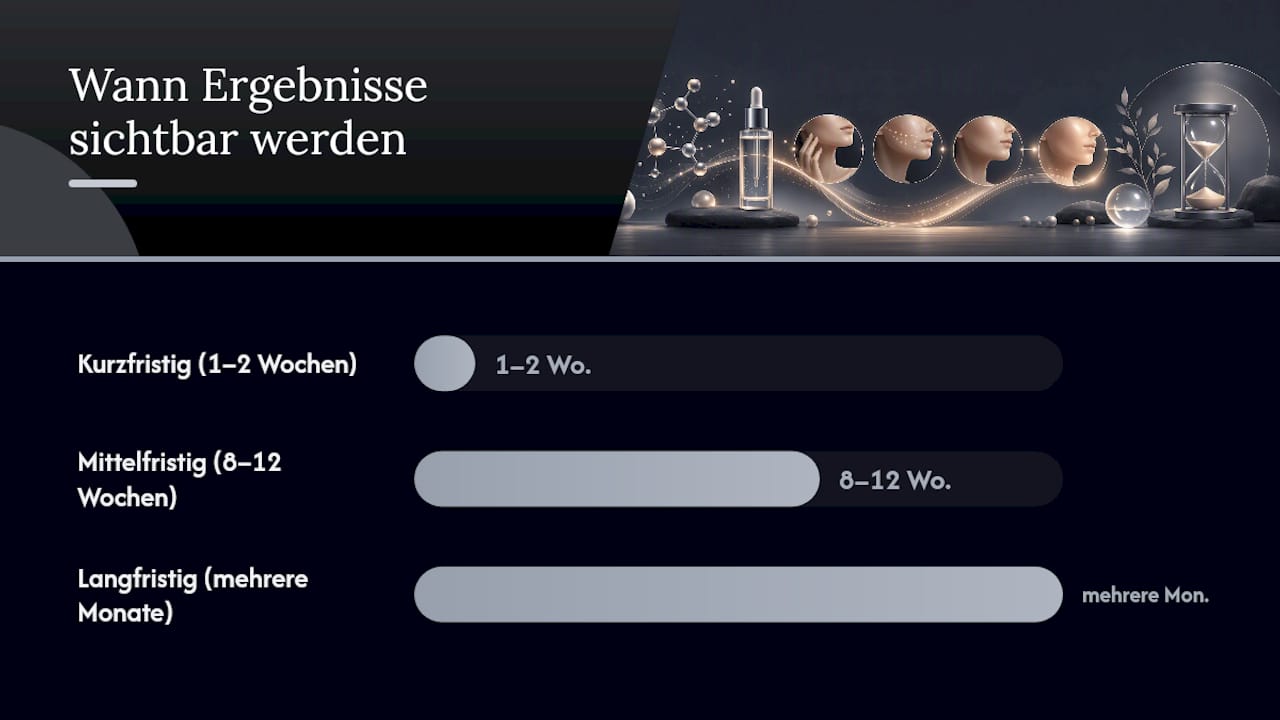
- Short-term (1–2 weeks): Improved hydration, softer texture, less redness in sensitive skin. These effects are often the first you notice.
- Mid-term (8–12 weeks): Clinical tests show measurable improvements in skin firmness and fine lines during this period. The scientific overview literature emphasizes that study designs and formulations vary greatly, making direct comparisons difficult.
- Long-term (several months): Possible collagen support and structural improvements, depending on consistent use and the quality of the formulation.
Comparison with Retinol: Retinol often delivers faster and more pronounced changes in texture, pigmentation, and wrinkles, but is significantly more prone to irritation. Retinol has stronger RCT evidence for wrinkle reduction, while peptides score on compatibility and safety. Those who cannot tolerate retinol or need to pause it will find peptides a viable alternative without compromising barrier care.
What Dermatologists Say About Peptides
Experts agree: Peptides are not a replacement for retinol when it comes to maximum anti-aging effects. But they are a valuable addition, especially for people who cannot tolerate retinol or want to make their routine gentler.
Dermatologists recommend peptides especially for sensitive skin, rosacea, and postoperative care because they soothe the barrier without causing additional irritation. This is also confirmed by The Independent in a summary of expert opinions.
Regarding the evidence: Retinol is better supported by numerous randomized controlled trials (RCTs). Peptides have solid but less extensive clinical data. PMC and PubMed sources show biologically plausible mechanisms, but clinical transferability depends heavily on the formulation.
Pro Tip: The "retinol sandwich" is an established method for beginners: First moisturizer, then retinol, then moisturizer again. Those who add peptides can use the serum before the first moisturizer to further support the barrier.
What to Look for When Buying a Peptide Serum
Not every product that advertises with "peptide complex" delivers what it promises. Here are the criteria that really matter:
- Peptide type suitable for the goal: For anti-aging: signal peptides like Matrixyl or GHK-Cu. For expression lines: Argireline. For barrier protection: carrier peptides or tripeptides.
- Supporting ingredients: Hyaluronic acid enhances moisture effect, ceramides strengthen the barrier, niacinamide soothes. Good peptide serums combine several of these active ingredients, as Vichy explains.
- Packaging: Airless pumps or opaque containers protect peptides from oxidation. Products in wide jars with screw caps are less ideal.
- pH stability: Peptides are most stable in a slightly acidic to neutral pH range. Products with a very low pH (below 4) can destabilize peptides.
- Concentration: Many manufacturers do not specify exact percentages. If a peptide is high on the ingredient list (INCI), the concentration is likely higher.
Caution with misleading marketing: Claims like "clinically proven to reduce wrinkles in 7 days" without source citation should be viewed skeptically. Serious brands mention study designs or refer to independent tests.
For sensitive skin, formulations without fragrances and alcohol are particularly suitable. Anti-aging-focused serums should contain Matrixyl or GHK-Cu. Those seeking regeneration after procedures or stress benefit from carrier peptides in combination with ceramides. At Rammilav, you will find in the assortment peptide-containing and collagen-supporting products selected for various skin needs.
Peptide Serums at Rammilav: Authentic K-Beauty for Your Routine
When looking to buy a peptide serum, you often face an overwhelming selection. Rammilav solves this problem: As a Swiss online shop for authentic Korean cosmetics, Rammilav sources all products directly from verified suppliers, ensuring originality and consistent quality.
Korean skincare has focused on peptides and barrier care earlier and more consistently than many Western brands. The Beauty Of Joseon Hanbang Serum Discovery Set is a good start to test various regenerative formulas before committing to a full product. Those specifically looking for collagen-supporting care will also find the Lebelage Wrinkle Collagen Ampoule Cream as a companion product to the serum at Rammilav.
Delivery in Switzerland usually takes 2–3 days, with free shipping from 80 CHF. Browse directly in the Rammilav shop and filter by your skin needs.
My Assessment: Peptides as a Base, Retinol as an Option
I recommend peptide serums as a base active ingredient for almost any routine, not as a replacement for stronger active ingredients, but as a stable foundation. Those who tolerate retinol should continue to use it: The evidence for wrinkle reduction is simply stronger there. But peptides complement retinol sensibly because they soothe the barrier and support regeneration without causing additional irritation.
Those who cannot tolerate retinol or are taking a break will find a real alternative in a well-formulated peptide serum with Matrixyl or GHK-Cu, not a stopgap. The effect is subtler but real and well-tolerated.
Rammilav offers a curated selection as a Swiss shop for authentic Korean cosmetics, where you don't have to choose between originality and price. For those who want to delve deeper: The Beauty Guide on Rammilav offers further guidance on active ingredients and routines.
Sources
- PMC Article — Overview on Peptides
- PubMed — Palmitoyl Pentapeptide Studies
- The Independent — Peptides vs Retinol
- Dr. Hamza Gemici — Glossary Peptide Serum


