
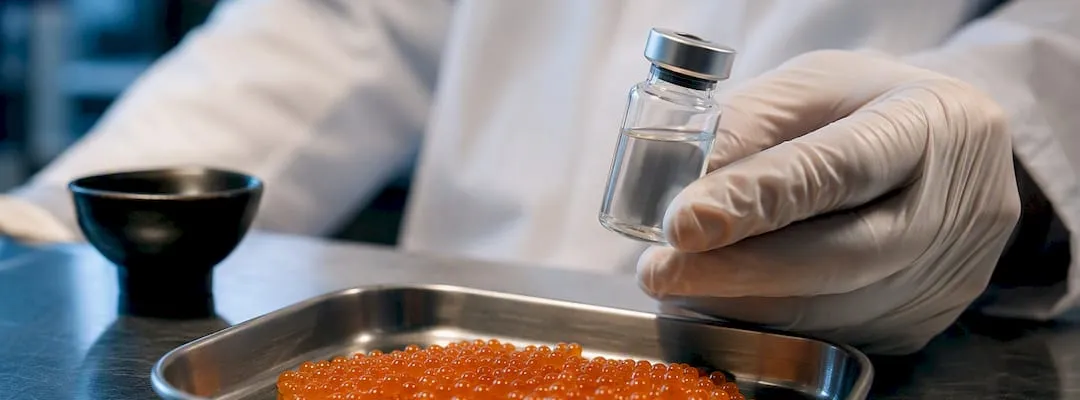
PDRN has been proven in several studies to have a regenerative effect on the skin: The DNA-based active ingredient stimulates collagen production, supports wound healing, and even shows stronger effects on wrinkle depth and skin density than Retinol in a randomized study. It is especially recommended for mature, stressed, or post-aesthetic procedure skin, both topically and as an injection. Anyone with a known fish allergy should perform a patch test beforehand, and invasive applications should always be handled by trained professionals.
In short:
- The effectiveness of PDRN is evident in skin regeneration, particularly in wound healing and collagen building, with effects that may be stronger than Retinol.
- For optimal penetration, medium-molecular PDRN formulations and carrier types are crucial, with hydrogels staying longer on site and serums acting faster.
- Studies show that PDRN significantly improves skin density and wrinkle depth in specific applications, although larger molecular weight can hinder penetration.
- In practice, PDRN is especially useful in topical products, injections, or needling applications, depending on skin condition and desired effect depth.
- When purchasing, pay attention to molecular weight indication, concentration, and origin of the active ingredient to ensure effective and safe use.
Table of Contents
- What is PDRN in Skincare? Origin and Differentiation from PN
- How PDRN Works on a Cellular Level
- What Benefits Do Studies Show About PDRN in Skincare?
- Topical, Injectable, or Needling: Which PDRN Application Suits You?
- Who is PDRN Suitable For, and What Should You Consider for Safety?
- Combining PDRN Correctly: What Fits Into the Routine, What Doesn't
- What to Look for When Buying PDRN Products
- My Assessment: Where PDRN Really Stands in the K-Beauty World
- PDRN Care at Rammilav: What We Focus On When Selecting
- Sources
What is PDRN in Skincare? Origin and Differentiation from PN
PDRN stands for Polydeoxyribonucleotide, short DNA fragments usually derived from the milk or roe of salmon. Some sources simply refer to it as "salmon DNA," which is vivid but not entirely accurate. Not the entire DNA ends up in the serum, but purified, defined fragments of it.
In scientific literature, there is an increasing distinction between two molecular classes. An overview paper proposes a clear cutoff, the so-called Marques Polynucleotide Cutoff: Fragments under 1500 kilodaltons are considered PDRN, everything above as PN, or polynucleotide. This is not an academic quibble. The two classes behave differently in formulation and are preferred for different purposes.
For you as a user, this means: A product that carries PDRN in its name but does not provide a molecular weight indication leaves you unclear about what properties you are actually buying. The common forms of administration differ accordingly:
- Topical serums and creams with low-molecular PDRN, intended for daily skincare routine.
- Masks and pads, often with hydrogel carriers, that keep the active ingredient on the skin for a longer time.
- Injectable hydrogels, so-called skin boosters, which are introduced directly into the dermis and can work with higher molecular PN variants.
This range also explains why PDRN now appears in both the drugstore shelf and the practice for aesthetic medicine in the K-Beauty world.
How PDRN Works on a Cellular Level
PDRN primarily activates a receptor called Adenosine-A2A. This is located on various skin cells and, when activated, triggers an anti-inflammatory cascade that simultaneously promotes blood circulation. This combination, less inflammation plus more angiogenesis, or new blood vessel formation, is considered one of the main reasons why PDRN is so interesting for wound healing and skin regeneration.
The second mechanism of action involves the so-called salvage pathway. Here, PDRN directly provides the cell with nucleotide building blocks that it would otherwise have to laboriously synthesize itself. Damaged or aging cells thus save a production step and can repair faster.
An overview paper summarizes that PDRN works through the activation of the A2A receptor and the supply of the salvage pathway, showing faster wound healing and improved healing rates in clinical data.
This observation comes from a narrative overview of PDRN's mechanisms of action and clinical application, compiling several studies on chronic wounds and dermatological applications.
How well this works in practice depends heavily on molecular weight and galenics. Large, water-loving molecules generally have difficulty penetrating the intact stratum corneum. This is precisely why many formulations rely on medium-molecular PDRN, as it offers a better balance between stability and penetration. A study on topical application specifically used such a medium-length PDRN variant and was able to actually detect the presence of the active ingredient in the living epidermis using Raman spectroscopy, a methodological indication that defined molecular weights can measurably penetrate the skin, as shown by the PLOS-One study on PDRN's effect on the dermal matrix. The carrier form also plays a role: Hydrogels keep the active ingredient longer on site and delay enzymatic degradation, while liquid serums are absorbed faster but also degrade faster.

What Benefits Do Studies Show About PDRN in Skincare?
The result was clear: For periocular wrinkles, dermis thickness, and skin density, the PDRN cream showed about twice as strong improvements as Retinol in the same period, documented in the randomized study on PDRN eye cream.
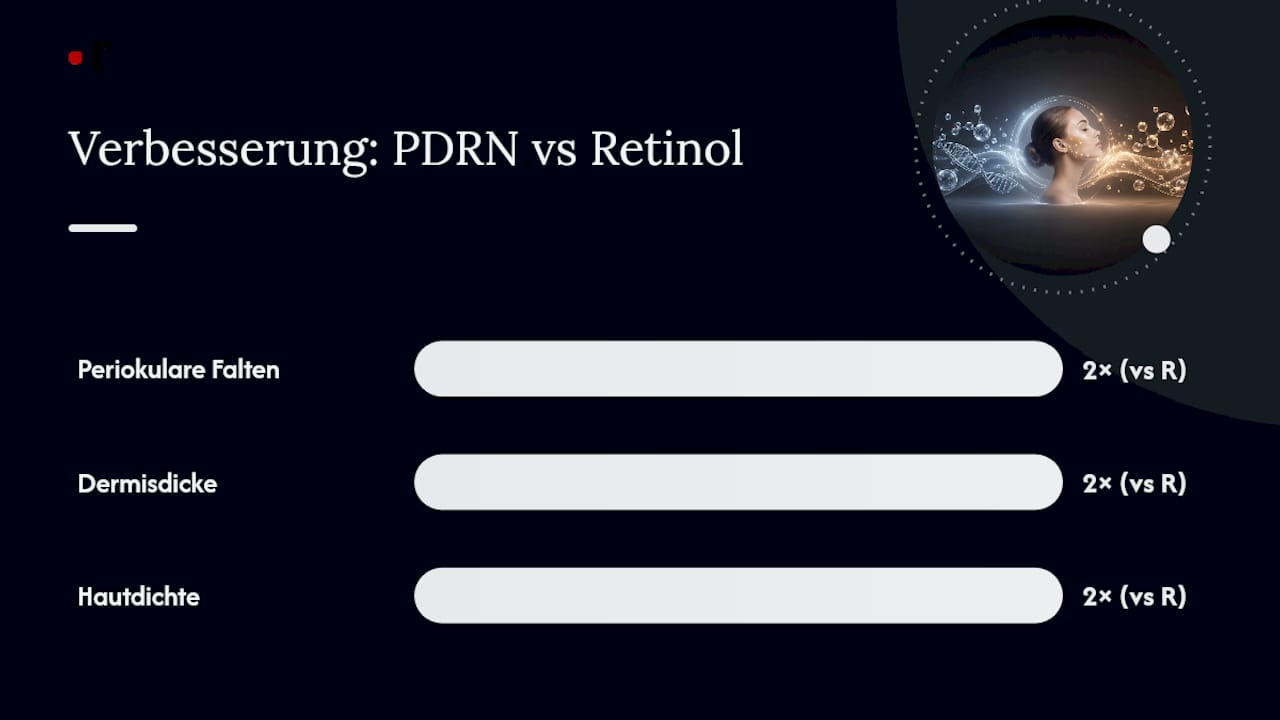
Important for classification: This is a single study with a specific product and a specific molecular size. It does not prove that every PDRN preparation automatically works better than every Retinol product, but it shows a strong signal for well-formulated, medium-molecular PDRN creams in the periocular area.
Beyond the eye cream study, further evidence is accumulating from preclinical and clinical investigations:
- Improved wound healing and faster epithelialization in chronic wounds in several clinical studies.
- Stimulation of collagen synthesis through pathways like PI3K–Akt and TGF-β, which are involved in the repair of the extracellular matrix.
- Indications of reduced scar formation and improved angiogenesis in animal experimental and preclinical data.
- Modulation of inflammatory processes, which is particularly relevant for irritated or post-procedure stressed skin.
An overview article that compiles clinical and translational data on PDRN and PN explicitly emphasizes that the formulation determines the actual benefit, not the active ingredient name alone, as read in the PMC review on mechanisms and clinical application of PDRN. The study situation is positive but inconsistent: Different molecular weights, concentrations, and study designs make direct comparisons between products difficult. Anyone reading PDRN fans in forums should keep this heterogeneity in mind before transferring a result one-to-one to another product.
Topical, Injectable, or Needling: Which PDRN Application Suits You?
The choice of form of administration depends significantly on what goal you are pursuing and how deep the active ingredient really needs to go.
- Topical serums, creams, and masks are the lowest-threshold entry. They are suitable for daily care and for anyone who wants to try PDRN without going to a practice. The physical limit remains the stratum corneum: Only part of the active ingredient reaches deeper skin layers, as the discussion on skin barrier and its repair shows.
- Injectable hydrogels, so-called skin boosters, bring PDRN or PN directly into the dermis and thus completely bypass the barrier. This application usually achieves more intense and faster effects, but belongs exclusively in the hands of trained medical personnel, as dose, injection scheme, and treatment depth directly influence result stability.
- Microneedling in combination with topical PDRN creates temporary microchannels in the stratum corneum and significantly increases penetration without being a real injection. Timing is crucial: PDRN is usually applied immediately after treatment when the skin is most receptive and at the same time most sensitive.
For everyday care, the topical route is usually sufficient. Those seeking more visible, deeper effects, for example after a procedure or with pronounced wrinkle formation, will tend to opt for needling protocols or professional injections.
Who is PDRN Suitable For, and What Should You Consider for Safety?
PDRN is particularly suitable for mature, sun-damaged, or post-aesthetic procedure stressed skin. It can also be useful for sensitive skin because it has an anti-inflammatory effect, but a cautious start with a low concentration is advisable.
One point deserves special attention: PDRN is usually derived from fish or salmon sources. Even if the active ingredient is highly purified, a patch test is recommended in case of a known fish or seafood allergy, for example on the inside of the forearm, 24 to 48 hours before the first extensive application on the face.
Other points to keep in mind:
- Light redness or a brief warming sensation immediately after application is possible but usually subsides quickly.
- Injections may cause temporary swelling or small hematomas at the injection site.
- Invasive applications like skin boosters or deep needling belong exclusively in the hands of professionals with appropriate training.
- Pregnancy and breastfeeding are topics to clarify in advance with a professional for injectable forms.
Pro Tip: Apply a new PDRN product only every other day in the first week and observe your skin, instead of immediately starting a daily double routine morning and evening. This way, you will notice early if your skin reacts sensitively before using larger amounts.
Combining PDRN Correctly: What Fits Into the Routine, What Doesn't
PDRN can be easily integrated into an existing skincare routine as long as you pay attention to the order and keep a few active ingredients in mind.
- Hyaluronic acid and niacinamide are very compatible with PDRN. Both support moisture retention or barrier function without disturbing the regenerating effect.
- Ceramides complement PDRN well because they strengthen the skin barrier while PDRN works on cell repair inside, a combination also found in products on peptide serum effects that rely on similar regeneration principles.
- Retinoids are not taboo but should be applied with distance, such as PDRN in the morning and retinoid in the evening, or on alternating days. Observe your skin closely in the first weeks, a comparison like Retinal vs. Retinol helps to assess the intensity of your retinoid correctly.
- Sunscreen in the morning is mandatory after any regeneration routine with PDRN, as freshly repaired skin is more sensitive to UV radiation.
After microneedling or an injection, the rule is: Only PDRN and mild moisturizers in the first 24 hours, no acids, no retinoid, no fragrance.
What to Look for When Buying PDRN Products
The market for PDRN cosmetics is growing rapidly, and not every label delivers what it promises. A short checklist helps to separate the wheat from the chaff:
- Is there a molecular weight indication on the packaging or in the product data sheet? If it is completely missing, that's a warning signal.
- Is the concentration clearly indicated, instead of just advertising "contains PDRN"?
- Does the formulation match the application goal, such as hydrogel for longer residence time, lighter serum for everyday use?
- Does the manufacturer refer to verifiable studies or sources, instead of just working with marketing promises?
- Is the distribution channel transparent, does the product come from verified suppliers instead of unclear third-party vendors?
| Criterion | What to Look For | Why It Matters |
|---|---|---|
| Molecular Weight | Indication in kDa on packaging/data sheet | Determines penetration and classification PDRN vs. PN |
| Concentration | Specific percentage indication | Allows comparison with study data |
| Formulation Type | Serum, cream, hydrogel, mask | Affects residence time and active ingredient degradation |
| Origin Transparency | Verified suppliers, clear origin indication | Reduces risk of counterfeits or impurities |
Realistic expectations are also part of the checklist. A serum will hardly achieve the same effect as a medically administered injection, but both have their rightful place. When selecting a range, such transparency criteria should be carefully considered before a product is listed.
My Assessment: Where PDRN Really Stands in the K-Beauty World
I consider PDRN one of the most interesting active ingredients that have transitioned from Korean skincare to the mainstream, but the hype is currently outpacing careful communication. The eye cream study against Retinol is impressive, but it is one study, not a carte blanche for every product with PDRN on the label. It's better to check the molecular weight indication and formulation of a product rather than being impressed by the word "DNA active ingredient" alone. And for anything beyond a serum, for needling protocols or injections, expert advice is simply essential. Responsible application beats quick results, every time.
— Aleksejs
PDRN Care at Rammilav: What We Focus On When Selecting
Every product in the range should be carefully checked and ideally sourced directly from verified suppliers to guarantee original goods. This also applies to regenerative formulations that build on similar active principles as PDRN, such as active ingredients for collagen stimulation or moisture-binding hydrogels. When ordering from trusted providers, it's important to know exactly what you're getting, appreciate fast delivery, and attractive shipping conditions.
Those interested in hydrogel-based formulations will find, for example, the Beauugreen Pomegranate & Ruby Hydrogel Eye Patches as a practical entry for the periocular area or the Lebelage Wrinkle Collagen Ampoule Cream for a more intensive anti-aging routine. In case of fish allergy, the rule remains: Patch test beforehand, and if interested in injections, be sure to seek medical advice before booking a treatment. Check out the Beauty Guide for more active ingredient comparisons or browse directly through our range to find your next skincare product.
Sources
For those who want to delve deeper, the core evidence can be found in the randomized PLOS-One study on PDRN eye cream, the nomenclature overview on PDRN and PN, and the PMC review on mechanisms and applications. Additionally, a look at the practical test of a PDRN serum is worthwhile.
- Topical medium-length PDRN enhances dermal extracellular matrix repair in photodamaged skin via PI3K–Akt/TGF-β–regulated pathways | PLOS One
- From Polydeoxyribonucleotides (PDRNs) to Polynucleotides (PNs): Bridging the Gap Between Scientific Definitions, Molecular Insights, and Clinical Applications of Multifunctional Biomolecules
- Polydeoxyribonucleotide (PDRN) review — mechanisms and clinical applications (PMC article)


