

Niacinamide strengthens the skin barrier, has anti-inflammatory properties, regulates sebum production, and lightens pigmentation spots. This is not marketing, but a well-documented reality supported by clinical studies and dermatological review articles. Eucerin describes that Niacinamide strengthens the barrier, regulates sebum, reduces pigmentation spots, and retains moisture.
The most important effects at a glance:
- Barrier Strengthening: Promotes ceramide formation and reduces transepidermal water loss
- Anti-Inflammatory: Reduces redness and acne-associated inflammation
- Sebum Regulation: Reduces shine and refines the appearance of pores
- Brightening: Inhibits melanosome transfer, preventing pigmentation spots
- Moisture Retention: Supports skin structure and retains moisture in the skin
Key Insights
Niacinamide works on multiple levels simultaneously: It strengthens the barrier, reduces inflammation, regulates sebum, and brightens pigmentation spots when used consistently and in the right concentration.
| Topic | Details |
|---|---|
| Starting Concentration | 2–5% is the best starting point for most skin types, effective and well-tolerated. |
| Time Frame | First effects after 2–4 weeks; significant improvements in pigmentation spots often only after several months. |
| Routine Placement | After cleansing, before cream; possible morning and evening, always with SPF during the day. |
| Combinations | Well combinable with Retinol, Hyaluronic Acid, and Ceramides; prefer stable formulations with Vitamin C. |
| Rammilav | Serums from Beauty Of Joseon, Cosrx, and Purito in the Rammilav shop offer well-formulated Niacinamide care for every skin type. |
Table of Contents
- What is Niacinamide, and why is it not an ordinary vitamin?
- How Niacinamide works on the skin: the cellular mechanisms
- Which concentration is sensible, and when does Niacinamide show effects?
- Niacinamide for acne, redness, pigmentation spots, and dry skin
- How to properly incorporate Niacinamide into your routine
- Is Niacinamide safe? Side effects, pregnancy, and patch test
- How to choose the right Niacinamide product
- What studies actually show: evidence and limitations
- My recommendation: Patience pays off
- Niacinamide serums and care products at Rammilav
- Sources
What is Niacinamide, and why is it not an ordinary vitamin?
Niacinamide, also known as Nicotinamide, is a water-soluble form of Vitamin B3. The crucial difference from Niacin (Nicotinic Acid): Niacinamide does not cause a so-called flush, meaning no temporary skin redness or heat sensation caused by vasodilation, which makes Niacinamide significantly more tolerable for topical application.
We ingest Vitamin B3 through food sources like meat, legumes, and nuts. However, for the skin, the direct route via serums and creams is far more effective because topically applied Niacinamide penetrates directly into the epidermis and works on a cellular level. In the EU, Niacinamide formulations in cosmetics are approved up to 20%; practical formulations, according to Typology, usually range between 2–5%, as the risk of irritation noticeably increases above 10%.
How Niacinamide works on the skin: the cellular mechanisms
The effect of Niacinamide on the skin is multifaceted. No other active ingredient in basic skincare influences so many different processes in the epidermis simultaneously.
Ceramide and Fatty Acid Synthesis: Niacinamide stimulates the production of ceramides and free fatty acids. These lipids are the main building blocks of the skin barrier. An intact barrier retains moisture in the skin and protects against external irritants. Clinical review articles show that this mechanism also significantly reduces transepidermal water loss.
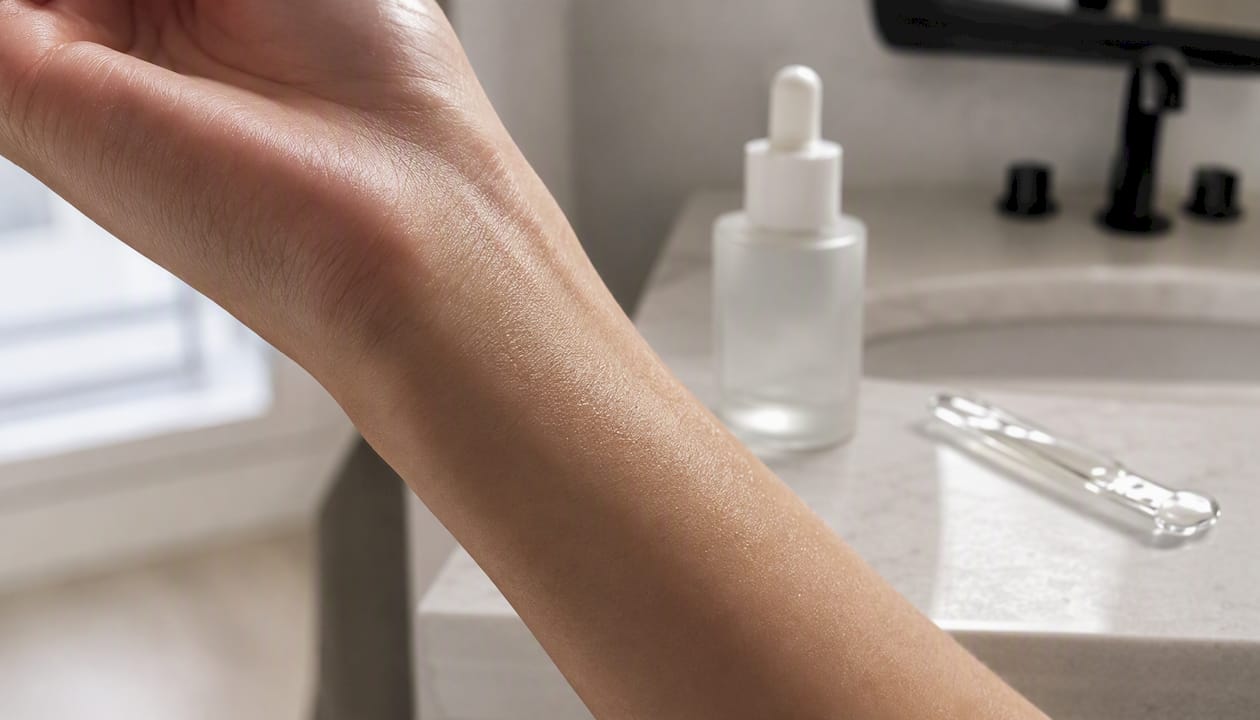
Anti-Inflammatory: Topical Niacinamide inhibits inflammatory processes and can thus reduce redness, irritation, and acne-associated inflammation. This effect is particularly relevant for sensitive skin and rosacea.
Sebum Regulation: Niacinamide influences the activity of the sebaceous glands. The result is less shine, a refined pore appearance, and an overall matte texture without drying out the skin.
Inhibition of Melanosome Transfer: Melanosomes are the cell organelles that transport melanin (the pigment of the skin) from melanocytes to keratinocytes. Niacinamide interrupts this transfer and can thus lighten existing pigmentation spots and prevent new ones.
Collagen Support: Some studies suggest that Niacinamide improves skin structure and supports collagen synthesis, which can contribute to a firmer texture in the long term.
First visible effects, such as calmer skin and less redness, can appear after 2–4 weeks according to review articles. Significant improvements in pigmentation spots or wrinkles often require several months of consistent application.
Which concentration is sensible, and when does Niacinamide show effects?
The concentration determines which effects you can realistically expect. Not every concentration suits every skin concern.
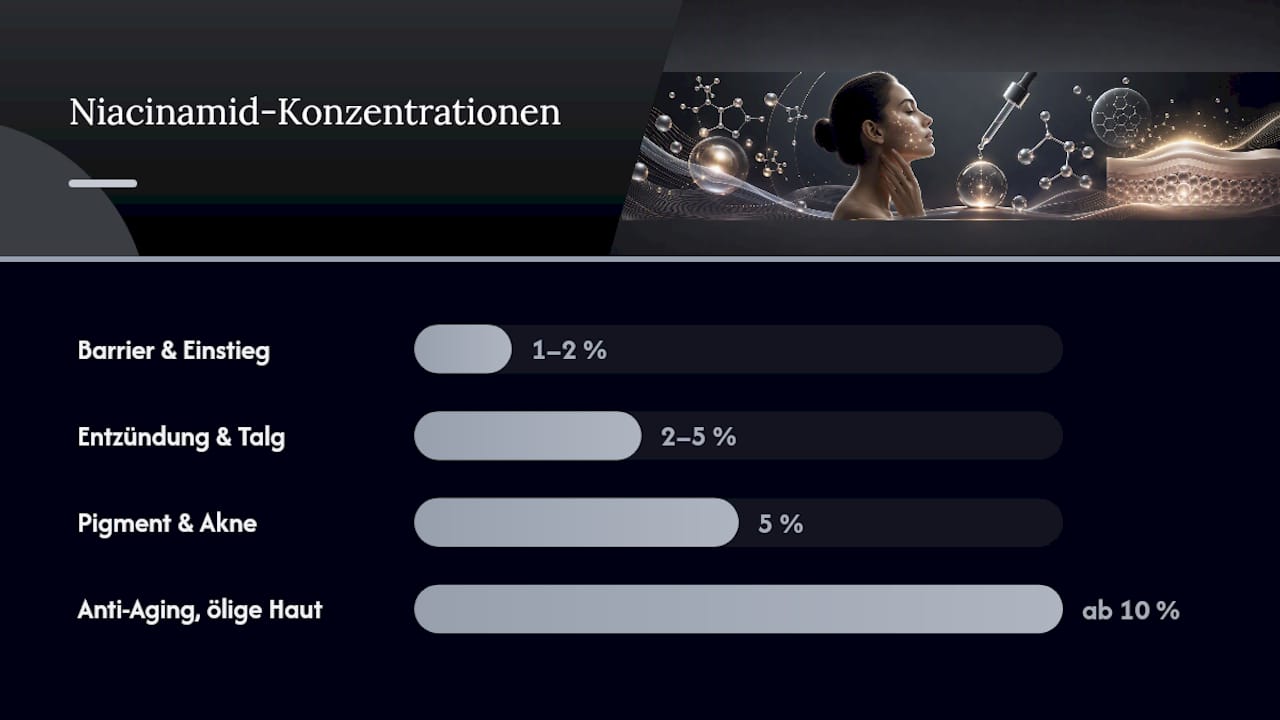
| Concentration | Typical Indication | Expected Timeline |
|---|---|---|
| 1–2% | Barrier strengthening, moisture retention, entry for sensitive skin | 2–4 weeks |
| 2–5% | Inflammation reduction, sebum regulation, light brightening | several months |
| 5% | Hyperpigmentation, acne, refined pores | several months |
| from 10% | Stronger brightening, anti-aging, oily skin | from 10%, increased irritation risk |
Professional information from Altmeyers confirms: Clinically noticeable effects are usually only from about higher concentrations can bring stronger results but increase the potential for irritation.
Important orientation points:
- 2% is suitable as an entry point for dry or sensitive skin
- 5% is the most commonly used concentration in clinical studies for pigmentation spots and acne
- From 10% one should proceed cautiously and closely observe the skin reaction
- First effects (calmer skin, less redness) are often visible after 2–4 weeks; significant improvements in pigmentation spots or wrinkles often appear only after several months
The German Apotheker Zeitung summarizes: The effectiveness is supported by studies, especially in pigment disorders and barrier deficits, but points to a heterogeneous study situation.
Niacinamide for acne, redness, pigmentation spots, and dry skin
Niacinamide is one of the few active ingredients suitable for almost all skin types and many different concerns simultaneously. Nevertheless, it is worth calibrating expectations depending on the skin problem.
Acne and Blemished Skin
Clinical and observational data show that Niacinamide can regulate sebum production and reduce inflammatory lesions in acne. Especially in mild to moderate acne, it is a well-tolerated addition to basic care. Additionally, products like the Cosrx Master Patch Basic help with targeted treatment of individual blemishes.
Redness, Rosacea, and Neurodermatitis
In rosacea and neurodermatitis, barrier strengthening is the crucial effect. Niacinamide reduces redness and sensitivity without burdening the skin. Those prone to overreactions should look for formulations without fragrances and aggressive alcohols.
Pigmentation Spots and Uneven Skin Tone
The mechanism is clear: Niacinamide inhibits melanosome transfer, preventing melanin from reaching the skin surface. For visible results, patience, consistent application, and mandatory sun protection during the day are required. Formulations with acidic pH can enhance the brightening effect. Additionally, brightening eye pads like the Naturebay Hy-Collagen Eye Pads are suitable for the sensitive eye area.
Dry Skin and Barrier Weakness
Niacinamide promotes ceramide formation and reduces transepidermal water loss. Combined with Hyaluronic Acid, a double moisture effect is created: Hyaluronic binds water, Niacinamide retains it in the skin. For very dry skin, a serum with Niacinamide under a ceramide-rich cream is worthwhile.
Anti-Aging
Niacinamide supports skin structure and can, in combination with Retinol or Peptides, mitigate signs of skin aging. It is not a substitute for Retinol but a sensible companion that buffers irritation from stronger active ingredients.
Pro Tip: For pigmentation spots: Niacinamide without daily SPF is only half as effective. UV radiation stimulates melanin production and nullifies brightening effects. A sunscreen like the Enough Collagen Sunscreen SPF50+ is essential in the morning routine.
How to properly incorporate Niacinamide into your routine
The order in the skincare routine influences how well Niacinamide can work. The general rule is: active ingredients are applied after cleansing and before moisturizer, from thin to thick consistency.
Recommended Morning Routine:
- Cleanse face (e.g., with the Enough Collagen 3in1 Cleansing Cream)
- Apply toner or essence (optional)
- Apply Niacinamide serum, let it absorb
- Moisturizer
- Sunscreen SPF 30 or higher
Evening skips the sunscreen. Niacinamide can be used morning and evening without causing problems. If using Retinol in the evening, apply Niacinamide beforehand: It buffers potential irritation and supports the barrier.
Combining Niacinamide: What works, what needs caution?
- With Retinol: Very good combination. Niacinamide reduces redness and dryness that Retinol can cause.
- With Vitamin C: This combination was long considered problematic because it was feared that both active ingredients would react with each other and form Nicotinic Acid, which triggers a flush. Modern, stable formulations show that this reaction is hardly relevant at normal room temperatures and usual concentrations. If unsure, apply Vitamin C in the morning and Niacinamide in the evening.
- With AHA/BHA: Niacinamide can be applied after acids (AHA like Glycolic Acid, BHA like Salicylic Acid) once the skin's pH has normalized. A short wait of 20–30 minutes is sensible, as Niacinamide is less stable at very low pH.
- With Hyaluronic Acid and Ceramides: Ideal combination without restrictions.
Pro Tip: Niacinamide in the morning or evening? Both are possible. Those with sensitive skin should start with once daily in the evening and increase to twice daily after 2–4 weeks.
Is Niacinamide safe? Side effects, pregnancy, and patch test
Niacinamide is considered one of the most well-tolerated active ingredients in skincare. Serious side effects are rare but not impossible.
Typical reactions with too high a concentration or Nicotinic Acid residues in the formulation: slight redness, burning, or temporary sensitivity. These reactions usually subside after a few days if the concentration is reduced or the application frequency is decreased.
What to do in case of irritation? Pause application briefly, switch to a lower concentration, and stabilize the skin barrier with a ceramide-rich cream, such as the I’m Sorry for My Skin Age Capture Soothing Skin Cream.
There are no indications of risks with external use. Nevertheless, it is advisable to consult a dermatologist or gynecologist if uncertain.
Patch test in three steps:
- Apply a small drop of the serum to the inside of the forearm
- Wait 24 hours without washing it off
- No redness, no itching? Then large-scale application is safe
For prescription skin therapies (e.g., topical antibiotics or cortisone), a dermatologist should be consulted briefly before introducing Niacinamide to rule out interactions.
This significantly minimizes the risk of irritation.*
How to choose the right Niacinamide product
The selection is large, but the decisive criteria are manageable.
Concentration first: If the concentration is not on the packaging, a look at the INCI list is worthwhile. Niacinamide should appear among the first five to seven ingredients for the concentration to be relevant.
Accompanying substances that enhance the effect:
- Hyaluronic Acid: Complements the moisture-binding effect
- Ceramides: Support barrier strengthening
- Azelaic Acid: Enhances the anti-inflammatory and brightening effect
- Panthenol (Provitamin B5): Soothes and regenerates
What to avoid:
- High amounts of denatured Alcohol (SD Alcohol, Alcohol denat.) in the first ingredients, as these weaken the barrier
- Formaldehyde-releasing preservatives (e.g., DMDM Hydantoin) for sensitive skin
- Fragrances for rosacea or neurodermatitis
Formulation form: Serums generally have the highest active ingredient concentration and penetrate the skin deepest. Creams with Niacinamide are suitable for dry skin as they also provide moisture. For oily skin, light, water-based serums or gels are the better choice.
Checklist for product selection:
- Concentration 2–5% for entry
- Niacinamide among the first ingredients of the INCI list
- Pump bottle or airtight container (protects against oxidation)
- No aggressive alcohols in the first ingredients
- Fragrance-free for sensitive skin
What studies actually show: evidence and limitations
The research situation on Niacinamide is solid but not without gaps.
Well-documented effects:
- Barrier strengthening through ceramide promotion and reduction of transepidermal water loss
- Anti-inflammatory effects in acne and redness
- Inhibition of melanosome transfer with measurable brightening in hyperpigmentation
- Sebum regulation in oily skin
Preliminary or less clear findings:
- Collagen support and anti-aging effects: The data is promising, but the studies are smaller and shorter than with Retinol
- Effects in rosacea: Positive signals, but still few large randomized studies
Limitations of the study situation:
| Aspect | Limitation |
|---|---|
| Study Size | Many studies have small participant numbers |
| Study Duration | Often only a few weeks, long-term data is lacking |
| Formulation Variability | Different carrier substances make comparison difficult |
| Endpoints | Clinical scales, melanin transfer, sebum measurement, rarely quality of life |
Practical conclusion: Niacinamide is not a cure-all, but a well-tolerated active ingredient with broad evidence for barrier strengthening and pigment reduction. Those who bring realistic expectations and apply consistently over weeks will see visible improvements in most cases.
My recommendation: Patience pays off
Niacinamide is one of the few active ingredients where I say without hesitation: Start with it. Not because it delivers spectacular immediate results, but because it works reliably in the long term without overwhelming the skin.
What I repeatedly observe in practice: Many people give up too early or switch products after two weeks because they don't see dramatic changes. But the skin needs time.
Combine Niacinamide with Ceramides, Hyaluronic Acid, and a good sunscreen. These three companions make the difference between an active ingredient that sounds good on paper and a skincare routine that actually changes the skin's appearance.
Pro Tip: Photograph your skin every four weeks under the same lighting conditions. Changes in texture and tone are often subtle and hardly noticeable in everyday life, but clearly visible in photos.
Niacinamide serums and care products at Rammilav
Those who want to try Niacinamide in practice will find a carefully selected range of Korean skincare products at Rammilav that focus on well-formulated active ingredients. Serums offer the highest active ingredient concentration and are suitable as the first step into a Niacinamide routine.
Brands like Beauty Of Joseon, Cosrx, and Purito are known for transparent formulations without unnecessary fillers. The Beauty Of Joseon Revive Serum with Ginseng and Snail Mucin is a good example of a formula that combines barrier strengthening and moisture supply. Those who want to test different serums before committing will find a practical option in the Beauty Of Joseon Hanbang Serum Discovery Set. All products are sourced directly from verified suppliers and are usually delivered to Switzerland within 2–3 days. Browse now in the Rammilav shop and find the serum that suits your skin type.
Sources
For those who want to delve deeper into the research on Niacinamide, here are the main sources underlying this article:
- Niacinamide: Effects & Application on the Skin
- Ncbi
- How to Use Niacinamide in Skincare? — Typology
- Altmeyers
- Niacin for the Skin – Is the Effect Proven? - German Apotheker Zeitung
For medical questions about skin conditions such as rosacea, neurodermatitis, or severe acne, a dermatologist should always be consulted. This article does not replace medical advice.
This article contains general information and does not replace consultation with a qualified doctor. Consult a qualified medical professional about your personal situation before acting based on this content.
Recommendation
- I’m Sorry for My Skin Age Capture Soothing Skin Cream | Rammilav.ch
- Current | Rammilav.ch
- Celimax Celimax – Noni Ampoule Mask | Rammilav.ch
- Cosrx Advanced Snail 92 All In One Cream 100ml Regenerating Skin Cream | Rammilav.ch
Built using BabyLoveGrowth


