
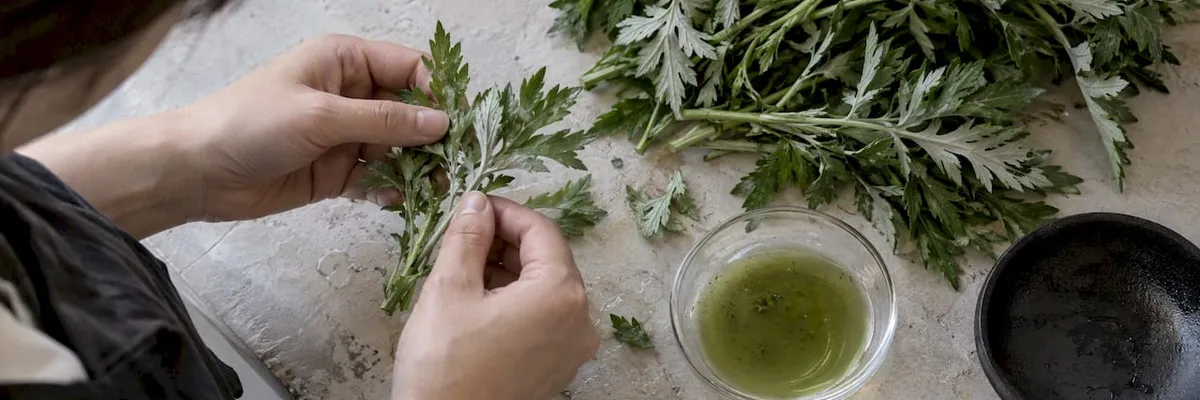
Mugwort, known in German as Beifuß (Artemisia vulgaris), is considered a soothing, anti-inflammatory, and antioxidant ingredient that K-Beauty often uses for stressed skin. The main drawback is its allergy potential: those who react to Asteraceae should definitely perform a patch test before first use.
In short:
- If you react to Asteraceae or mugwort pollen, seek medical advice; others should test a small amount first and watch for redness, itching, or swelling.
- After an unremarkable test, initially introduce only a low-dosed product every other evening; sensitive skin should avoid strong acids.
- Research describes possible anti-inflammatory and antioxidant effects, but reliable long-term human studies are lacking; mugwort does not replace sunscreen.
- The further up mugwort is on the ingredient list, the higher its concentration tends to be; manufacturers usually do not specify exact percentages.
Table of Contents
- How Does Mugwort Affect the Skin?
- Which Skin Types is Mugwort Suitable For?
- How to Incorporate Mugwort into Your Routine
- Which Products Contain Mugwort and What to Look for When Buying?
- What Does Science Say, and What Are the Limits?
- My Recommendation: Start Slowly and Document
- Discover Mugwort Care with Us
- FAQ
- Sources
How Does Mugwort Affect the Skin?
Mugwort contains essential oils, flavonoids, and sesquiterpene lactones. The plant has been used in many medical systems, and research today examines its antioxidant and other biological activities. What can be derived from this for skincare?
- Antioxidant: In an animal model, mugwort extracts showed antioxidant effects on UV-exposed skin. This suggests some protection against oxidative stress, but does not replace sunscreen.
- Anti-inflammatory: Reviews describe anti-inflammatory, antimicrobial, and photoprotective properties of Artemisia species. This is why the extract is found in many products for irritated skin.
- Production matters: Fermented filtrates and simple plant extracts can differ in their effect profiles. Claims of better bioavailability of fermented variants are plausible but not well substantiated.
A systematic review of topical mugwort derivatives reached a clear conclusion:
Topical mugwort derivatives showed anti-inflammatory, antimicrobial, and antioxidant effects. However, the authors explicitly called for further human studies before long-term statements can be made.
Which Skin Types is Mugwort Suitable For?
Most often, people with sensitive, redness-prone, or stressed skin turn to mugwort. Even blemished and combination skin can sometimes benefit, as the active ingredient is said to soothe irritation without being too heavy.
It is different for people sensitized to Asteraceae. Mugwort belongs to this family, and Asteraceae can trigger contact allergies. Additionally, there is the pollen context: in Central Europe, mugwort typically blooms between July and September, and it is considered one of the most important herbal allergens in allergology.
Here's how to proceed safely:
- Apply a small amount of the product behind the ear or on the crook of the arm.
- Observe the area for redness, itching, or swelling.
- If the skin remains calm, initially introduce the product only on individual evenings.
- If reactions occur, stop using it immediately and consult a dermatologist.
This is not caution for caution's sake. Clinical findings document that mugwort is a known contact allergen.
How to Incorporate Mugwort into Your Routine
Mugwort products fit at the beginning or middle of the skincare routine, depending on texture. The usual K-Beauty order applies here too: first light, watery products, then richer ones. How layering works is explained in our guide to layering serums.
- Order: Toner or essence, then serum or ampoule, followed by cream. A mask replaces the serum step once or twice a week.
- Introduction: Start with a product in low concentration and use it only every other evening at first. The patch test always comes first.
- Good partners: Panthenol, hyaluronic acid, and niacinamide complement the soothing effect. An example is the Green Tea Panthenol Serum by Beauty Of Joseon.
- With caution: Irritating acids like highly dosed AHA or BHA should not be used on the same evening, especially for sensitive skin.
Pro tip: Introduce only one new product at a time. If your skin reacts, you'll know immediately what caused it.
Which Products Contain Mugwort and What to Look for When Buying?
Mugwort is mainly found in essences, serums, toners, sheet masks, pads, and mild cleansing products. On the label, you can recognize it by entries like "Artemisia vulgaris extract" or "Artemisia ferment filtrate." The second term indicates a fermented variant. A look at the INCI list is always worthwhile.
These criteria help with selection:
- Form of production: Check whether the extract is fermented or classically obtained. Both can work, but the textures and skin feel differ.
- Position in the INCI list: The further up mugwort is, the higher its concentration tends to be. Few manufacturers specify exact percentages.
- Accompanying active ingredients: Soothing partners like panthenol, centella, or aloe are sensible. Perfume and essential oils are rather a downside for sensitive skin.
- Label indications: Serious products point out sensitivities and recommend a test before first use.
- Suitable texture: A light essence is suitable for beginners, a serum for more targeted care, a mask as an occasional extra boost.
What Does Science Say, and What Are the Limits?
The situation is encouraging but not yet conclusive. A review describes anti-inflammatory and antioxidant properties of Artemisia species. However, good long-term human studies are lacking, as the authors of the systematic review emphasize.
Case reports document contact dermatitis after topical application of mugwort products; the sensitization risk and cross-reactions are consistently described in the literature.
We offer Korean skincare products and inform you about our delivery conditions.
My Recommendation: Start Slowly and Document
Mugwort is worthwhile for many, but not in a rush. Test a product in your routine, document your skin condition beforehand with a photo, and compare after two to three weeks. If unsure, ask at the dermatologist's office beforehand. We offer K-Beauty formulations. Check the ingredients before use and test the product cautiously at first.
— Aleksejs
Discover Mugwort Care with Us
Those looking for mugwort care or wanting to try soothing K-Beauty alternatives will find toners, essences, and serums from brands like Cosrx, Beauty Of Joseon, and Purito in our catalog.
- We source our products from suppliers and pay attention to their origin.
- We deliver throughout Switzerland. You will learn the delivery time when ordering.
- Information on the conditions for free shipping can be found when ordering.
FAQ
What Effect Does Mugwort Have on the Skin?
Mugwort is said to soothe irritation, reduce inflammation, and protect skin cells from oxidative stress. The systematic review describes possible effects but emphasizes that further human studies are needed.
What is Mugwort Called in German?
Mugwort is called Beifuß in German. It usually refers to the species Artemisia vulgaris, which is used in skincare as an extract or fermented filtrate.
Who Should Avoid Mugwort in Skincare?
People with a known allergy to Asteraceae or mugwort pollen. Occupational mugwort allergies with severe reactions are also documented, so if in doubt, seek medical advice beforehand.
How Long Does It Take for Mugwort Care to Work?
Many feel a soothing effect after just a few applications. For a reliable assessment, you should use the product regularly and document the progress.
Sources
- Meduniwien
- 1538 Efficacy of topical mugworts in cosmetics and treatment of dermatologic diseases: A systematic review - Journal of Investigative Dermatology
- Pubmed
- Therapeutic potential of Artemisia vulgaris: An insight into underlying immunological mechanisms


