
Madecassoside soothes irritated skin, supports wound healing, and stimulates collagen production. Studies confirm anti-inflammatory effects, a reduction in the melanin index after eight weeks of use, and an increase in collagen type I synthesis by about 30% after approximately six weeks. The active ingredient is mostly used topically in serums or creams, with visible results appearing after several weeks of regular use.
In short:
- Madecassoside shows visible effects after about six to eight weeks of use through the reduction of the melanin index and improvement of skin flow.
- The anti-inflammatory effect is noticeable after two to four weeks, while collagen-stimulating effects usually become more visible from week six.
- Concentrations in cosmetic products are often in the low single-digit percentage range, with regular application being crucial.
- Madecassoside should be applied at night but can be combined with sunscreen during the day as it supports UV protection.
- Long-term studies are lacking, but mechanistic insights and short-term clinical results support the diverse positive effects on sensitive or irritated skin.
Table of Contents
- Madecassoside Effects at a Glance: Key Skin Benefits
- Mechanisms: How Madecassoside Works Biologically
- Clinical Evidence: What Human Studies Show
- Madecassoside Application: Concentration, Order, and Timeline
- Combinations: Which Ingredients Enhance the Effect?
- Safety and Tolerability: Side Effects of Madecassoside
- Why Rammilav is the Right Source for Centella Products
- What Really Matters with Madecassoside
- Discover Madecassoside Products at Rammilav
- Sources
- FAQ
Madecassoside Effects at a Glance: Key Skin Benefits
Anyone exploring Madecassoside will quickly encounter four central effects that repeatedly appear in dermatological research. We summarize them before delving deeper into the mechanisms.
- Anti-inflammatory: Redness subsides, and the skin calms down faster after irritations or cosmetic procedures.
- Collagen Stimulation: Fibroblast activity increases, improving elasticity and reducing fine lines.
- Wound Healing and Cell Protection: Keratinocytes regenerate faster, and damaged tissue closes more quickly.
- Pigment Reduction: Post-inflammatory hyperpigmentation, such as that caused by sun exposure or acne, measurably decreases.
These four effects are closely interconnected. Those seeking the anti-inflammatory effect of Madecassoside often benefit simultaneously from the pigment-regulating component, as both processes run through related signaling pathways in the skin.
Mechanisms: How Madecassoside Works Biologically
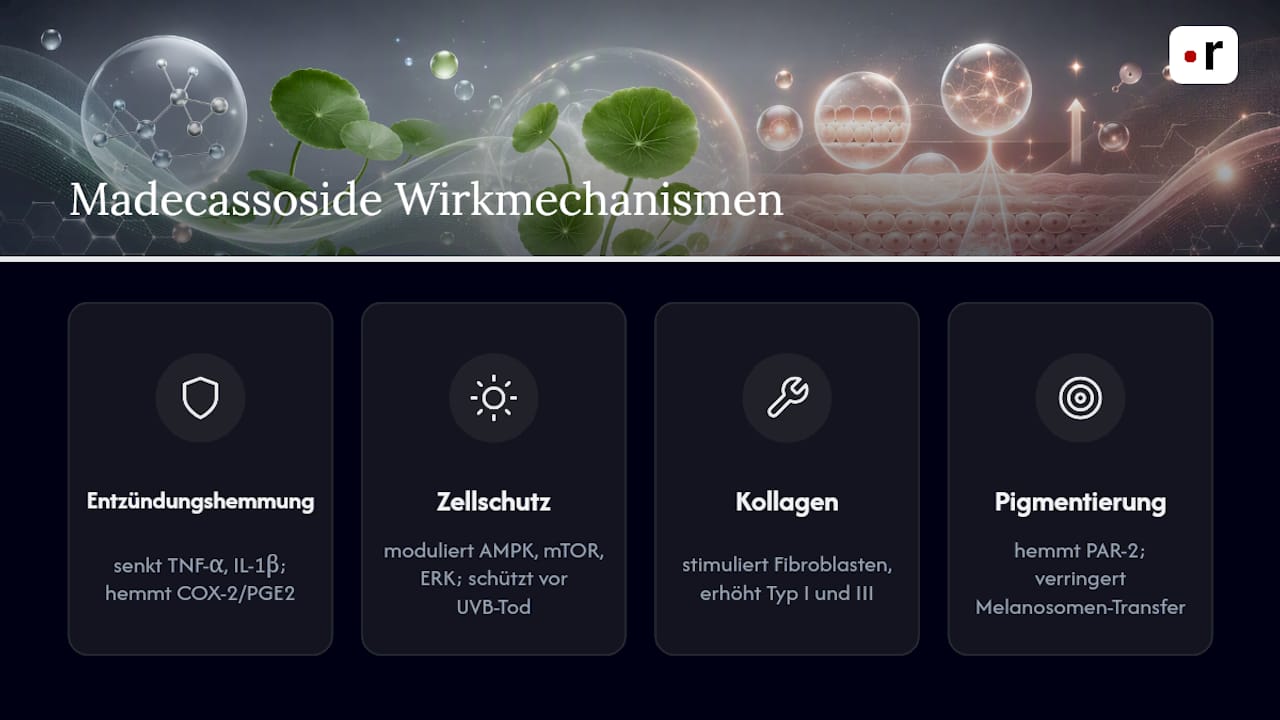
The effects of Madecassoside can be traced back to several parallel signaling pathways, which makes the substance so interesting for skincare. First, Madecassoside suppresses pro-inflammatory cytokines like TNF-α and IL-1β. At the same time, it interferes with the COX-2/PGE2 signaling pathway, which plays a central role in skin inflammatory reactions. In vitro studies also show suppression of COX-2, PGE2, and PGF2α, which is directly related to reduced melanin production in keratinocytes and melanocytes.
A second mechanism involves cell protection. Madecassoside modulates AMPK, mTOR, and ERK signaling pathways, protecting keratinocytes from UVB-induced cell death. For collagen formation, a third pathway is crucial: The active ingredient stimulates fibroblasts, thereby increasing the synthesis of collagen types I and III. Finally, Madecassoside inhibits the PAR-2 receptor, slowing melanosome transfer and counteracting hyperpigmentation. A recent review on Centella triterpenes confirms that isolated Madecassoside is particularly anti-inflammatory, while combination extracts often have a broader approach.
Clinical Evidence: What Human Studies Show
The most robust study on the effects of Madecassoside against hyperpigmentation showed a significant reduction in the melanin index after eight weeks of topical application, measured by Mexameter on artificially tanned skin. This is an objective, device-based procedure, not a subjective perception of the participants.
For the collagen-stimulating effect, older but frequently cited data exist: A study on fibroblast activity documents an increase in collagen type I synthesis by about 30% after around six weeks. Additionally, mechanistic studies show that Madecassoside promotes wound healing and protects keratinocytes from oxidative stress.
Where are the limits? Many studies work with small cohorts, often with limited skin type diversity, and most observation periods end after eight to twelve weeks. Long-term data over months or years are largely lacking. The laboratory evidence on molecular mechanisms is robust, the clinical evidence in humans is solid but not yet exhaustive. A recent review article on Asiaticoside and Madecassoside summarizes this range of effects and classifies them as well-documented dermatologically, without claiming them to be conclusively proven.
Madecassoside Application: Concentration, Order, and Timeline
Madecassoside is mostly found in serums, ampoules, and light creams, less often in rich balms. Serums have an advantage: Their thin texture allows for a higher concentration of active ingredients and absorbs quickly before a moisturizing cream seals the skin.
The concentrations used in studies vary, with many cosmetic formulations in the low single-digit percentage range. Those waiting for visible results should have realistic expectations:
- Week 2 to 4: Initial relief from redness and tightness.
- Week 6 to 8: More noticeable improvement in pigmentation and skin texture, consistent with the study periods of Mexameter measurements.
- From week 8: Collagen-related effects such as firmer texture become more tangible, often parallel to ongoing application.
For the order in the routine: apply after cleansing, on still slightly damp skin, before a richer cream. Since Madecassoside supports UV protection against pigmentation but is not a sunscreen itself, a separate sunscreen in the morning is essential.
Pro Tip: Apply Madecassoside products in the evening when skin regeneration is already more active, and consistently combine them with SPF in the morning to avoid undermining the pigment-reducing effect with new UV stimuli.
Combinations: Which Ingredients Enhance the Effect?
Madecassoside can be well combined with other soothing and moisturizing ingredients without the effects blocking each other.
- Hyaluronic Acid: provides additional moisture retention while Madecassoside soothes the barrier.
- Ceramides: support the lipid barrier and complement the cell-protecting effect sensibly.
- Mild Antioxidants like Vitamin B5 or Niacinamide: enhance protection against oxidative stress.
It is important to distinguish between isolated Madecassoside and the full Centella extract, often referred to as TECA: TECA contains four triterpene saponins together, creating a broader effect, while isolated Madecassoside works more specifically anti-inflammatory. With freshly irritated or recently peeled skin, aggressive acids or retinoids should be temporarily paused, as the combination with highly irritating ingredients can nullify the soothing effect.
Safety and Tolerability: Side Effects of Madecassoside
Madecassoside is considered one of the better-tolerated plant-based active ingredients in skincare. Local irritations are rare, usually only occurring in very sensitive or severely damaged skin. A patch test on the inside of the forearm before the first application on the face is still advisable, especially if there is known sensitivity to plant extracts.
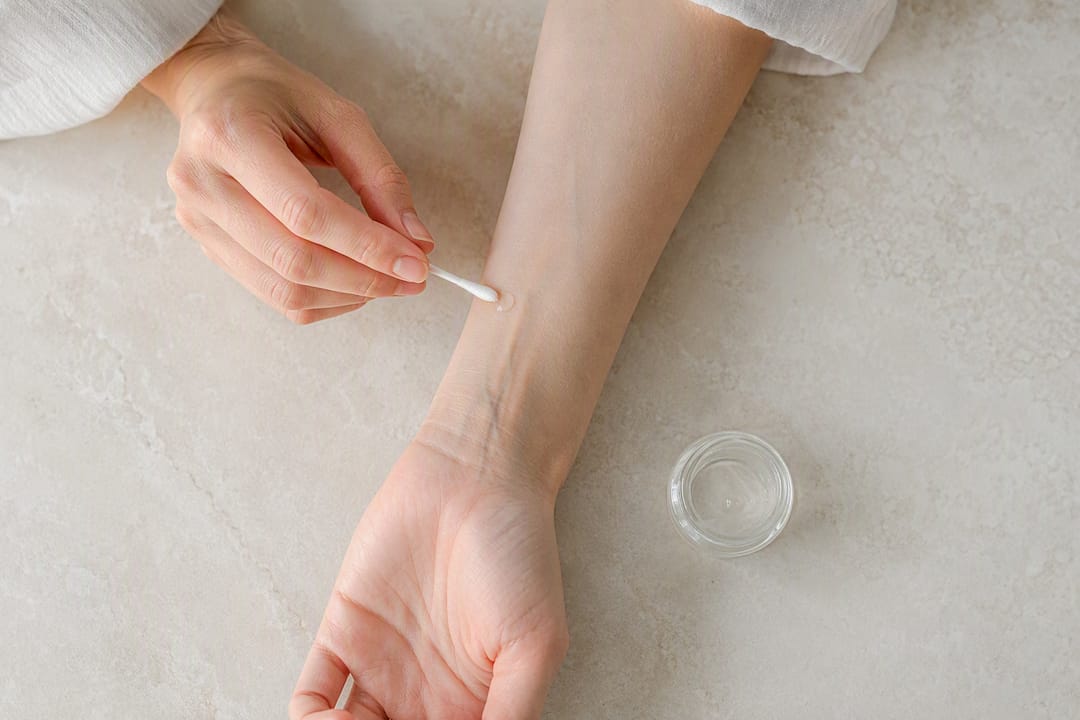
If redness or burning persists for more than one to two days, the application should be stopped. Systemic risks are not known with purely topical use. Those with severe skin conditions such as pronounced rosacea, eczema flares, or active acne infections should discuss the use with a dermatological professional beforehand, as Madecassoside does not replace medical treatment but complements the skincare routine.
Why Rammilav is the Right Source for Centella Products
Rammilav sources its Korean cosmetics directly from verified suppliers, ensuring original products and consistent quality, especially with sensitive active ingredients like Madecassoside. Those who want to learn more about the extract beforehand can find an overview of the main plant substances in the guide to Centella Asiatica effects. Some users report visibly soothed skin and faster regeneration after using the corresponding products. Those who want to consider the barrier function can find relevant tips in the article on rebuilding the skin barrier.
What Really Matters with Madecassoside
The research on Madecassoside is unusually consistent for a plant-based active ingredient. What convinces me is not a single spectacular study, but that several independent mechanisms, cytokine inhibition, fibroblast stimulation, PAR-2 blockade, all point in the same direction. This is rare in cosmetic science.
The common expectation that plant-based active ingredients are either ineffective or only mildly supportive does not do justice to the data situation here. At the same time, I caution against the opposite exaggeration: Madecassoside is not a substitute for retinoids in pronounced wrinkle formation, and the pigment effects require patience, eight weeks are the rule, not the exception.
Those who benefit the most are people with reactive, redness-prone skin or with post-inflammatory spots after acne. For everyone else, the active ingredient is a sensible, low-risk addition, not a miracle formula. The priority should be on consistent, multi-week application, not on seeking the highest concentration on the label.
— Aleksejs
Discover Madecassoside Products at Rammilav
There is a selection of Centella and Madecassoside-containing products, from ampoules to soothing creams, sourced directly from Korean manufacturers. The Skin1004 Madagascar Centella Ampoule provides a concentrated dose for irritated skin, while the matching soothing Centella cream is suitable for daily care. Orders are usually delivered within a few days in Switzerland, and shipping is free when a certain minimum order value is reached. Those unsure which format suits their skin can find further classifications of ingredient combinations in the K-Beauty Guide. Browse the product pages and find the formulation that suits your current skin situation.
Sources
- Madecassoside Inhibits Melanin Synthesis by Blocking Ultraviolet-Induced Inflammation
- Study reporting fibroblast stimulation and collagen synthesis (historic reference)
- Centella asiatica phytochemical Madecassoside enhances skin wound healing and protects against UVB-induced keratinocyte damage
- Madecassoside effects on UV-induced melanogenesis (PubMed reference)
FAQ
What Does Cica Do for the Skin?
Cica, or Centella asiatica, soothes redness, supports wound healing, and strengthens the skin barrier through several triterpene saponins, including Madecassoside.
Is Centella Really Good for the Skin?
The evidence supports it: Studies show anti-inflammatory, collagen-stimulating, and pigment-regulating effects, although with limited long-term data.
What is Centella Asiatica Good For?
Centella Asiatica is particularly suitable for irritated, redness-prone skin and for supporting regeneration after sun damage or cosmetic procedures.
What Does Gotu Kola Do in the Body?
When taken internally, Gotu Kola is mainly associated with effects on circulation and wound healing, but in skincare, the focus is on the topical, anti-inflammatory effects of Madecassoside.
How Does the Madecassoside Effect Manifest Over Time?
Initial soothing effects appear after two to four weeks, with more noticeable improvements in pigmentation and skin texture usually after six to eight weeks of continuous use.


