
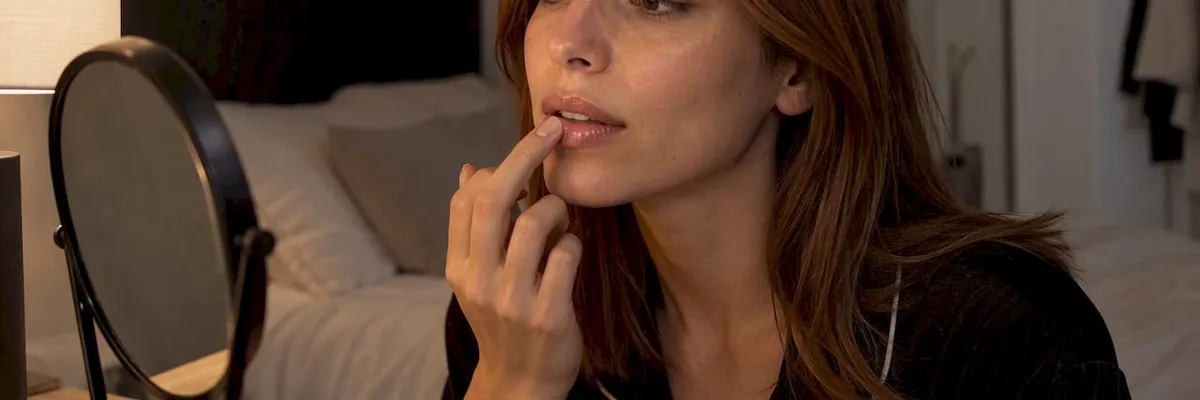
Apply a Lip Sleeping Mask in the evening as the very last step: after brushing your teeth and facial care, on clean and dry lips, in a slightly thicker layer than a lip balm. Then let it work overnight and gently wipe off the residue in the morning, without rinsing. In this guide, we'll show you how much product is sensible, how often you can use the mask, what sensitive lips need, and which small mistakes can reduce its effectiveness.
In Short
- Apply as the last step of the evening routine, after brushing teeth, cleansing, and face cream.
- Gently remove lipstick and residues from the lips beforehand and pat dry.
- An amount about the size of a pea is usually enough: covering but not dripping.
- Let it work overnight, remove residue with a soft cloth in the morning, do not wash off.
- For dry lips in winter, use every night, otherwise one to three times a week; pause if burning or redness occurs.
Table of Contents
- What a Lip Sleeping Mask is and Why You Need It
- Application Step by Step
- How Much Product is the Right Amount
- In the Morning: Wipe Instead of Wash
- How Often You Can Use the Lip Mask
- Sensitive Lips: What You Should Pay Attention To
- Common Mistakes in Application
- Understanding Ingredients: What's in a Lip Sleeping Mask
- Usefully Complementing the Lip Routine
- Our View: Lip Care is Routine, Not a Miracle Cure
- Frequently Asked Questions About the Lip Sleeping Mask
- Sources
What a Lip Sleeping Mask is and Why You Need It
A Lip Sleeping Mask is a rich lip care product that stays on the lips for several hours. The word "mask" can be misleading: you don't have to peel it off or wash it off. It's more like a thick, creamy balm that provides the lips with moisture and nourishing lipids overnight, making them appear softer and smoother in the morning.
The difference from regular lip balm lies mainly in the concentration. According to Vogue, lip masks are considered richer care for the night, while a balm is intended as a lighter day care. Dermatologists interviewed there explain this with the formulation: More occlusive, sealing ingredients form a protective film under which the lips lose less moisture.
Why at night? During the day, any lip care is constantly challenged: you eat, drink, speak, unconsciously wipe your mouth. These disturbances largely disappear during sleep, and a rich layer can work undisturbed for hours.
Who benefits particularly from it?
- For dry, chapped, or slightly cracked lips, for example during the heating period or after days in cold mountain air.
- For people who wear matte or long-lasting lipsticks during the day, which can dry out the lips.
- For anyone who wants smooth lips in the morning as a base for lipstick or gloss.
- For mouth breathers and people who sleep in dry bedroom air.
Application Step by Step
The application takes barely a minute. The product itself is less important than the right timing and clean lips. Here's how to proceed:
- Remove makeup from lips. Gently remove lipstick, liner, and gloss. A cleansing balm or cleansing oil also dissolves long-lasting colors without rubbing. How this works as part of the entire facial cleansing is explained in our article on Double Cleansing in K-Beauty.
- Brush your teeth. Toothpaste and mouthwash often end up on the lips. If you apply the mask afterward, you won't wipe it away when rinsing, and toothpaste residues won't remain under the care film.
- Complete your facial routine. Toner, serum, cream: everything you usually use in the evening comes first. This way, you won't rub off the lip mask with a towel or while massaging in the cream.
- Pat lips dry. Moist lips are not a problem for the mask, but standing water dilutes the layer and makes it slip. Lightly pat the lips with a soft cloth without rubbing.
- Apply the mask. Use the included spatula or a clean fingertip to take the appropriate amount and spread it from the center outwards over the upper and lower lip. Don't forget the corners of the mouth and the lip line, as lips often crack there first.
- Let it absorb. Wait one to two minutes before lying down. The texture sets a bit, and less ends up on the pillow.
A tip for the spatula: Many lip masks come in a jar. If you take the product with the spatula instead of your finger, fewer germs get into the jar. Rinse the spatula occasionally with warm water and let it dry.
How Much Product is the Right Amount
Recommendations for the amount vary slightly, depending on how rich the formula is. As a rule of thumb, about the size of a pea has proven effective. The layer should be thicker than your day balm and look more like a coating than a fine shine. At the same time, nothing should drip or disturb you when falling asleep.
Here's how to tell if the amount is right:
- Too little: After a few minutes, the lips feel normal again, and no film is noticeable in the morning. Use a bit more next time.
- Just right: The lips are completely covered, the film feels soft and slightly sticky, and there's still some left in the morning.
- Too much: The product collects in the corners of the mouth, sticks to hair, or leaves noticeable marks on the pillow.
Very dry lips usually tolerate a more generous layer. If your lips are more normal and you use the mask preventively, a thin to medium layer is often sufficient.
In the Morning: Wipe Instead of Wash
After waking up, there's usually some residue of the mask on the lips. You don't need to wash it off. Simply remove excess product with a soft cloth or a damp cotton pad. This often also removes fine skin flakes that have softened overnight. But don't rub hard, as the lip skin is thin and easily injured.
After that, you can continue directly: During the day, a light lip balm is suitable, preferably one with sun protection if you're outdoors a lot. Lips are constantly exposed to the sun, which you quickly notice when hiking, skiing, or on a sunny day by the lake. What dry skin generally needs for sun protection can be found in our article on Sun Protection for Dry Skin.
If you wear lipstick: The smoothed lips are a good base. To prevent the color from slipping, completely remove any mask residue beforehand.
How Often You Can Use the Lip Mask
The frequency depends on how dry your lips are. Vogue mentions once to three times a week as sufficient for many people; in case of pronounced dryness, especially in winter, nightly use may be advisable. Most lip masks are formulated to be used daily.
A simple orientation by situation:
| Situation | Recommended Frequency | What to Watch For |
|---|---|---|
| Normal lips, prevention | 1–3 evenings per week | Thin to medium layer |
| Dry lips during the heating period | Every evening | Generous layer, also balm during the day |
| Cracked lips after sun, cold, or wind | Every evening until they recover | No peeling, no strongly perfumed products |
| Burning, increased peeling after use | Reduce to every other evening or pause | Check formula, consult a doctor if symptoms persist |
In Switzerland, the heating period from autumn to spring is the time when most lips suffer. The dry indoor air draws moisture from the skin, and outside, cold and wind are added. Especially in these months, daily use is worthwhile.
One more note: If you need the mask daily and your lips remain cracked for weeks, the cause may not only be the care. Then talk to your family doctor or pharmacist about it.
Sensitive Lips: What You Should Pay Attention To
Lips are more sensitive than the rest of the facial skin because their skin is particularly thin. Many popular lip masks smell like berries, vanilla, or sweets, and that can be a problem for sensitive lips. Fragrances can worsen dryness and flaking in sensitive lips instead of alleviating them.
From a dermatological perspective, this is well documented. A study published in 2025 on 21 suspected cases of allergic contact cheilitis, an allergic inflammation of the lips, found the fragrance mix 1 as the most frequently positively tested substance. The authors mention lip cosmetics, toothpastes, topical medications, and perfumes as possible triggers. So if your lips regularly burn, it's worth keeping an eye on not only the lip care but also the toothpaste.
For sensitive lips, we recommend:
- Prefer fragrance-free formulas. Look for "Parfum" or "Fragrance" in the ingredient list, as well as essential oils like peppermint or citrus.
- Avoid alcohol and menthol. What cools or tingles can further irritate sensitive lips.
- Test new products. Apply a small amount to an inconspicuous skin area, such as the jawline, for 24 hours before applying the mask to the lips.
- Don't peel while lips are cracked. Mechanical peels open small cracks further. The mask softens flakes overnight, which you gently remove in the morning.
Important: If red spots, swelling, itching, or burning appear after use, stop using it immediately. If symptoms persist or recur, consult a dermatologist. A patch test can determine which substance is causing the reaction.
Common Mistakes in Application
Most disappointments with lip masks have simple causes:
- Applying too early. Those who apply the mask before brushing their teeth or before face cream wipe away part of it right away.
- Applying on made-up lips. Lipstick residues remain under the film, and the care reaches the lips less effectively.
- Rubbing too hard. In the morning, gentle dabbing is enough. Rubbing daily irritates the lips.
- Constantly licking. Saliva evaporates and dries out the lips. A slightly sweet-tasting mask sometimes tempts you to do so.
- Drinking too little and ignoring dry indoor air. The mask helps a lot but doesn't replace adequate fluid intake. During the heating period, a humidifier in the bedroom can also help.
Understanding Ingredients: What's in a Lip Sleeping Mask
Most lip masks follow a similar construction principle, even if the ingredient lists vary by brand and type. Typically, there are three groups:
- Occlusive substances: Waxes, plant butters like shea butter or murumuru seed butter, and emollients like Diisostearyl Malate or Hydrogenated Polyisobutene. They form the protective film that slows moisture loss.
- Humectants: Glycerin or hyaluronic acid bind water in the top layer of the skin.
- Nourishing additives: Vitamin E (Tocopherol), vitamin C derivatives, and fruit extracts, such as from berries, pomegranate, or grape, act as antioxidants.
Many types also include fragrance and colorants, which mainly enhance the experience. If you have sensitive lips, this is the part of the list to look at more closely.
Is a lip mask vegan? That depends on the individual type, not the product category. Animal-derived ingredients commonly found in lip care include beeswax (Cera Alba), lanolin from sheep wool, honey, propolis, and the red dye carmine (CI 75470). Check the ingredient list on the packaging or the product page of the respective type. Note that "cruelty-free" and "vegan" are two different claims.
Usefully Complementing the Lip Routine
A lip mask is the foundation, but not the only tool. For a quick moisture boost, for example before an event or after a day on the slopes, hydrogel lip patches are suitable. The Beauugreen Hydrogel Glam Lip Patches are applied for a short time and then you apply your lip care.
The face also benefits from a targeted evening care routine. If you use sheet masks, the lip mask simply comes afterward. How often sheet masks are useful is summarized in our article Sheet Mask: How Often to Use. For very dry skin, the Isntree Hyaluronic Acid Sheet Mask fits well into a moisture-focused evening routine.
Everything you need for evening care, from cleansing to toner and serum to moisturizing care and masks, can be found in our K-Beauty range. We source each product directly from verified suppliers, deliver throughout Switzerland usually within 2–3 days, and shipping is free for orders over 80 francs.
Our View: Lip Care is Routine, Not a Miracle Cure
At Rammilav, we often see lip masks being bought as a miracle product and set aside after a week. Yet their strength lies precisely in regularity. One night makes the lips softer in the morning, but they only become noticeably more resilient if you incorporate the mask into your evening routine for weeks, as naturally as brushing your teeth.
We therefore advise you not to view the lips in isolation. Dry lips rarely come alone: often the facial skin is also tight in winter, and the causes are the same, namely heating air, cold, and insufficient protection. Gentle cleansing, moisturizing care, and finally the lip mask complement each other.
And if your lips are sensitive: Don't take burning as a sign that something is working. Good care feels pleasant. Better a simple, fragrance-free formula that you enjoy using every evening than an aromatic one that you set aside after three days.
— Aleksejs
Frequently Asked Questions About the Lip Sleeping Mask
Can I Use a Lip Sleeping Mask During the Day?
Yes, that's possible. However, during the day, the layer lasts less long due to eating, drinking, and speaking, and the shine is quite visible. Some apply it as a short treatment for 10 to 15 minutes before makeup and then remove the residue.
Do I Have to Wash Off the Lip Mask in the Morning?
No. In the morning, you simply wipe off excess product with a soft cloth or a damp cotton pad. This also removes softened skin flakes.
Does the Lip Mask Replace a Lip Scrub?
For many lips, yes, because the mask softens flakes overnight, and they can be gently removed in the morning. An additional scrub is only advisable for intact lips, and never while they are cracked or irritated.
Can I Combine Lip Mask and Lip Balm?
Yes, that's even the usual division of labor. The lighter balm protects during the day, preferably with sun protection, and the richer mask takes over care at night.
What to Do if Lips Burn After the Mask?
Remove the mask and stop using it. Check the ingredient list for fragrances, essential oils, or menthol and switch to a fragrance-free formula. If redness, swelling, or itching persists, have it examined dermatologically.
Sources
- 7 Best Lip Masks to Stave Off Dry, Chapped Lips | Vogue
- Epidemiological profile and main allergens identified in allergic contact cheilitis | Anais Brasileiros de Dermatologia


