
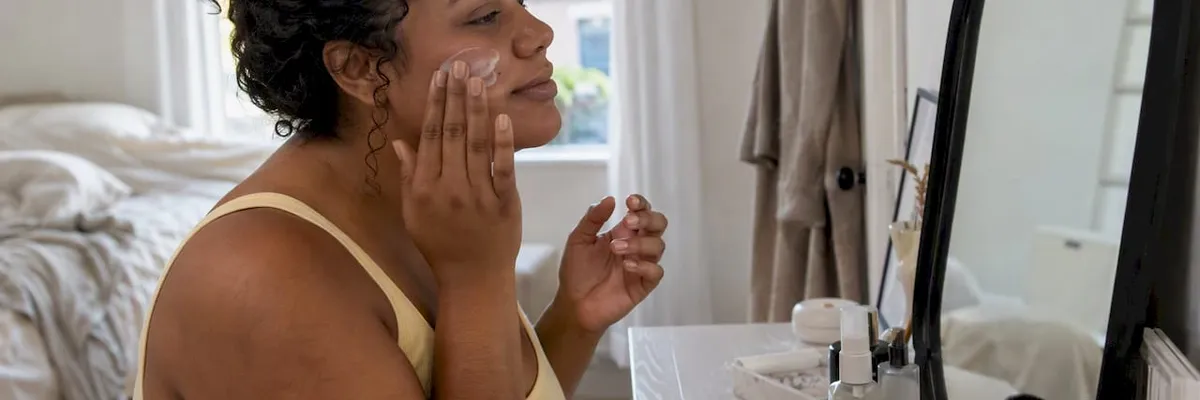
Impure skin doesn't need harsh treatment. It needs care that keeps pores clear, soothes inflammation, and protects the skin barrier. That's exactly what Korean skincare focuses on: thorough but gentle cleansing, a measured exfoliation with BHA, soothing plant extracts, and a light moisturizer. Here you'll learn how to create a routine that suits your skin, how to dissolve blackheads without squeezing, and when a dermatologist's office is the better address.
In Short
- The foundation is gentle cleansing twice a day and removing makeup in the evening. Every K-Beauty routine against blemishes builds on this.
- Salicylic acid (BHA) is fat-soluble and works directly in the pore. That's why it's the most important active ingredient for blackheads. Introduce it slowly, initially on two evenings per week.
- Soothing ingredients like Centella asiatica and a light moisturizer are essential. Dry skin often becomes more blemished, not clearer.
- Do not squeeze blackheads or scrub the skin. This irritates the skin and can leave scars.
- For painful, deep, or persistent pimples, a dermatologist is more helpful than any new product.
Table of Contents
- How Pimples and Blackheads Form
- What K-Beauty Does Differently for Impure Skin
- The Routine for Impure Skin, Step by Step
- Overview of Key Active Ingredients
- Gently Dissolve Blackheads Instead of Squeezing
- Introduce BHA Correctly
- Mistakes That Further Irritate Impure Skin
- Our View: Calmness is the Strongest Active Ingredient
- Assemble Your Routine at Rammilav
- When You Should Visit a Dermatologist
- Frequently Asked Questions
- Sources
How Pimples and Blackheads Form
To understand why certain products help, it's worth taking a quick look into the pore. Each pore is connected to a sebaceous gland. The sebum actually protects the skin, keeping it supple. However, if more sebum is produced than can flow out, and dead skin cells do not shed cleanly, the pore becomes clogged.
This is how a comedo, or blackhead, forms. If the pore remains open at the surface, the sebum plug oxidizes and appears dark: this is the blackhead. It's not dirt, even if it looks like it, and therefore cannot be scrubbed away. If the pore is closed, you see a small skin-colored or whitish bump, the closed blackhead.
If bacteria multiply in the clogged pore, the tissue can become inflamed. This results in red papules or pus-filled pimples. Hormones, stress, predisposition, and overly rich or pore-clogging products can exacerbate this cycle. Impure skin is therefore not a sign of poor hygiene but a combination of sebum production, keratinization, and inflammation. A good routine addresses all three points.
What K-Beauty Does Differently for Impure Skin
Many classic anti-pimple concepts work on the principle of "drying out and exfoliating": strong degreasing cleansers, alcohol-based toners, frequent exfoliations. In the short term, the skin feels clean. In the long term, it often reacts with tightness, redness, and even more sebum.
Korean skincare takes a calmer approach. It separates tasks into several light steps: one product cleanses, one clarifies the pores, one soothes, one moisturizes, one protects against UV radiation. Each step is mild on its own, together they form effective care. Typical are textures that are light and watery and hardly weigh on the skin, as well as soothing plant substances that accompany inflammation instead of stressing the skin further.
This doesn't mean you need ten steps. For impure skin, less is often more. We've described the basic logic in detail in our article on the Korean acne routine. Here we focus on what you can concretely do.
The Routine for Impure Skin, Step by Step
The NHS recommendations for acne state as a basis: wash with a mild cleanser twice daily, remove makeup at the end of the day, and use non-comedogenic skin and makeup products. We follow this. The K-Beauty routine complements this basis with targeted clarification and soothing.
Evenings
- First cleanse with oil or balm. If you wear makeup or sunscreen, a cleansing oil or balm best dissolves these fat-soluble residues. Oil on impure skin sounds contradictory, but it isn't: oil dissolves oil, including excess sebum. It's important that the product emulsifies with water and is rinsed off completely. A light example is the Skin1004 Madagascar Centella Cleansing Oil.
- Second cleanse with a mild foam or gel. This removes water-soluble residues and the remnants of the oil. We explain why this double cleansing is particularly useful for blemishes in our article on Double Cleansing.
- Toner. A balancing toner prepares the skin. On BHA evenings, this can be a clarifying toner with acids, on other evenings a purely soothing, moisturizing one.
- Serum. Choose a serum with one task: soothing (for example with Centella), balancing sebum, or brightening pimple marks. If you want to combine multiple serums, our guide to layering serums can help.
- Light moisturizer. A gel or light cream completes the routine. Even oily skin needs moisture.
Mornings
- Gentle cleansing with water and a mild gel or foam.
- Toner to soothe and hydrate.
- Light moisturizer.
- Sunscreen. It's not an optional step: pimple marks darken under UV radiation, and a light, non-greasy sunscreen makes daily application easier.
Additionally, once or twice a week
A soothing sheet mask after the toner can provide extra moisture on BHA-free evenings. Local pimple patches on individual open pimples protect the area and keep fingers away.
| Step | Task for Impure Skin | What to Look For |
|---|---|---|
| Cleansing Oil or Balm | Dissolve makeup, sunscreen, and sebum | Emulsifies with water, rinse thoroughly |
| Mild Cleanser | Remove residues | No tight feeling afterward |
| Toner | Balance, soothe, possibly clarify | BHA toner only on exfoliation evenings |
| Serum | Targeted effect | One main goal per serum |
| Moisturizer | Support barrier | Light texture, non-comedogenic |
| Sunscreen | Protect pimple marks | Light, daily, mornings |
Overview of Key Active Ingredients
You don't need to know every ingredient. These groups are most commonly found in Korean care for impure skin.
Salicylic Acid (BHA). The best-known beta-hydroxy acid. It is fat-soluble and can penetrate the sebum-filled pore to dissolve keratinized cells and sebum. This makes it the first choice for blackheads. The NHS also names salicylic acid as a topical option for acne.
AHA like glycolic or lactic acid. They are water-soluble and work on the skin's surface. They smooth the skin texture and help with pimple marks. Combination products with AHA and BHA, such as the Beauty of Joseon Green Plum Toner with AHA and BHA, combine both approaches in one mild step.
Centella asiatica. The classic of Korean care. Plant actives like madecassoside are used in care products to soothe stressed, reddened skin. For impure skin, Centella is the balance to acids.
Heartleaf (Houttuynia cordata). Another soothing plant extract found in many Korean toners for sensitive and impure skin.
Tea Tree Oil and Propolis. Both frequently appear in care for impure skin. However, tea tree oil can irritate sensitive skin, so it's worth testing on a small area.
Niacinamide. A vitamin B3 derivative used in many serums for oily skin and a more even skin tone. It is considered well-tolerated and can be combined with most other steps.
Benzoyl Peroxide. Also named by the NHS as a topical option for acne. It is more commonly found in pharmacy and medicinal products than in classic K-Beauty and can dry out the skin. Seek advice from a pharmacy.
Gently Dissolve Blackheads Instead of Squeezing
The temptation is great, especially in front of the bathroom mirror. Nevertheless, squeezing is the most common reason why a harmless blackhead turns into an inflamed pimple or a permanent scar. The NHS explicitly advises against squeezing pimples or scrubbing the skin, as this can cause scars and worsen acne. This also applies to needles, comedone extractors, and pore vacuums, which can injure the skin and push germs deeper into the pore.
Here's how to proceed instead:
- Regular double cleansing. A cleansing oil or balm dissolves the sebum on the surface of the pore. Balms with fine grains like the Dr. Althea Pore Refresh Grinding Cleansing Balm are suitable for the nose and chin area, as long as you massage gently and don't rub.
- Massage oil for one to two minutes. Especially on the nose, small sebum threads dissolve, which you then rinse off when emulsifying with water.
- BHA on exfoliation evenings. Salicylic acid continues to work in the pore even when you can't see it. Blackheads don't disappear overnight but become smaller and less frequent over time.
- Moisture afterward. Exfoliated skin needs light care to keep the barrier stable.
- Patience. Expect several weeks before you see a noticeable difference. A pore doesn't become permanently clear in a week.
Very stubborn, large, or deep-seated blackheads can be hygienically removed by a dermatologist or a trained beautician. This is safer than any attempt at home.
Introduce BHA Correctly
Salicylic acid is effective, and that's why a cautious start is worthwhile. We recommend this procedure:
- Week 1 to 2: two evenings per week, not consecutive. On the remaining evenings, just cleanse, soothe, and care.
- From week 3: If your skin remains calm, you can increase to three evenings. Sensitive skin often does better with one to two evenings.
- Don't stack: On BHA evenings, no additional exfoliation, no retinoid, and no grainy cleansing product.
- Pay attention to signals: Burning, persistent redness, flaking, or a shiny tight skin feeling mean you should pause and rebuild the barrier.
- Sunscreen in the morning: Acids make the skin more sensitive to light.
Find detailed application examples in our article on using BHA peels.
Mistakes That Further Irritate Impure Skin
Often the problem isn't missing products, but too many. These mistakes are the most common we see:
- Starting everything at once. If you change cleanser, toner, serum, and cream on the same day, you won't know which product is to blame in case of a reaction. Introduce new products at intervals of about one to two weeks.
- Too much exfoliation. Acid toners, peeling pads, and grainy cleansers together overwhelm the skin. One clarifying product per evening is enough.
- Drying out. A squeaky-clean skin feeling after cleansing is not a good sign. Stressed skin reacts with redness and sometimes even more sebum.
- Skipping moisturizer. Especially with oily skin, the cream is often skipped. A light gel cream like the Lebelage Super Aqua Moisture Cream keeps the skin balanced without weighing it down.
- Underestimating fragrances. The allergy center aha! Switzerland points out that fragrances and preservatives can cause skin irritation or allergies and recommends products without these substances for sensitive skin. Read more in our article on fragrance-free K-Beauty.
- Buying the large pack right away. The same center advises choosing new cosmetics in the smallest size or as a sample first, as intolerances can also occur with a delay.
- Forgetting hands and phone. Frequent touching of the face, a rarely changed pillowcase, or a phone display on the cheek bring sebum and germs onto the skin.
Our View: Calmness is the Strongest Active Ingredient
When we select products for impure skin, we always ask ourselves the same question: Does it help the skin regulate itself, or does it put it under pressure? In our range, you'll mainly find brands like Cosrx, Beauty of Joseon, and Purito, whose care for sensitive and impure skin focuses on gentle cleansing, measured acids, and soothing extracts.
Our experience from many conversations with customers: The greatest progress rarely comes from one miracle product. It happens when someone consistently applies three or four suitable steps over weeks and stops pressing on the skin. Teenagers with first pimples benefit from this just as much as adults whose skin suddenly becomes impure again.
We place great importance on every product coming directly from verified suppliers. This is especially important with acids and active ingredient products, as with a counterfeit, you don't know what's actually landing on your skin. And if you're unsure whether a routine suits you, better one product less and with patience.
— Aleksejs
Assemble Your Routine at Rammilav
In our catalog of Korean skincare, you'll find all the steps of this routine sorted by category: cleansing, toner, serum, moisturizer, masks, and sunscreen. All products are original from verified suppliers and in stock in Switzerland. Delivery usually takes 2 to 3 days, and shipping is free for orders over 80 CHF. This way, you can assemble a complete basic routine of cleanser, BHA toner, moisturizer, and sunscreen in one order.
When You Should Visit a Dermatologist
Cosmetics can accompany mild blemishes and blackheads well. With real, pronounced acne, it reaches its limits. See a dermatologist if:
- you have deep, painful nodules or cysts under the skin,
- pimples leave scars or dark spots,
- your skin doesn't improve despite a consistent routine over two to three months,
- blemishes suddenly increase significantly in adulthood,
- your skin is a significant burden in everyday life or emotionally.
The NHS also recommends seeking medical help if acne is moderate to severe or over-the-counter remedies don't work. Prescription treatments are available that no cosmetic product can replace. You can find a dermatologist near you through the doctor and pharmacy search from aha!. If you suspect an allergy to an ingredient, skin tests for suspected allergies can provide clarity. It's best to bring the packaging of your products to the appointment.
Frequently Asked Questions
Can I Use Cleansing Oil on Impure Skin?
Yes, as long as it emulsifies with water and is rinsed off thoroughly. Oil dissolves makeup, sunscreen, and excess sebum particularly well. Follow with a mild second cleanser to ensure no residues remain in the pores.
How Quickly Does BHA Work Against Blackheads?
You often see initial changes after a few weeks of regular use. Since clogged pores only gradually clear, consistency is more important than a high frequency of application. Over-exfoliating risks irritation instead of faster results.
Can I Combine BHA with Vitamin C or Retinol?
Initially, not on the same evening. Distribute strong active ingredients over different days or times and introduce them individually. For prescription acne medications, discuss the combination with your dermatologist.
Do I Really Need a Moisturizer for Oily Skin?
Yes. Oil and moisture are not the same: oily skin can still lack water. A light gel or fluid texture supports the barrier, especially when working with acids.
Are Pimple Patches Useful?
For individual, open pimples, yes. They protect the area from fingers and dirt and keep it moist. For deep, closed, or very painful pimples, they do not replace medical treatment.
Sources
- NHS: Acne
- aha! Allergy Centre Switzerland: Cosmetics
- aha! Allergy Centre Switzerland: Contact Allergic Hand Eczema
- aha! Swiss Allergy Centre: Doctor and Pharmacy Search


