
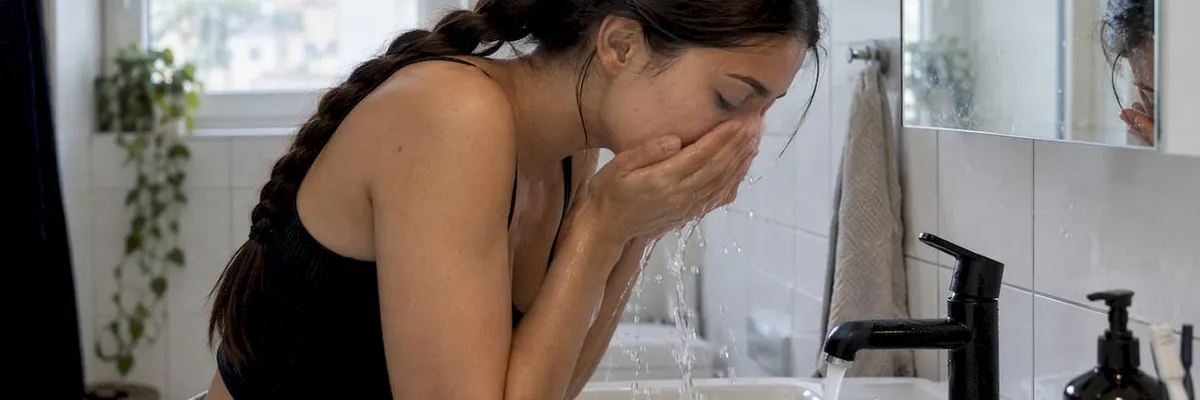
Hormonal acne often returns in the same rhythm: chin, jawline, and neck, just before your period or a few days after ovulation. Korean skincare is well-suited for this because it doesn't work with harshness but with three principles: gentle cleansing, targeted use of a soothing or clarifying active ingredient, and keeping the skin barrier stable with enough moisture. This way, you care for skin that is already under hormonal pressure without further irritating it. In this guide, we explain how to recognize hormonal acne, what happens in your skin during the cycle, what a simple K-Beauty routine looks like, and when a dermatologist is the right next step.
In Short
- Hormonal acne typically appears in a U-shape on the chin and jawline in women and often worsens during the cycle.
- The trigger is usually not an excess of hormones in the blood but sebaceous glands that are particularly sensitive to androgens.
- K-Beauty relies on soothing ingredients like Centella asiatica and Azelaic acid, as well as mild acids instead of aggressive drying.
- A good routine is short: gentle cleansing, one active ingredient, light moisturizing, and sunscreen during the day.
- If scarring occurs, severe inflammation, or no improvement after three months, the skin should be in dermatological hands.
Table of Contents
- How to Recognize Hormonal Acne
- Why Skin Becomes More Impure During the Cycle
- What K-Beauty Can Do for Hormonal Acne
- Ingredients Suitable for Hormonally Stressed Skin
- Your Routine Step by Step
- Introduce New Products Gently
- What Else Relieves Your Skin in Everyday Life
- When to See a Dermatologist
- The Right Products at Rammilav
- Our View on Hormonal Acne
- Frequently Asked Questions
- Sources
How to Recognize Hormonal Acne
Not every pimple is hormonal. However, there is a pattern that many affected individuals recognize. The blemishes repeatedly appear in the same spots, especially in the lower third of the face. According to BARMER, adult acne in women often appears on the jawline and chin, distributed in a U-shape, while in men, it tends to occur on the torso. The same source, supported by the German Dermatological Society, states that about one in four women between 25 and 45 years old has so-called adult acne. So, you are far from alone with this issue.
Typical features indicating a hormonal component:
- Location: Chin, jawline, neck, sometimes also lower cheeks.
- Rhythm: The skin worsens in a certain cycle phase and calms down afterward.
- Type of pimples: Often deeper, pressure-sensitive inflammations that heal slowly, instead of many small blackheads on the forehead.
- Age: Acne appears anew after puberty or returns in adulthood.
Important: Appearance alone is not a diagnosis. Whether hormones actually play the main role can only be clarified by a medical examination. For your daily care, however, it is enough to know the pattern, as it helps you to think of care and cycle together.
Why Skin Becomes More Impure During the Cycle
The basis of any acne is well-researched. The University Hospital Zurich describes that an overproduction of sebum, stimulated by male sex hormones, the androgens, is involved in its development. These also lead to increased formation of horn material in the skin, hyperkeratosis, which can clog the sebaceous gland duct. Sebum accumulates, bacteria find a good environment, and inflammation occurs.
In the female cycle, the hormone ratio shifts continuously. Around ovulation, estrogen levels are high. In the second half of the cycle, and especially just before the period, estrogen decreases, while the influence of androgens can become more noticeable. The role of rising progesterone is debated but not clearly understood. Dr. Leoni Matt explains in the Mobil Krankenkasse guide that it is likely not a single hormone that decides, but the interplay of hormone fluctuations and the skin's readiness for inflammation. Shortly before menstruation, the skin's immune response also changes.
This also explains why some women react strongly and others hardly at all. The S2k guideline of the German Dermatological Society states that most acne patients have normal hormone levels in the blood. However, sebaceous gland cells from acne regions respond more strongly to androgens than sebaceous glands in other body areas. Hormonal acne usually means: normal hormones, but skin that responds more sensitively to them.
For care, this is reassuring news. You cannot care away your cycle, but you can influence the factors that act in the skin itself: clogged pores, inflammation, and a weakened barrier.
What K-Beauty Can Do for Hormonal Acne
Anyone who has tried to fight pimples with strongly drying products in the past knows the result: the skin feels tight, reddens, and the next inflammation still comes. Korean skincare takes a different approach. According to Cosmopolitan, in Korea, acne is more often treated with soothing ingredients like Centella asiatica and Azelaic acid to reduce inflammation, while in the USA, highly concentrated active ingredients are more common. Since pure salicylic acid is only used in small amounts in Korean cosmetics, you will find milder variants like Betaine Salicylate and PHA more often there.
This approach fits hormonally stressed skin:
- The barrier is the focus. An intact skin barrier reacts more calmly to fluctuations. You can read more about this in our guide to the skin barrier in K-Beauty.
- Active ingredients are dosed, not stacked. One targeted step instead of five aggressive products.
- Moisture also belongs to oily skin. Light, water-based textures keep the skin balanced without burdening the pores.
K-Beauty is care that accompanies your skin in everyday life. It does not replace medical treatment if acne is severe, and it complements such treatment sensibly because medical active ingredients often make the skin drier and more sensitive.
Ingredients Suitable for Hormonally Stressed Skin
With hormonal acne, it is worth paying attention to two directions of action: keeping pores clear and calming inflammation. These active ingredients are particularly common in Korean skincare:
| Active Ingredient | What It Does in Care | Especially Suitable When … |
|---|---|---|
| Centella asiatica (Cica) | soothes, supports regeneration | the skin is red and sensitive |
| Azelaic acid | clarifies and reduces inflammation | red pimples and spots remain |
| Niacinamide | strengthens the barrier, reduces redness, balances sebum | the skin is oily and sensitive at the same time |
| Salicylic acid, Betaine Salicylate (BHA) | dissolves sebum in the pore, refines the skin texture | clogged pores and blackheads dominate |
| PHA | very mild acid for the surface | the skin reacts to classic acids |
| Hyaluronic acid, Panthenol | bind moisture, soothe | the skin feels tight or becomes dry from active ingredients |
Additionally, there is a principle that the University Hospital Zurich generally mentions for acne: cleanse with pH-neutral products without perfume and care with water-based creams. For you, this means: light textures, preferably unperfumed if your skin is sensitive.
What we consciously do not recommend are mechanical peels with coarse grains. The Cantonal Hospital Baden advises against them for acne and suggests an enzyme peel as a gentler alternative. Rubbing inflamed pimples only irritates them further.
Your Routine Step by Step
A good routine for hormonal acne is shorter than many think. The key is to follow it regularly, even in weeks when the skin is calm.
Morning
- Gentle cleansing: a mild cleansing foam or gel, for dry skin, lukewarm water may suffice.
- Toner or Essence: provides an initial layer of moisture and prepares the skin. We explain the difference in the guide Toner or Essence.
- Serum: for example, with Niacinamide or Centella, depending on whether your skin is more oily or more red.
- Light moisturizer: a gel-cream or emulsion that absorbs quickly.
- Sunscreen: every day, even in the Swiss winter. The USZ recommends protecting the skin from too much sun, heat, and cold, and red spots after pimples fade significantly slower without UV protection.
How you specifically build your morning routine is shown in our K-Beauty morning routine.
Evening
- First cleanse with oil or balm: removes sunscreen, makeup, and excess sebum. A balm like the Dr. Althea Pore Refresh Cleansing Balm or the Purito From Green Avocado Cleansing Balm is massaged onto dry skin and emulsified with water.
- Second water-based cleanse: removes residues and leaves a clean base. Why this works so well for impure skin is explained in the guide to Double Cleansing.
- One active ingredient: use a BHA or PHA product two to three evenings a week, and a soothing serum on the other evenings.
- Moisturizer: slightly richer than in the morning if the skin becomes drier from active ingredients.
Think with the Cycle
If you know that your skin becomes more restless in the second half of the cycle, you can slightly adjust your care during these days. Stick to the same routine, but use the clarifying active ingredient consistently and pay special attention to thorough evening cleansing. In the calm days after the period, the care can be more focused on soothing and regeneration. This way, you maintain a solid base while still responding to your rhythm.
Introduce New Products Gently
Especially when the skin flares up again, the temptation is great to change everything at once. The Cantonal Hospital Baden explicitly mentions frequent changes of care products as one of the points that can irritate acne-prone skin. A calm approach works better:
- One new product at a time. Give each product one to two weeks before adding the next. This way, you know exactly what benefits your skin.
- Start slowly with the active ingredient. Use acids first on one to two evenings a week and only increase if the skin remains calm.
- Do not use multiple acids on the same evening. One active ingredient per evening is enough, the rest is handled by the moisturizer.
- Patience with the skin cycle. The skin renews itself over several weeks. Plan for at least two to three monthly cycles before evaluating your routine, as with hormonal acne, the effect only shows in comparison over several cycles.
- Layer serums correctly. From thin to thick, from watery to creamy. Our guide to layering serums shows how to do this without overloading.
If a spot burns, itches, or becomes severely red, leave out the new active ingredient for a few days and care only with cleansing, moisture, and sunscreen. If the skin does not calm down, consult your pharmacy or dermatologist.
What Else Relieves Your Skin in Everyday Life
Care works best when everyday life follows suit. The University Hospital Zurich mentions several external factors you can influence: do not smoke, avoid excessive consumption of milk and dairy products, and carbohydrates with a high glycemic index. This does not mean a strict diet, but rather a conscious look at habits like the daily large milk coffee or a lot of white bread and sweets.
Even small hygiene habits make a difference. The Cantonal Hospital Baden recommends, among other things:
- Do not reuse washcloths multiple times.
- Change pillowcases twice a week.
- Do not squeeze pimples yourself, as this can deepen inflammation and promote scarring.
Additionally, stress and sleep are often experienced as amplifiers by many affected individuals. A calm evening ritual with cleansing and care can have a double effect: for the skin and for you. Some people also seek relaxation in wellness offers, such as salt therapy in a salt chamber, and combine such breaks with their usual skincare at home.
If blemishes also affect the back or décolleté, you will find suitable tips in our guide to acne on the back.
When to See a Dermatologist
Care and medical treatment are not mutually exclusive; they complement each other. There are clear situations where you should not wait. The updated Swiss practice recommendations for acne therapy from 2025 list the following as reasons for referral to dermatology:
- Acne prone to scarring
- Severe forms like acne conglobata or acne fulminans
- Insufficient response to treatment after three months
- Frequent relapses
Even if acne suddenly occurs or worsens rapidly, an appointment is worthwhile. The S2k guideline recommends hormone tests, among other things, for acute onset or acute worsening of acne in women, for adult acne, and for adult women whose acne persists despite classical therapy. The Revue Médicale Suisse points out that acne in adult women is often associated with an excess of androgens, which can be linked to polycystic ovary syndrome (PCOS). However, acne alone is not a reliable indication of this. Therefore, pay attention to other signs such as a very irregular cycle, increased hair growth on the chin or abdomen, or hair loss, and then talk to your gynecologist or general practitioner.
Medical treatment is primarily based on topical retinoids, according to Swiss recommendations, combined with benzoyl peroxide in more severe cases. Systemic antibiotics are added for moderate to severe acne. According to an overview by the Revue Médicale Suisse on acne and rosacea therapy, oral isotretinoin is reserved for severe or resistant forms, and in women, hormone therapy, such as with antiandrogenic contraceptives or spironolactone, can be used. These agents belong in medical hands and should not be combined independently.
If you use medically prescribed active ingredients, discuss your care routine with your dermatologist. Usually, gentle cleansing, moisturizing, and sunscreen remain the basis, while additional acids or other active ingredients are paused to avoid over-irritating the skin.
The Right Products at Rammilav
In our shop, you will find everything you need for a calm routine for hormonally induced blemishes: cleansing, toner, serums, moisturizers, masks, and sunscreen from brands like Cosrx, Beauty of Joseon, and Purito. We source each product directly from verified suppliers to ensure you receive genuine products. Within Switzerland, we usually deliver in 2 to 3 days, and shipping is free for orders over 80 CHF. Put together your routine directly from our K-Beauty range.
Our View on Hormonal Acne
We often find that people with hormonal acne have worked against their skin for years: with products that dry out, burn, and ultimately leave more redness than before. That's exactly why we believe in Korean skincare.
Hormonal skin doesn't need harshness; it needs reliability. A gentle double cleanse, a well-chosen active ingredient, light moisture, and daily sunscreen: This is not a complicated ten-step routine, but a system that strengthens your skin day by day. We have built our range so that you can find suitable products for each of these steps, whether your skin is more oily, sensitive, or both.
It's also important to us to be honest: If your acne leaves scars or doesn't calm down despite good care, a dermatologist is the right contact. Good care accompanies you even then, because especially under medical treatment, the skin needs moisture and protection.
What we wish for you is a more relaxed look in the mirror, even in the week before your period.
Aleksejs
Frequently Asked Questions
Why Do I Have Impure Skin After Ovulation?
After ovulation, estrogen levels decrease during the second half of the cycle, and the influence of androgens can become more noticeable. The sebaceous glands then produce more sebum, and the pores clog more easily. Additionally, the skin's readiness for inflammation changes shortly before the period, which is why pimples often become more severe during this time.
What Does Hormonal Acne Look Like?
Typical are inflamed, often deeper pimples on the chin, jawline, and neck, usually distributed in a U-shape in the lower face in women. They repeatedly appear in the same spots and often follow the cycle. Only a medical examination can provide a reliable classification.
Can I Use K-Beauty Alongside Medical Acne Therapy?
Yes, gentle cleansing, moisturizing, and sunscreen are particularly important under treatment with retinoids or benzoyl peroxide, as these often make the skin drier. However, you should only use additional acids or strong active ingredients after consulting your dermatologist.
How Long Does It Take for a New Routine to Work?
Expect at least two to three monthly cycles before evaluating the result. The skin renews itself over several weeks, and with hormonal acne, the change only shows in comparison over several cycles. Stick to the same products during this time instead of constantly switching.
Which Korean Brands Are Suitable for Impure Skin?
For impure and sensitive skin, brands that focus on mild formulations are popular, such as Cosrx, Beauty of Joseon, and Purito, all of which you can find with us. More important than the brand name is that the products suit your skin type and that you use only one clarifying active ingredient per evening. Our guide to the Korean acne routine provides more ideas.
Sources
BARMER: Recognizing and Treating Hormonal Acne University Hospital Zurich: Acne Mobil Krankenkasse: Hormones and Skin German Dermatological Society: S2k Guideline Acne Cosmopolitan: Korean Skincare Trends 2025 Cantonal Hospital Baden: Acne, Finally End with Pimples and Pustules Swiss Practice Recommendations for Acne Therapy 2025 Revue Médicale Suisse: Acne in Adult Women and Hormone Testing Revue Médicale Suisse: Acne and Rosacea, the Best Treatments


