
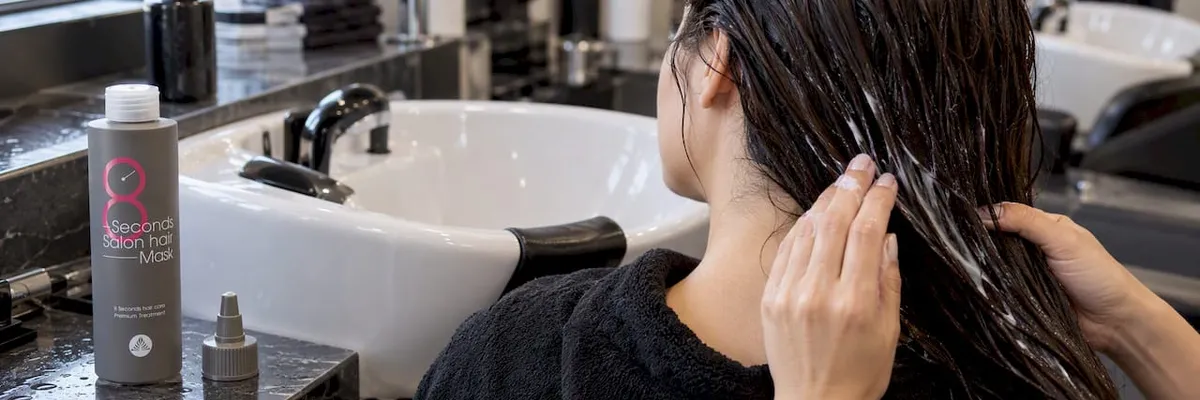
This is how you apply a Korean hair mask: Shampoo your hair, towel dry thoroughly, work a small amount into the lengths and ends only, let it sit briefly, and rinse thoroughly. For most hair types, one to two applications per week are sufficient. Quick-acting masks from Korea, like the well-known '8-Second Masks', are designed to work quickly. With them, technique is more important than time. Below, we show you step by step how to use your mask, how often it makes sense for your hair type, and how to tell if your hair needs more or less.
TL;DR
- The mask goes into towel-dried hair after shampooing, not dripping wet hair.
- Apply it to lengths and ends. Skip the roots unless the product is specifically for the scalp.
- Once or twice a week is enough for most. Severely damaged hair can handle more temporarily, fine hair often less.
- Stick to the application time on the package. Longer doesn't mean better, especially for protein masks.
- The water glass test helps you find out what your hair needs: more moisture or more structure.
Table of Contents
- What Makes a Korean Hair Mask Different
- Before You Start: Understanding Your Hair
- Step by Step: How to Apply the Mask
- How Often Should You Use a Hair Mask?
- Application Time: Why Longer Isn't Better
- Can a Hair Mask Work Overnight?
- When the Scalp is Sensitive
- Common Mistakes and How to Avoid Them
- Our View: Less Pressure, More Regularity
- Korean Hair Masks at Rammilav
- Frequently Asked Questions About Hair Masks
- Sources
What Makes a Korean Hair Mask Different
In Korean care, hair is treated similarly to facial skin. You first look at what it currently needs and then choose the right product in the right dose. That's why many K-Beauty hair masks are not intended as rare, heavy intensive treatments. They are a regular, light care step that fits into the normal hair washing routine.
The most well-known are the quick-acting masks. They are highly concentrated so that they show noticeable effects in a very short time: The hair feels smoother, is easier to comb, and shines more. For those who don't want to wait ten minutes in the shower in the morning, this is a real advantage.
In addition, there are richer repair masks for colored, bleached, or heat-damaged hair. For a sensitive scalp, there are special soothing scalp masks. It's important to distinguish between the three types. Each is applied a little differently:
- Quick-acting mask (Rinse-off): after shampoo, a few seconds to a few minutes, then rinse.
- Repair mask (Rinse-off): after shampoo, usually a few minutes of application time, for heavily stressed lengths.
- Leave-in repair mask: is not rinsed out. Here, the waiting time on the package is particularly precise, after which you can style directly.
- Scalp mask: often applied to the dry scalp before shampooing, then rinsed and washed.
If you want to build your entire routine from scalp to ends, you'll find the individual steps in the correct order in our guide to the Korean hair care routine.
Before You Start: Understanding Your Hair
The most common reason a hair mask "doesn't work" is not the product. Most of the time, it simply doesn't match the hair. Fine hair with a closed cuticle layer feels heavy and stringy after a rich mask. Highly porous, bleached hair, on the other hand, absorbs almost everything and demands more. Therefore, a quick look at two points is worthwhile.
The Water Glass Test for Porosity
Take a clean, fallen hair without styling residues and place it in a glass of water. Check after a few minutes:
- The hair floats on top: rather low porosity. The cuticle layer is closed, care penetrates slowly. Light masks and small amounts are ideal.
- The hair floats in the middle: medium porosity. Your hair is usually uncomplicated, a standard application fits.
- The hair sinks quickly: high porosity, typical after coloring, bleaching, or a lot of heat. The hair absorbs moisture quickly but also loses it quickly. Repairing masks and regular application help here.
The test is a rough guide and not a lab test. But as a starting point, it is much better than guessing.
Moisture or Structure?
The second question: What does your hair currently lack? If it feels dry, rough, and frizzy, it mainly needs moisture. If it is rather limp, stretches a lot when combing wet, and tears easily, it lacks structure. Then protein-rich or repairing masks are the better choice. Many hairs need both in alternation. A routine with two masks is practical for this.
Step by Step: How to Apply the Mask
This guide applies to classic rinse-off masks and Korean quick-acting masks. The difference is seen in step 5.
- Thoroughly shampoo. The mask works best on clean hair without silicone or styling residues. Massage the shampoo mainly into the scalp. For the lengths, the foam that runs through when rinsing is sufficient.
- Squeeze out water. Gently squeeze the lengths with your hands or a towel, without rubbing. In dripping wet hair, the mask is diluted and runs off. In towel-dried hair, it adheres better.
- Take the right amount. For medium-length hair, a coin-sized amount is sufficient, about the size of a two-franc coin. For long or very thick hair, take a little more, for fine short hair a little less. Better to add more than overdo it.
- Distribute in lengths and ends. Start about at ear height and work the mask downwards. The ends are the oldest and usually driest part, they get the most. Skip the roots: The scalp provides its own sebum, and additional care makes it quickly heavy and greasy.
- Let it work. For a quick-acting mask, a few seconds to one or two minutes are enough, depending on the package instructions. For a classic mask, Beauty.at typically mentions 5 to 15 minutes. Use the time to wash your face or shave.
- Comb through with a wide-tooth comb. This distributes the mask evenly into every strand and untangles knots while the hair is particularly slippery from the care.
- Rinse thoroughly. Rinse with lukewarm water until the hair feels smooth but no longer slippery. Residues make the hair dull and weigh it down. A cooler final water jet is pleasant and good for shine.
- Dry gently. Squeeze hair in a towel or wrap in a microfiber towel, then use heat protection and blow-dry on medium setting. Well-cared-for hair often dries faster and is easier to style.
You can use a conditioner after the mask, but it's usually not necessary. The mask takes over its task, just more intensively. With leave-in repair masks, it's often the other way around: Some manufacturers recommend not using a conditioner beforehand so that the active ingredients reach the hair directly. In this case, read the package insert carefully.
How Often Should You Use a Hair Mask?
As a rule of thumb, as Beauty.at also recommends: once or twice a week after shampooing. How often it should be for you depends on your hair, your washing frequency, and the type of mask. This overview helps you get started:
| Hair Type and Condition | Recommended Mask | Frequency | Tip |
|---|---|---|---|
| Fine, quickly greasy | Light quick-acting mask | Once a week | Only in the ends, very small amount |
| Normal, medium porosity | Quick-acting or classic mask | 1 to 2 times a week | Good as a fixed washing day step |
| Dry, thick or curly | Rich moisture mask | Twice a week | Generously supply lengths |
| Colored, bleached, heat-damaged | Repair mask alternating with moisture | 2 to 3 times a week, then reduce | Watch out for protein overload |
| Sensitive scalp | Mild mask for lengths, separate scalp care | 1 to 2 times a week | Choose fragrance-free, gentle formulas |
If you wash your hair every day, you don't have to use a mask with every wash. A light quick-acting mask can also be used more often with frequent washing because it weighs little. If you only wash twice a week, the mask can be included each time.
It's best to rely on your hair rather than a rigid plan. If it becomes limp, stringy, or feels "over-cared for" after a few weeks, reduce. If it still feels strawy despite the mask, switch to a richer formula or slightly increase the frequency. You might know this principle from facial care, where we explain it similarly in the question of the right frequency of sheet masks.
Application Time: Why Longer Isn't Better
Many leave their mask on for half an hour "just to be safe". This is well-intentioned but rarely brings more. A pharmacist explains in the German Fräuleins magazine that the belief "the longer, the better" is a misconception from a galenic perspective. A mask is formulated for a specific application time. After that, the hair hardly absorbs any additional care.
With protein-rich masks, too much of a good thing can even be harmful. If proteins accumulate over a long time or in too many layers on the hair, it can feel stiff, brittle, and break easily. This is called protein overload. Typical signs: The hair crackles when running through, breaks more easily, and feels dry despite care. Then a break from the repair mask and a pure moisture mask for a while helps.
Korean quick-acting masks address this issue. They are designed to take effect in a short time. This saves you time and reduces the risk of over-caring for your hair. If you want more intensity, slightly extend the time, for example, to one or two minutes. However, it's not worth turning them into a quarter-hour treatment.
Can a Hair Mask Work Overnight?
For normal rinse-off masks, we advise against it. Over many hours, the hair can swell and then feel soft and limp instead of smooth. With sensitive scalp, there's the added issue that care substances have long contact and the pillow transfers the mask to the forehead and face. With impure skin, this is unnecessary.
There are exceptions: Some oils and products are explicitly intended as overnight treatments, and very dry, heavily stressed hair can benefit from them. If "overnight" is not on the packaging, stick to the specified time. Korean care generally relies more on regular, light care than on rare intensive treatments.
When the Scalp is Sensitive
If your scalp itches, tightens, or reddens easily, that's a reason to keep the mask even more consistently away from the roots. For the lengths, choose a mild, preferably fragrance-free formula. The scalp itself is cared for separately. Soothing scalp masks are usually applied to the dry scalp before shampooing, left on for a while, and then washed out. What helps and which active ingredients are suitable, we describe in detail in our guide to soothing the scalp with K-Beauty.
If itching, dandruff, or redness persists despite gentle care for several weeks, or if oozing spots, severe hair loss, or circular bald spots occur, this is not a case for a new mask. Then it's best to go to your family doctor or directly to a dermatological practice to clarify the cause.
Common Mistakes and How to Avoid Them
- Mask on dripping wet hair: The water dilutes the product. Squeeze out first, then apply.
- Mask on the roots: This leads to quickly greasy, flat hair. Only lengths and ends, except for scalp products.
- Too large amount: More product doesn't mean more care, just more to rinse out. Start with little.
- Rinsed too briefly: Residues make the hair dull. Rinse until it feels smooth but no longer slippery.
- Always the same repair mask: With protein masks, overload threatens. Alternate with a moisture mask.
- Mask instead of diagnosis: If the hair doesn't get better after weeks, the product might not match your porosity. Do the water glass test and choose anew.
- Heat directly after without protection: Even well-cared-for hair needs heat protection before blow-drying or straightening.
Hard tap water can make hair appear rough and dull. If you observe this, a regular mask is particularly helpful. Thorough but gentle rinsing is even more important then.
Our View: Less Pressure, More Regularity
When customers ask us which hair mask is "the best", we usually ask a counter-question: How does your hair feel right now, and how often do you wash it? From our experience with Korean care, the right fit determines the result, not the highest price or the longest application time.
We like that K-Beauty hair masks fit into everyday life. A quick-acting mask that you use reliably twice a week brings more than a complex treatment that waits for you in the bathroom cabinet once a month. For heavily stressed hair, we often recommend a second, repairing mask in alternation. This way, the hair gets moisture and structure without being overloaded.
We source our products directly from verified suppliers because, especially with popular Korean brands, original goods make the difference. You should be able to rely on the formula in the tube being the one the manufacturer developed. And then: Listen to your hair. It reliably shows you whether you should do more or less.
— Aleksejs
Korean Hair Masks at Rammilav
If you want to try the quick-acting method yourself, the Masil 8 Seconds Salon Hair Mask is a good start. For more sensitive needs, there is the Super-Mild Variant. For stressed, colored lengths, the Masil 10 Premium Repair Hair Mask is suitable as a repairing partner in alternation. We deliver throughout Switzerland, usually within 2 to 3 days, and shipping is free for orders over CHF 80. You can find more care for hair and scalp in our catalog.
Frequently Asked Questions About Hair Masks
Does the Hair Mask Come Before or After Shampoo?
Classic hair masks and Korean quick-acting masks are applied to towel-dried hair after shampooing. Only special scalp masks are often applied to the dry scalp before washing. If in doubt, the package shows you which type your product belongs to.
Do I Need a Conditioner After the Hair Mask?
Usually not. A rinse-off mask takes over the task of the conditioner, just more intensively. If you have very long or curly hair, a light leave-in conditioner can make combing easier afterward.
Can I Use a Hair Mask Every Day?
A light quick-acting mask can handle frequent washing if you use it sparingly and only care for the lengths. Rich or protein-rich masks should not be used daily, otherwise, the hair quickly becomes heavy or brittle. If your hair becomes limp or stringy, reduce to once or twice a week.
When Will I See a Difference?
Smoothness, shine, and better combability are usually noticeable right after the first application. For heavily stressed hair, it takes several weeks of regular care until the hair feels more resilient overall. Already split ends cannot be permanently repaired, they need to be cut.
Sources
- Beauty.at: How to Properly Use Hair Masks?
- German Fräuleins: Maximizing Hair Mask Effectiveness, a Pharmacist Explains


