
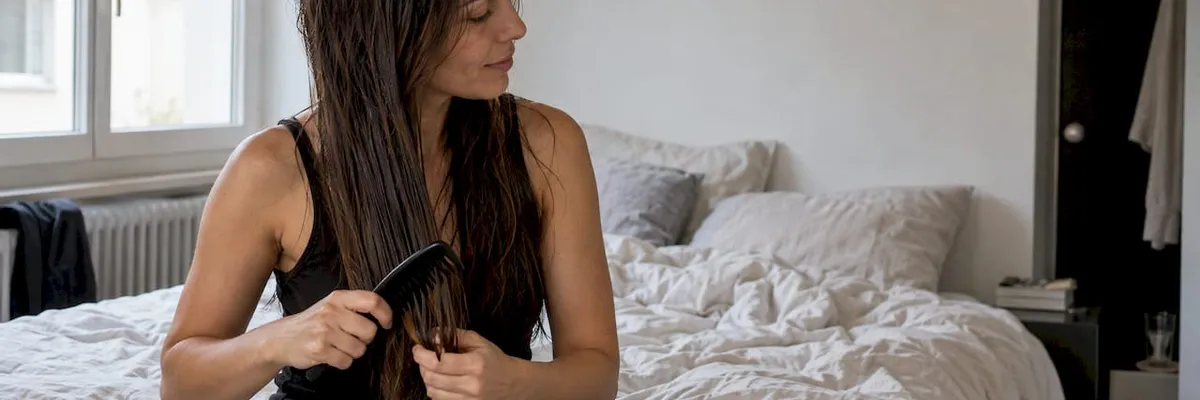
If your hair breaks at the lengths, a layered care routine that protects the hair with every wash can help. A single miracle treatment, on the other hand, does little. This is exactly how Korean hair care is designed: First comes a healthy scalp, then a gentle cleansing, followed by conditioner, mask, and a light leave-in that smooths the hair fiber and protects against friction and heat. A hair that has already broken does not grow back together. However, those who consistently care for their hair can significantly slow down breakage, and the new length remains intact. In this guide, we show you how to recognize hair breakage, what your hair needs now, and how to build a K-Beauty routine step by step.
In Short
- Hair breakage affects the hair shaft, while hair loss affects the root. If you suddenly lose a lot more hair with roots or develop bald spots, it should be addressed by a doctor.
- The hair shaft is keratinized tissue and cannot repair damage itself. Care smooths the surface, reduces friction, and prevents new breakage.
- Protein-rich care strengthens damaged hair with each application. Therefore, a regular routine is more important than a one-time intensive treatment.
- The Korean routine combines scalp care, mild shampoo, conditioner, mask, and leave-in serum into a gentle package.
- Heat, bleaching, alkaline shampoos, and friction on wet hair are the most common triggers. This is where the routine comes in.
Table of Contents
- Hair Breakage or Hair Loss: The Difference
- Why Hair Breaks
- What Broken Hair Needs Now
- The K-Beauty Routine Against Hair Breakage in Six Steps
- Your Weekly Plan at a Glance
- Small Habits That Make a Big Difference
- Korean Hair Care at Rammilav
- Our View: Hair Breakage Needs Consistency
- Frequently Asked Questions About Hair Breakage and K-Beauty
- Sources
Hair Breakage or Hair Loss: The Difference
Many are alarmed when their hairbrush is full of hair and immediately think of hair loss. Often, however, hair breakage is the cause. The difference can be seen by looking at the hair.
- Hair Breakage: The hair breaks off somewhere along the length. The pieces are of different lengths, and you don't see a root at the end. Often, short, sticking-out hairs appear on the top of the head or sides, and the ends look frayed.
- Hair Loss: The hair comes out of the scalp with the root. At the end of the fallen hair, you can see a small light knot. Experts speak of pathological hair loss when more than 100 hairs fall out daily.
Split ends also belong to the breakage family. In this case, the hair tip splits lengthwise, and if not cut, the split can travel further up.
When to Seek Medical Advice
Hair breakage is a care issue, while hair loss can sometimes be a medical one. An examination is advisable if hair loss occurs suddenly or without an apparent reason, round bald spots become visible, the loss increases rapidly, or the scalp is inflamed or painful. In Switzerland, the general practitioner's office is usually the first point of contact. From there, you may be referred to a dermatologist or endocrinologist if necessary. The same applies if your hair becomes noticeably thinner after an illness, new medication, or pregnancy. Care supports the hair during this time but does not replace finding the cause.
Why Hair Breaks
Every hair is enveloped by a cuticle layer. In a healthy state, it lies flat like roof tiles and protects the fiber core. When the cuticles are lifted or roughened, the hairs rub against each other, lose moisture, and break more easily. You probably know the most common triggers from everyday life.
Chemical Treatments
Bleaching, coloring, and perms deeply affect the hair structure. The hair remains stable mainly due to so-called disulfide bonds. These are chemical connections between the keratin chains that give the fiber its strength. A typical bleaching splits up to a quarter of these bonds. Therefore, freshly lightened lengths often break even when combed.
A Too Alkaline Shampoo
The pH value indicates how acidic or basic a product is. Hair and scalp feel most comfortable in a slightly acidic range. In a study of 123 shampoos, about 62 percent had a pH value above 5.5. The more alkaline the shampoo was, the more the hairs could rub against each other. Therefore, choosing a shampoo is much more than a question of fragrance.
Heat and Mechanics
Flat irons, curling irons, and a too-hot blow dryer extract moisture from the hair. There are also stresses that are easily overlooked: wet hair that is brushed roughly, tight braids and ponytails, friction on wool scarves or pillowcases. Even the dry heating air in the Swiss winter makes the lengths more brittle.
What Broken Hair Needs Now
You might wonder if damaged hair can recover. The honest answer is encouraging, even if it doesn't promise miracles. A Zurich hairdresser told 20 Minuten that damaged hair can be repaired to a certain extent with the right products. Only completely dried-out ends need to be cut off.
Science explains why this is so. Conditioners with hydrolyzed proteins, i.e., proteins broken down into very small building blocks, bind to the keratin and replace lost proteins. This strengthens damaged hair. This effect lasts until the next hair wash and is then renewed. For you, this means: Good care works best when it is a fixed part of every wash.
Your hair needs three things when breaking, and in balance:
- Protein for Strength: Hydrolyzed keratin, silk or wheat proteins, and amino acids fill in rough spots in the fiber.
- Moisture for Elasticity: Humectants like glycerin, panthenol, or hyaluronic acid keep the hair supple so it bends and doesn't break easily.
- Lipids for Protection: Plant oils and butters coat the surface, smooth the cuticle, and reduce friction. Treatments with rapeseed or coconut oil return the missing lipids to dry, brittle hair.
And to prevent the hair from getting to this point, experts recommend regular haircuts, gentle handling of wet hair, heat protection, and moisture care. These building blocks are precisely what the Korean routine includes.
The K-Beauty Routine Against Hair Breakage in Six Steps
In Korean care, the scalp is considered an extension of the facial skin, and the lengths are also cared for in several light layers. A typical routine consists of five steps: weekly scalp peeling, shampoo, weekly scalp treatment, conditioner, and leave-in serum. For brittle hair, we add a sixth step, heat protection. You can find a more detailed explanation of the basic structure in our guide to the Korean hair care routine.
1. Prepare the Scalp, Once a Week
A healthy scalp is the foundation from which strong hair grows. A mild scalp peeling or a scalp scaler removes residues from styling products, sebum, and flakes. Massage it in with your fingertips, not your nails. For sensitive or itchy scalps, choose soothing formulas. Read more about this in our article on soothing the scalp with K-Beauty.
2. Wash Gently, Two to Three Times a Week
Korean shampoos for stressed hair are often gently formulated and focused on the scalp. Look for mild surfactants and a slightly acidic pH value, as seen above, an alkaline shampoo roughens the surface. Shampoo belongs on the scalp. The lengths are cleaned by the foam when rinsing out, without rubbing them together. Wash with lukewarm water instead of hot.
3. Conditioner with Every Wash
You should never skip this step with hair breakage. A conditioner closes the cuticle and balances the pH value again. Apply it from about ear height to the ends and leave it on for two to three minutes. Then you can detangle the lengths with a wide-toothed comb from bottom to top while the conditioner is still in the hair. This way, you pull out the fewest hairs.
4. Hair Mask or Treatment as Intensive Care
Korean treatments often rely on proteins, amino acids, and plant oils in a creamy texture. At least twice a month, a mask with at least ten minutes of exposure time should be part of your program, and for heavily bleached hair, once a week. A warm towel around the head helps the care to be absorbed evenly. How to dose and rinse masks correctly is shown in our guide to the application of hair masks.
5. Leave-in, Serum or Hair Oil in the Lengths
In towel-dried hair, distribute a light leave-in, an essence, or a few drops of hair serum in the lengths and ends. Here, K-Beauty shows one of its strengths: Many products are light and do not weigh down fine hair. They still envelop the fiber with a smoothing film. If your hair tends to frizz in addition to breakage, you will find suitable tips in our article on reducing frizz with K-Beauty.
6. Heat Protection and Gentle Blow-Drying
It's best to avoid heat styling as much as possible. If you do need it, always work with a heat protectant in your hair. Blow-drying is by no means your enemy: In the lab, blow-drying from a 15 cm distance and with a constantly moving device damaged the hair less than air drying, probably because wet hair remains swollen for a long time otherwise. So choose a medium temperature, keep your distance, and don't stay in one place.
Your Weekly Plan at a Glance
To make the routine work in everyday life, a fixed rhythm helps. Here's what a week for shoulder-length, brittle hair might look like:
| Step | How Often | What to Watch For |
|---|---|---|
| Scalp Peeling or Scalp Scaler | Once a week | gently massage with fingertips |
| Mild Shampoo | 2 to 3 times a week | only on the scalp, rinse lukewarm |
| Conditioner | with every wash | from ear height, leave on for 2 to 3 minutes |
| Hair Mask or Treatment | 2 to 4 times a month | at least 10 minutes exposure time |
| Leave-in or Hair Serum | after every wash | only lengths and ends, use sparingly |
| Heat Protection | before every blow-dry or style | keep the blow dryer moving, about 15 cm distance |
| Trim Ends | about every two to three months | consistently remove split ends |
If after a few weeks you notice that your hair feels stiff and straw-like, it may have been too much protein. Then skip the protein-rich mask once and instead use a moisture-focused care. If the hair feels limp and stretches noticeably when wet, it can use more protein again.
Small Habits That Make a Big Difference
The best care is of little use if the hair is constantly exposed to new stresses in everyday life. These habits additionally protect your lengths:
- Handle Wet Hair Gently: Wet hair is most sensitive. Pat it dry with a soft cotton or microfiber towel instead of rubbing it.
- Bind Loosely: Soft spiral hair ties or scrunchies put less strain on the hair than thin ties with metal parts. Vary the position of your ponytail.
- Protect at Night: A loose braid or a smooth pillowcase made of silk or satin reduces friction while sleeping.
- Consider Winter: Under hats and wool scarves, the ends constantly rub. A few drops of hair oil in the ends and pinned-up hair help in the cold season.
- Plan Chemical Treatments: Allow enough time between bleachings and care particularly consistently with masks and leave-in during these weeks.
With a little patience, it's worth it. Hair grows slowly, and what comes out of the scalp today will be your new length in a year. Those who protect this length from the start will see the difference month by month.
Korean Hair Care at Rammilav
In our online shop, you will find Korean shampoos and other care products in the hair care category, with which you can build the routine step by step. We source each product directly from verified suppliers to ensure you receive an original product. Within Switzerland, your order usually arrives in 2 to 3 days, and shipping is free for orders over CHF 80. Shampoo, mask, and leave-in can be conveniently combined in one order.
Our View: Hair Breakage Needs Consistency
We often see people with brittle hair looking for the one product that will make everything right again. We understand this desire well. However, Korean care has taught us that healthy hair results from many small, gentle steps that work together.
This is precisely where we see the strength of K-Beauty in hair breakage. Scalp, cleansing, conditioner, mask, and leave-in are coordinated and usually light in texture. This way, you can layer the care without weighing down your hair. Since care works anew with every wash, it is crucial that you stick with it, and for that, the routine must be enjoyable.
It is important to us that you can rely on what you put on your hair. Therefore, we source all products directly from verified suppliers and deliver them quickly within Switzerland. This way, you have your next treatment at home in time before the old one runs out, and your routine doesn't stall.
Our advice: Start with conditioner and leave-in, as these two steps provide the most protection. Then add mask and scalp care. Your hair will thank you a little more each week.
Aleksejs
Frequently Asked Questions About Hair Breakage and K-Beauty
Can You Stop Hair Breakage?
You can significantly slow down new breakage. However, already broken hairs do not grow back together. Key are a conditioner with every wash, regular masks, heat protection, and gentle handling of wet hair. Split ends should be cut regularly to prevent the split from traveling further up.
How Long Does It Take to See a Change?
You often feel smoothness and shine after the first washes with conditioner and leave-in because the care immediately smooths the surface. You usually notice less hair breakage after a few weeks on the brush. Stronger new lengths take months, as hair grows slowly.
Is Korean Hair Care Suitable for Sensitive Scalps?
Yes, many Korean formulas are particularly mild and tailored to the scalp. For sensitive scalps, choose a gentle shampoo and soothing scalp care and massage only with your fingertips. If the scalp itches or reddens persistently, have it checked by a doctor.
Do Bleached Hair Need Different Care?
Bleached hair needs the same steps, just more intensively. Because bleaching splits some of the stabilizing bonds in the hair, lightened lengths benefit from protein-rich treatments, a weekly mask, and a leave-in after every wash. Avoid heat styling as much as possible in the first weeks after coloring.
Sources
German Hair Research: Strengthen and Gently Care for Hair McGill University, Office for Science and Society: Can You Repair Split Ends? 20 Minuten: Damaged Hair, Can It Be Repaired? WMN: Repairing Damaged Hair, Is That Even Possible? Vogue Germany: Glass Hair, Korean Hair Care netDoktor.ch: Hair Loss, Prevention and Diagnosis OnlineDoctor: Hair Loss, Symptoms, Causes, and Treatment


