
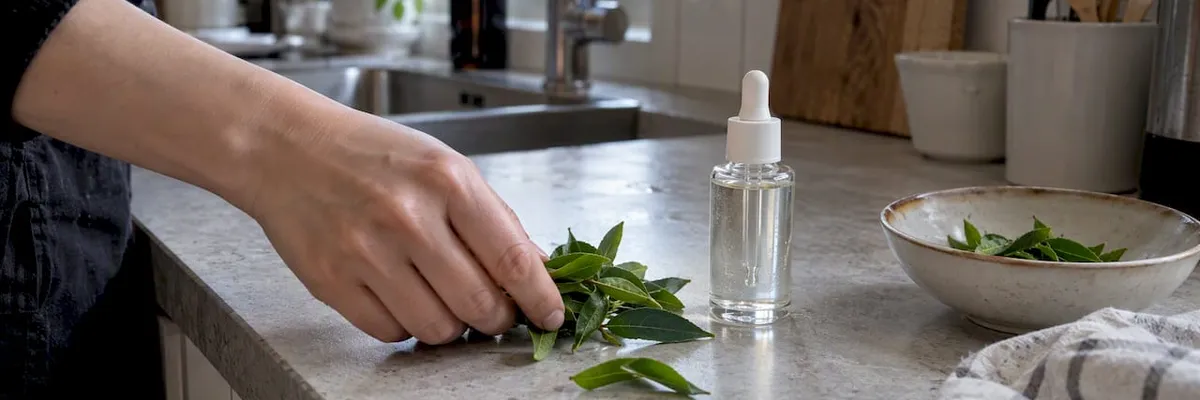
Green tea is one of the most well-known plant-based active ingredients in Korean skincare, and for good reason: Its catechins, especially EGCG, have antioxidant properties and can influence inflammatory processes in the skin. The benefits are best documented for blemished, redness-prone skin, particularly when you apply green tea as a formulated product, not when you drink it. In this guide, we show you what the studies actually say, where the limits are, and how to effectively incorporate a green tea serum into your routine.
In Short
- Green tea catechins, especially EGCG, have antioxidant and anti-inflammatory properties, making them a good complementary ingredient for sensitive and blemished skin.
- For acne, applied green tea shows a significantly stronger effect in studies than when consumed as a drink.
- Expect several weeks before seeing a change: In one study, a clear difference was measurable after six weeks.
- Green tea does not replace sunscreen. A daily sunscreen remains the most important step against photoaging.
- A skin serum and green tea capsules are two different things: High-dose capsules are controversial due to potential liver damage.
Table of Contents
- What's in Green Tea: Catechins and EGCG
- What Research Shows and What It Doesn't
- Drink Green Tea, Apply Tea, or Use Serum?
- How to Incorporate Green Tea into Your Routine
- Who Green Tea is Suitable For
- What to Look for When Buying Green Tea Cosmetics
- Our View on Green Tea
- Frequently Asked Questions
- Sources
What's in Green Tea: Catechins and EGCG
Green tea is derived from the leaves of the Camellia sinensis plant. Unlike black tea, the leaves are not fermented, preserving a large portion of the polyphenols. The most important group among them is the catechins.
Among the catechins, epigallocatechin gallate, or EGCG, stands out. A systematic review in the Journal of Investigative Dermatology from 2024 describes EGCG as the most common and biologically active catechin in green tea, with antioxidant, anti-inflammatory, and immunomodulatory properties.
What does this mean for your skin? Simply put:
- Antioxidant: Catechins can neutralize free radicals caused by UV light, pollution, or stress that burden the skin.
- Anti-inflammatory: They can influence messengers involved in redness and inflammatory pimples.
- Sebum-regulating: Researchers have also investigated effects on sebum production, making green tea interesting for oily and combination skin.
It's important to make a sober distinction. Many of these mechanisms have been observed in the lab or on cells. Dermatological reviews clearly separate such findings from clinically proven results in humans. Claims like "detoxifies the skin" or "guaranteed to firm" are therefore not sufficiently scientifically supported. We believe: Green tea doesn't need such exaggerations.
What Research Shows and What It Doesn't
The good news first: Green tea is not a trend ingredient without data. The 2024 review found 20 dermatological studies with a total of 920 participants. Improvements were reported in dermatitis, acne, and wound healing. At the same time, the authors note that larger and standardized studies are still lacking. This honesty is part of any serious assessment.
| Skin Issue | What Studies Show | Our Assessment |
|---|---|---|
| Inflammatory Pimples | Applied green tea significantly reduced inflammatory lesions | Well-suited complementary ingredient |
| Blackheads, Closed Pores | No significant overall effect, indications only in subgroups | Supplementary, but not as a main ingredient |
| Redness, Irritated Skin | Improvements reported in dermatitis, good tolerability | Useful for soothing routines |
| Skin Aging, Firmness | Plausible mechanisms, limited clinical data | Cautious expectations |
| UV Protection | No reliable protection demonstrated | No substitute for sunscreen |
Blemishes and Acne
Here, the data is clearest. A meta-analysis of randomized studies from 2020 evaluated five studies with 125 people in the green tea groups and 122 controls. Topically applied green tea significantly reduced the number of inflammatory lesions, with a pooled difference of −11.39 lesions. The effect of consumed or ingested green tea was much smaller at −1.40.
The analysis found no significant effect on non-inflammatory blemishes like blackheads overall, although the subgroup with topical application showed a reduction. For you, this means: Green tea helps mainly where the skin is red and inflamed.
Redness and Sensitive Skin
The 2024 review reports overall good tolerability. Redness or irritation occurred in only two studies, and a concentration of 1% EGCG was better tolerated than 5%. More extract is not automatically better. Especially for sensitive skin, a product that combines green tea with other soothing ingredients is worthwhile, rather than aiming for the highest possible dose.
Skin Aging and UV Protection
Green tea is often marketed as an anti-aging ingredient. The antioxidant effect is plausible, but the clinical data is thinner here. On the subject of sun, the situation is clear: In a randomized study with 50 adults, daily 1,080 mg of green tea catechins over three months did not lead to less UV-induced redness or inflammation. A systematic review from 2022 found indications in UV-induced skin changes but emphasized contradictory results and methodological limitations.
The Swiss Cancer League names shade as the best sun protection, especially at midday. For facial care, this means: Green tea can complement your routine, but morning sunscreen remains essential.
Drink Green Tea, Apply Tea, or Use Serum?
This question is often asked, and the answer is clearer than many think.
Drinking: A cup of green tea is a pleasant beverage, but the acne meta-analysis shows only a small effect on the skin with oral intake. The EFSA generally considers traditional infusions safe. The typical daily EGCG intake from tea in the EU is 90 to 300 mg.
Capsules: Caution is advised here. According to EFSA, dietary supplements with 800 mg EGCG per day or more can be associated with liver damage. In examined products, the daily dose ranged from 5 to 1,000 mg. This warning concerns ingestion, not topically applied cosmetics, but clearly speaks against self-dosed capsules "for beautiful skin." If you want to take green tea supplements, discuss it with your doctor or pharmacist first, especially if you are taking medications.
Home-brewed tea on the skin: Cotton pads with cold tea are a popular home remedy. A kitchen infusion is neither preserved nor standardized. You don't know how much active ingredient is in your infusion, and after a few hours, germs can multiply in it. In studies, formulated lotions or defined EGCG preparations were used, not homemade infusions.
Formulated Serum or Toner: This option is closest to what was tested in studies. A good product keeps the active ingredient stable, has a pleasant texture, and can be used daily.
Incidentally, in Switzerland, green tea clearly belongs to topical cosmetics. Swissmedic limits cosmetics to application on the skin surface: What is injected or implanted is not a cosmetic. Home microneedling with any serum is therefore not a good shortcut.
How to Incorporate Green Tea into Your Routine
Green tea is an uncomplicated active ingredient that fits well with other steps. Here's how to proceed:
- Patch Test: Apply the product to a small area, such as behind the ear or along the jawline, for two to three days. If the skin remains calm, you can use it on the entire face.
- Thorough but Gentle Cleansing: In the evening, a double cleanse removes sunscreen and makeup without drying out the skin.
- Apply Green Tea to Slightly Damp Skin: A toner or serum with green tea comes right after cleansing. A few drops are enough. If you use multiple serums, the rule is: from thin to thick. Read more in our guide on layering serums.
- Seal in Moisture: A cream afterward strengthens the skin barrier and prevents moisture from evaporating.
- Morning Sunscreen: As the last step, apply a sunscreen with a high SPF, such as the Enough Collagen 3x Moisture Sun Cream SPF50+ PA++++.
- Be Patient: Evaluate the results after six to eight weeks, not just a few days.
Why six weeks? In a clinical study with 2% green tea lotion, 20 people applied the lotion twice daily. After six weeks, the average number of lesions decreased from 24 to 10, a reduction of 58.33%. The group was small, so this is not a promise for every product, but a realistic guideline.
If you have very sensitive skin, introduce only one new product at a time and look for short ingredient lists without fragrances. Why this makes such a difference for sensitive skin is explained in this article about fragrance-free balms for sensitive skin. Our selection can be found in the guide to fragrance-free K-Beauty.
Who Green Tea is Suitable For
Green tea is a versatile active ingredient that fits into different routines.
Teenagers with Blemishes
Especially for inflammatory pimples, green tea fits well into a mild routine because it soothes without drying out. However, it does not replace treatment. If your pimples are painful, deep under the skin, or leave scars, consult a dermatologist, as these forms often require medical therapy. How a gentle routine can look is shown in our Korean acne routine.
Sensitive and Reddened Skin
Green tea combined with panthenol or Centella asiatica (Cica) provides gentle care for skin that quickly reacts with redness. Even after healed pimples, red spots often remain. Our guide to redness after acne explains which active ingredients work together here.
Adult Skin
For more mature skin, green tea is a good antioxidant component in the morning, under sunscreen. For firmness and moisture, however, additional active ingredients are needed, such as peptides, hyaluronic acid, or a rich cream. Green tea is a team player here, not a soloist.
Oily and Combination Skin
If your T-zone gets shiny quickly, you'll appreciate the light, watery textures in which green tea is usually found. They provide moisture without weighing down.
What to Look for When Buying Green Tea Cosmetics
Not every product with a green tea leaf on the packaging contains a significant amount of green tea. These points help you choose:
- Read the ingredient list: Green tea appears as "Camellia Sinensis Leaf Extract" or "Camellia Sinensis Leaf Water." If it's high on the list, the content is likely higher.
- Consider accompanying ingredients: Panthenol, Centella asiatica, allantoin, or mugwort complement the soothing effect well.
- Avoid fragrances if your skin is sensitive.
- Choose texture: Toners and serums for oily skin, creams for dry skin.
- Opt for original products: Especially with popular K-Beauty brands, it's worth choosing a retailer who checks their sources.
At Rammilav, we source each product directly from verified suppliers, ensuring you receive genuine products. A product we particularly like for green tea beginners is the Beauty Of Joseon Green Tea Panthenol Calming Serum: light, quickly absorbed, and designed for soothing care. Those looking for additional Cica can check out the Beauugreen Cica Well Serum. We deliver throughout Switzerland, usually within two to three days, and shipping is free for orders over 80 CHF. Browse our range of serums, toners, and sunscreens to complement your routine.
Our View on Green Tea
We work with Korean cosmetics daily, and green tea is one of the active ingredients we most frequently recommend, precisely because it is so unpretentious. It rarely irritates, can be combined with almost anything, and suits many skin types, from blemished teenage skin to sensitive adult skin.
What we consciously do not do: sell green tea as a miracle cure. The studies show a real but limited benefit, especially for inflammation and redness. Those who start with realistic expectations are usually very satisfied with green tea. Those expecting a serum to smooth wrinkles or replace sunscreen will be disappointed.
Our advice: Choose a well-formulated product, give it six to eight weeks, and combine it with good cleansing, moisture, and daily sun protection. Customers report visibly improved skin tone and faster regeneration when they stick to such a calm routine. That's exactly the strength of green tea: It helps the skin to calm down.
— Aleksejs
Frequently Asked Questions
What is the Difference Between Green Tea and Green Tea Extract?
Green tea is the infusion from unfermented leaves of the tea plant. An extract is a concentrated preparation whose catechin and EGCG content can vary greatly depending on production. In cosmetics, an extract or green tea water is usually used, which is stably incorporated into the formulation.
When Does Green Tea Start to Work on the Skin?
You often feel a pleasantly soothing sensation right after application. Visible changes in blemishes take time: In a clinical study, a significant reduction was seen after six weeks of twice-daily use. Therefore, plan for six to eight weeks before judging.
Can I Combine Green Tea with Other Active Ingredients?
Yes, green tea pairs well with most active ingredients, such as niacinamide, hyaluronic acid, panthenol, or Cica. If you use stronger active ingredients like acids or retinoids, introduce new ones gradually and monitor your skin. For prescription acne medications, discuss the combination with your dermatologist.
Which Tea is Best for the Skin?
For topical use, green tea is the most studied because it contains particularly many catechins. Drinking does less for the skin than often claimed: In acne, the effect of applied green tea was significantly greater in studies. A cup of tea is still a nice ritual, just not a substitute for care.
Sources
- The ‘tea’ on green tea: A systematic review, Journal of Investigative Dermatology (2024)
- The effects of green tea on acne vulgaris: Meta-Analysis, Phytotherapy Research (2020)
- The efficacy of topical 2% green tea lotion in mild-to-moderate acne vulgaris (2009)
- A randomized controlled trial of green tea catechins against UV-induced cutaneous inflammation (2015)
- Efficacy and Safety of Oral Green Tea Preparations in Skin Ailments (2022)
- Review on Green Tea Polyphenols in Dermatology
- EFSA evaluates the safety of green tea catechins (2018)
- Swissmedic: Information sheet for the cosmetics industry, Parenterals without medical purpose
- Swiss Cancer League: Protect from the sun


