

Yes, when applied topically, Ginseng can have antioxidant, anti-inflammatory, and moisturizing effects, supporting anti-aging and the strengthening of the skin barrier. The root is generally well-tolerated, but a patch test is still advisable. Warnings regarding pregnancy or diabetes almost always pertain to oral intake, not the cream on your face. And yes, there are indeed clinical studies on this, not just marketing promises.
In short:
- Ginseng acts as an antioxidant, anti-inflammatory, and moisturizer, with ginsenosides inhibiting the signaling pathways for inflammation and oxidative stress.
- The potential of Ginseng, as evidenced in studies, includes improving skin hydration, reducing wrinkles, and promoting the microbiome-friendly bacterium S. epidermidis.
- For sensitive skin, a patch test is advisable, and use should be limited to external applications during breastfeeding or with diabetes.
- Concentrations of Ginseng extracts in products vary greatly, but a high ginsenoside content is often hard to discern from the INCI list.
- Ginseng pairs well with hyaluronic acid or niacinamide, while exfoliating acids and retinoids should be used cautiously on the same evenings.
Table of Contents
- How Ginseng Works on the Skin: Ginsenosides, Gintonin, and the Biological Mechanisms
- Which Skin Types and Issues is Ginseng Suitable For?
- Ginseng Serum, Toner, or Cream: Which Application Fits Your Routine?
- Safety and Side Effects: What You Should Know Before Use
- What the Studies Say: Key Findings from Clinical Studies and Reviews
- Product Selection: What to Look for When Buying a Ginseng Product
- History and Traditional Use of Ginseng in Skincare
- Panax Ginseng or American Ginseng: Are There Differences for the Skin?
- Active Ingredient Concentration: How Much Ginseng is Really in the Product?
- Combining Ginseng: These Interactions You Should Know
- What Happens with Long-term Use of Ginseng in Skincare?
- Publisher Perspective: Why We at Rammilav Rely on Ginseng
- Discover Ginseng Products in the Shop
- Sources
How Ginseng Works on the Skin: Ginsenosides, Gintonin, and the Biological Mechanisms
The effect of Ginseng on the skin is due to two groups of molecules that are rarely found in this combination in any other plant. Ginsenosides, the characteristic saponins of the Ginseng root, have antioxidant effects and inhibit inflammatory signaling pathways like NF-κB and MAPK. These pathways are also behind inflammatory skin reactions and atopic conditions, which is why ginsenosides frequently appear in research related to irritated, sensitive skin.
Gintonin is the second, less known component. It binds to LPA receptors on skin cells and can thus stimulate wound healing and cell renewal, which could also explain some protection against UV-induced cell damage.
Additionally, polysaccharides and so-called KRGM byproducts, byproducts of red ginseng processing, bind moisture and in initial studies, mitigate inflammation-related skin reactions.
In summary, Ginseng works on multiple levels simultaneously:
- Ginsenosides inhibit oxidative stress and inflammatory signals
- Gintonin supports cell renewal via LPA receptors
- Polysaccharides bind moisture in the stratum corneum
- Red ginseng formulations can beneficially shift the skin microbiome
A randomized split-face study showed that a topical red ginseng formulation selectively promotes the desired bacterium S. epidermidis while reducing C. acnes. This is an effect not necessarily expected from a plant extract, explaining why Ginseng is increasingly discussed for blemishes.
Which Skin Types and Issues is Ginseng Suitable For?
Ginseng is not a niche active ingredient for a single skin issue but covers multiple concerns simultaneously, albeit with varying levels of evidence.
- Mature Skin: For wrinkles and reduced elasticity, a nanoemulsion study showed measurable improvements after 28 days. Those interested in active ingredients for mature skin can find further information in the Guide to Mature Skin Care.
- Dry and Dehydrated Skin: The moisture-binding polysaccharides strengthen the barrier function, which becomes particularly noticeable in the Swiss winter climate with dry heating air.
- Sensitive, Irritated Skin: The anti-inflammatory properties speak for Ginseng, but a patch test remains mandatory, especially since sensitive skin generally reacts more strongly to new ingredients.
- Acne-Prone Skin: The microbiome-promoting effects are an interesting side effect but do not replace targeted acne treatment with salicylic acid or benzoyl peroxide.
For all four skin types, Ginseng supports the skin barrier, not as a standalone solution. Those looking to repair their barrier can find background information in the Article on Skin Barrier Repair.
Ginseng Serum, Toner, or Cream: Which Application Fits Your Routine?
Ginseng appears in four basic forms, each with its own justification. Toners with Ginseng extract are suitable for the first moisture boost right after cleansing, but they absorb quickly and rarely deliver high concentrations of active ingredients. A Ginseng serum is usually formulated more concentrated, making it the form with the strongest proven effect. Face creams with Ginseng combine the active ingredient with occlusive components that retain moisture longer. Masks provide an intense but targeted boost, more as a treatment than a permanent solution.
For the daily morning sequence, a simple scheme has proven effective:
- Cleansing with a mild cleansing gel or cleansing milk
- Ginseng toner or Ginseng serum on still slightly damp skin
- Moisturizing cream to seal in moisture
- Sunscreen as the final step
Ginseng pairs well with hyaluronic acid and niacinamide, both enhancing the moisturizing and soothing effects without blocking each other. With strong exfoliating acids or retinoids, however, caution is advised on the same evenings, as the combination can further irritate the skin.
Pro Tip: Don't expect miracles after three days. The documented effects on hydration and skin appearance usually appeared in studies only after about 28 days of daily use, roughly one skin cycle.
Safety and Side Effects: What You Should Know Before Use
Topically applied, Ginseng is considered well-tolerated. The Cosmetic Ingredient Review classifies Panax root derivatives in typical cosmetic concentrations as safe, documenting already reported usage amounts of up to 0.5% in leave-on products.
A patch test is still advisable, as even plant extracts can trigger contact allergies. Apply the product to the crook of your arm for 24 hours before using it on your face.
It's important to distinguish between ingestion and topical application:
- Warnings about pregnancy, breastfeeding, and diabetes almost exclusively concern oral Ginseng supplements, not creams or serums.
- With highly concentrated leave-on products, some caution is still advisable, especially during this life phase.
- People with a known allergy to the Araliaceae plant family should avoid Ginseng products.
- If unsure, a conversation with a gynecologist, general practitioner, or pharmacist can help, often just a quick inquiry is enough.
What the Studies Say: Key Findings from Clinical Studies and Reviews
The body of research on Ginseng in skincare is unusually concrete for a plant-based active ingredient, although not yet extensive. Three studies provide the most reliable figures.
| Study | Design | Key Result |
|---|---|---|
| Nanoemulsion Study | 28 days | measurable improvements in hydration and transepidermal water loss as well as visible wrinkle reduction |
| Split-Face Microbiome Study | randomized | increase in S. epidermidis, decrease in C. acnes |
| Systematic Review on Ginsenosides/Gintonin | Summary in vitro/in vivo | anti-aging, anti-inflammatory, and barrier-strengthening effects, lack of standardization |
The review on Ginseng components summarizes that ginsenosides and gintonin are plausibly effective but cautions: There is still a lack of uniform standards for how much active ingredient a product must actually contain to achieve these effects.
The limitations are real: small sample sizes, very different formulations, and hardly any independent studies outside the cosmetics industry. The practical conclusion remains positive. The scientifically supported benefit is there, but in the end, the specific product formulation decides, not the name on the packaging.
Product Selection: What to Look for When Buying a Ginseng Product
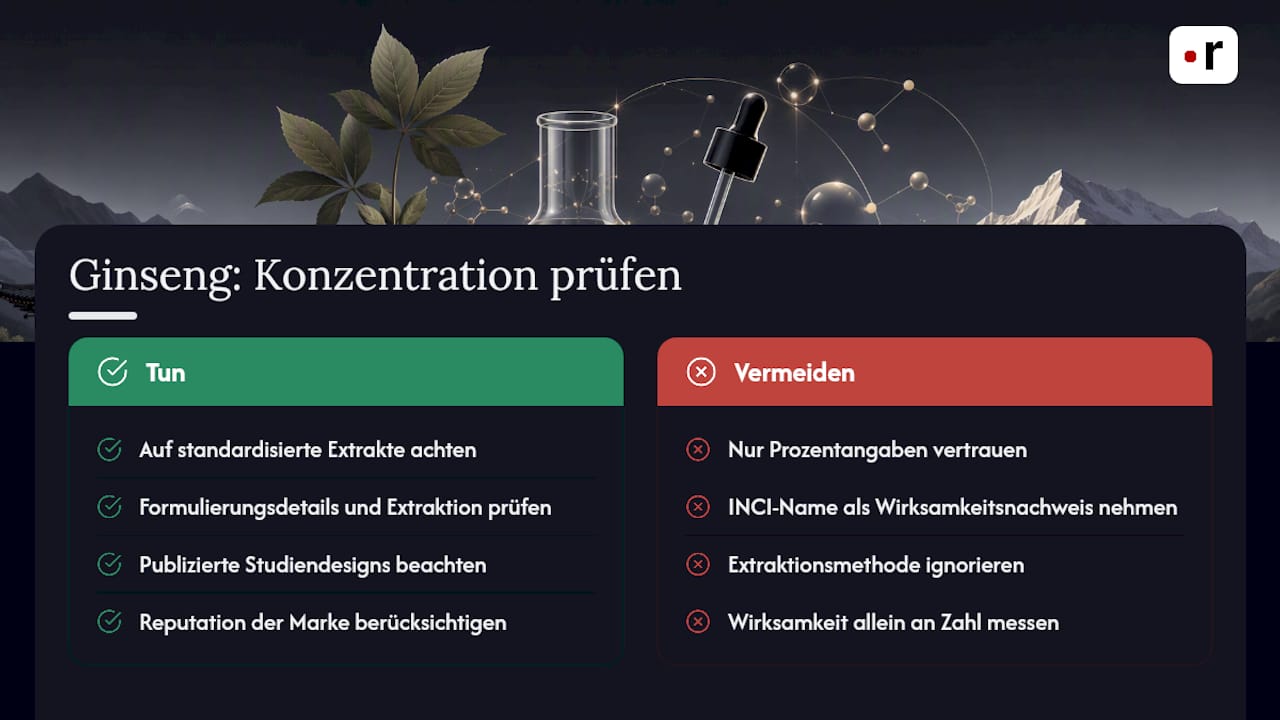
On the INCI list, it usually says "Panax Ginseng Root Extract," less often will you find a specific ginsenoside content. This makes comparing products difficult, as the same ingredient can release very different amounts of active ingredients in different formulations.
Additionally, pay attention to these points:
- The pH value of the formulation should match the rest of your routine, usually slightly acidic.
- Complementary active ingredients like hyaluronic acid or niacinamide enhance the moisturizing effect sensibly.
- The preservation should be transparently declared, especially in water-based serums.
- The texture must suit your skin goal: light toners for oily skin, richer creams for dry skin.
A Ginseng serum like the Beauty Of Joseon Revive Serum with Ginseng and Snail Mucin exemplifies how this combination looks in practice.
History and Traditional Use of Ginseng in Skincare
Ginseng has been a staple in Korean medicine, known as Hanbang, for centuries and was traditionally considered a remedy that should make vitality visible from the inside out. During the Joseon Dynasty, the root was so valuable that it was sometimes reserved for the royal family and processed into creams and tinctures for the imperial court. It was only later that Ginseng found its way into the skincare of the broader population.
The traditional application differed significantly from today's use. The root was cooked, fermented, or processed into pastes and applied directly to the skin, often in combination with honey or rice water. This practice was based on empirical knowledge, not lab data, but proved safe and effective enough over generations to survive to this day.
What the modern cosmetics industry has made of it is essentially a translation of this tradition into measurable sizes. Where "the skin looks fresher" once sufficed as an observation, today a hydration increase of plus 29.56 percent from a controlled study stands. The approach remains the same, the Ginseng root as a source of vitality for the skin, only the evidence has changed. This connection between centuries-old Hanbang practice and today's study situation makes Ginseng one of the more interesting active ingredients in Korean skincare because it is rare: Most traditional ingredients never make it into a peer-reviewed journal.
Panax Ginseng or American Ginseng: Are There Differences for the Skin?
Not every Ginseng is the same Ginseng, botanically and in terms of active ingredients. Panax ginseng, also known as Korean or Asian Ginseng, is the species that has been studied in most of the aforementioned studies and was also traditionally used in Hanbang. American Ginseng, botanically Panax quinquefolius, is closely related but has a different ginsenoside profile.
The main difference lies in the ratio of the individual ginsenoside types to each other. Panax ginseng tends to contain more of the ginsenosides associated with stimulating and anti-inflammatory effects, while American Ginseng shows a profile traditionally classified as calming. For skincare, this means: Most of the cited clinical data, from the nanoemulsion study to the microbiome study, refer to Panax ginseng, usually in its red ginseng form, where the root is steamed and dried.
American Ginseng appears much less frequently in cosmetic research. This does not mean it is ineffective, but the evidence for its use in creams and serums is simply thinner than for its Korean relative. Those who want to rely on scientifically backed statements will currently find a more solid data basis with Panax ginseng. In Siberia, a third, botanically unrelated plant grows under the name "Siberian Ginseng," which has nothing to do with the actual Ginseng family and plays a minor role in skincare.
Active Ingredient Concentration: How Much Ginseng is Really in the Product?
The concentration of Ginseng extract in skincare products varies significantly, and this is one of the biggest pitfalls for consumers. The Cosmetic Ingredient Review documents in its safety assessment usage amounts of Panax root derivatives in leave-on products, typically in concentrations that are usually safe. This sounds like little, but it is typical for plant extracts, whose active ingredients are biologically active even in small amounts.
The problem is that the INCI declaration "Panax Ginseng Root Extract" does not provide information about the actual ginsenoside content. Two products with identical percentage indications on the packaging can contain completely different amounts of effective ginsenosides, depending on how the extract was obtained and which solvent was used. This point is emphasized by the review on Ginseng byproducts: Formulation details like extraction method and penetration enhancers greatly change the amount of active ingredient released, even if the percentage on two labels looks identical.
For consumers, this means in practice: A high percentage on the packaging is not a reliable indicator of effectiveness. It is more sensible to rely on brands that work with standardized extracts or orient their formulations to published study designs, as is common with fermented red ginseng extracts from the Korean cosmetics industry. If unsure, it is better to focus less on the bare number and more on the overall formulation and the brand's reputation.
Combining Ginseng: These Interactions You Should Know
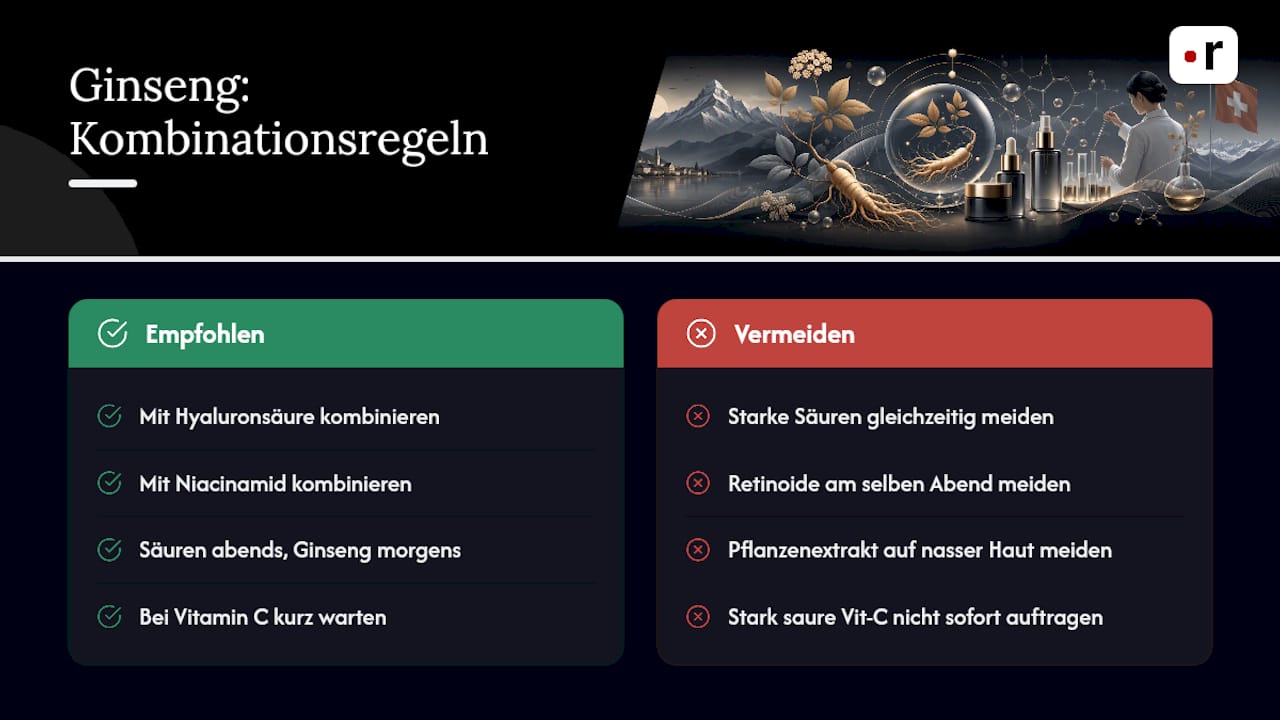
Ginseng can be well integrated into an existing routine but does not behave neutrally towards every other active ingredient. It harmonizes particularly well with hyaluronic acid and niacinamide: Both support the moisture-binding effect of Ginseng polysaccharides without disrupting the pH value of the formulation or neutralizing each other. This combination therefore often appears together in many Korean serum formulations.
It is different with strongly exfoliating acids like high-percentage glycolic acid or salicylic acid. These active ingredients significantly lower the skin's pH value and can lower the irritation threshold when combined with active plant extracts, especially for sensitive skin. This does not mean you can never use Ginseng and exfoliating acids together, but a time gap, such as acids in the evening and Ginseng in the morning, is the safer option.
With retinoids, caution is also advisable on the same evenings. Retinoids already irritate the skin, and an additional active ingredient with its own biological activity can amplify this effect instead of buffering it. Those who want both in their routine usually do better with a split: Retinoid on even days, Ginseng serum on odd days. There are no known incompatibilities with Vitamin C, but you should not apply strongly acidic Vitamin C formulations and plant extracts simultaneously on freshly cleansed, still slightly permeable skin. A short interval of a few minutes between steps is usually sufficient.
What Happens with Long-term Use of Ginseng in Skincare?
The short-term effects of Ginseng are comparatively well documented, with the 28-day mark appearing in several studies as the first measurable turning point. There is significantly less controlled data on long-term use, i.e., over months or years. This is not specific to Ginseng but a general problem in cosmetic research: Long-term studies are expensive, complex, and economically unattractive for the industry.
What can be derived from the available data is still insightful. Since the documented effects, moisture retention, barrier strengthening, microbiome-promoting effect, rely on continuous application and not on a one-time effect, there is little against integrating Ginseng permanently into the routine. Unlike some aggressive active ingredients, there is no evidence that the skin "gets used to" Ginseng and the effect diminishes.
In practice, users often report a gradual improvement in the skin's appearance over several weeks, which stabilizes with continued use rather than increasing further. This aligns with the study logic: Ginseng repairs and supports existing skin functions instead of initiating new processes that could continually increase. Those who interrupt use for several months usually lose the built-up effects on hydration and barrier function, similar to other moisturizing active ingredients. Continuity counts more than intensity here.
Publisher Perspective: Why We at Rammilav Rely on Ginseng
At Rammilav, we source our Ginseng products from brands like Beauty Of Joseon directly from verified suppliers, not through intermediaries with unclear origins. This is not a detail but half the purchase decision for an active ingredient whose effectiveness depends so much on the formulation. Our delivery within Switzerland usually takes two to three days, free shipping from an order value of 80 francs. This removes the uncertainty of whether a seemingly cheap offer actually contains what is stated on the packaging.
— Aleksejs
Discover Ginseng Products in the Shop
If you want to try Ginseng specifically now, it's worth looking at formulations that combine the active ingredient with proven partners like hyaluronic acid or snail mucin, rather than using it in isolation. At Rammilav, we carry Ginseng products from Beauty Of Joseon, such as the Ginseng Sun Serum with SPF 50, which combines active ingredient and sun protection in one step. Unlike many online offers from abroad, you buy original goods directly from verified suppliers here, with delivery within Switzerland usually in two to three days and free shipping from an order value of 80 francs. Browse through our entire range of Korean skincare and find the Ginseng product that suits your skin goal.
Sources
- Efficacy of Panax ginseng Tissue Culture Nanoemulsion on Anti-Aging in Cosmetics
- Influence of Panax ginseng formulation on skin microbiota: A randomized, split face comparative clinical study
- Medicinal potential of Panax ginseng and its ginsenosides in atopic dermatitis treatment
- CIR Safety Assessment: Panax spp. root-derived cosmetic ingredients


