
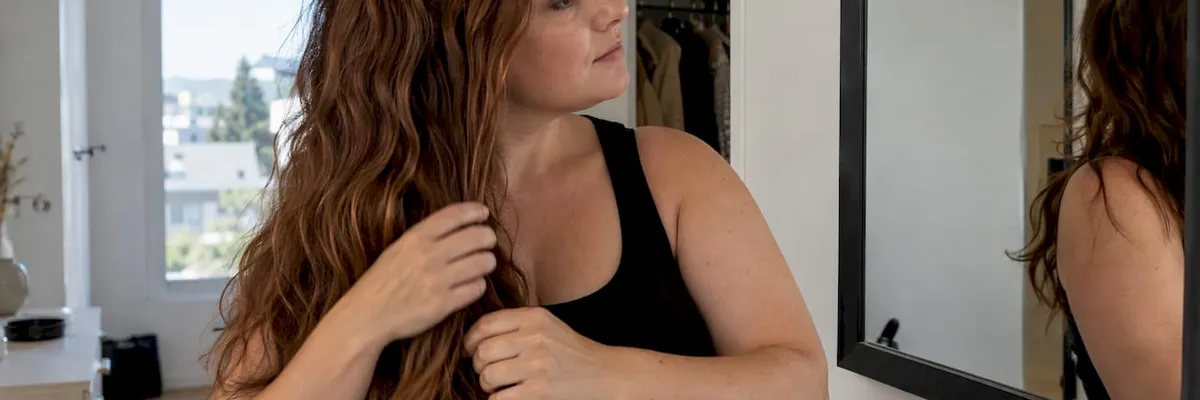
You reduce frizz with K-Beauty by protecting the outer cuticle layer of your hair and providing targeted moisture from the scalp to the ends. Korean hair care relies on a clear sequence: cleanse the scalp, wash gently, nourish lengths with a mask and conditioner, seal the result with a leave-in, and dry gently. In this guide, we explain why hair swells, which steps and ingredients really matter, and how to adapt your routine to Swiss weather, from humid summer days to dry heating air in winter.
In Short
- Frizz occurs when the cuticle, the outer layer, is opened or damaged and the hair absorbs moisture from the air.
- The Korean routine starts at the scalp and works its way through five steps to the leave-in serum.
- A hair mask once a week for 10 to 15 minutes is the centerpiece against dry, frizzy lengths.
- Gentle patting, heat protection, and a cold air blast at the end prevent you from creating new frizz while drying.
- In Swiss winter, your hair needs more moisture, while in humid summer, it needs lighter, sealing care.
Table of Contents
- Why Hair Becomes Frizzy
- What Korean Hair Care Does Differently
- The K-Beauty Routine Against Frizz in Five Steps
- Which Care Suits Your Hair
- How to Apply the Hair Mask Correctly
- Drying and Styling Without New Frizz
- Common Care Mistakes That Increase Frizz
- Adapting the Routine to Swiss Weather
- Our View on Frizz and K-Beauty
- Your K-Beauty Hair Care at Rammilav
- Frequently Asked Questions About Frizz and Korean Hair Care
- Sources
Why Hair Becomes Frizzy
To effectively reduce frizz, it helps to take a quick look at the structure of hair. Each hair consists of an inner core, the cortex, and an outer protective layer of overlapping scales, the cuticle. As long as these scales lie flat, the hair reflects light, feels smooth, and is well protected from environmental influences.
If the cuticle is damaged, for example by heat, coloring, friction, or simply by dryness, more water can penetrate the cortex. As Scientific American explains the chemistry behind it, too much water in high humidity causes the cuticle to swell and break, while a healthy cuticle protects the cortex. The hair then absorbs moisture from the air uncontrollably, individual strands swell to different degrees and stand out. This is what we see as frizz.
This results in three factors you can influence:
- Dryness: Thirsty hair takes moisture wherever it finds it, i.e., from the surrounding air. Well-nourished hair has less of this urge.
- Humidity: On humid days, the supply of water in the air is large. The more open the cuticle, the stronger the hair reacts.
- Hair type: Curly and wavy hair is naturally more prone to frizz because the cuticle lifts more easily at the bends. Fine, straight hair often shows frizz mainly at the ends and on the top of the head.
The good news: Frizz is not a sign of “bad” hair, but an indication that your care does not quite match your hair. And that can be changed.
What Korean Hair Care Does Differently
In Korea, hair care is thought of similarly to skincare: in layers, with patience, and with a focus on the basics. The basis here is the scalp. Only when it is clean, balanced, and calm can the hair grow healthily, and only then is it worth caring for the lengths.
The ingredients also show the proximity to skincare. According to Elle, typical active ingredients in Korean hair care include fermented ingredients, plant oils, and silk proteins. Vogue UK highlights that Korean hair masks rely on active ingredients known from facial care, such as ceramides, ferments, and PDRN. If you already know how ceramides in cosmetics strengthen the skin barrier, you understand why they are so popular in hair: They support the protective film that retains moisture.
The goal of this care now has its own name: Glass Hair, hair that looks so smooth and shiny that it reflects light like glass. Frizz is the natural opponent here. If you want Glass Hair, you must first calm the cuticle.
The K-Beauty Routine Against Frizz in Five Steps
Vogue Germany divides a typical Korean hair care routine into five steps: a weekly scalp scrub, daily shampoo, a weekly scalp mask, a daily conditioner, and a daily leave-in serum for moisture and shine. “Daily” means on every wash day. How often you wash depends on your scalp. We show you how each step works against frizz.
1. Scalp Scrub: Once a Week
The scrub removes residues of sebum, styling products, and dead skin cells. According to Anna Stolper, who runs K-Beauty boutiques in Berlin, a scalp scrub cleanses the scalp thoroughly, promotes blood circulation, and ensures that subsequent products like shampoo or serum can work better (Vogue Germany). Gently massage the scrub in with your fingertips, not your nails. If your scalp is sensitive or reddened, you will find in our guide how to calm the scalp with K-Beauty.
2. Mild Shampoo: On Every Wash Day
The shampoo belongs on the scalp, not in the lengths. Lather it at the roots and let the foam simply run through the lengths when rinsing. This is enough to clean them without unnecessarily drying them out. Use lukewarm instead of hot water, as very hot water additionally stresses the scalp and hair.
3. Scalp Mask: Once a Week
While the scrub clarifies, the scalp mask provides moisture and balances a stressed scalp. You can easily combine this step with your scrub day to keep the routine manageable.
4. Conditioner or Hair Mask: In the Lengths
Now it's about the cuticle. The conditioner smooths the cuticle layer after washing and makes the hair combable. Once a week, replace it with a hair mask that nourishes more intensively. Apply both to towel-dried hair from the lengths to the ends, avoiding the scalp. How to get the most out of a mask is explained further below and in detail in our article on applying a hair mask in K-Beauty style.
5. Leave-in Serum: As a Protective Finish
The leave-in stays in the hair and forms a light protective layer that retains moisture and slows down absorption from the surrounding air. Distribute it only in lengths and ends. For fine hair, a small amount is enough, for thick or curly hair, it can be a bit more. Less is often more here: Too much product weighs the hair down and makes it look greasy faster.
An overview of all the steps, even beyond the frizz question, can be found in our guide to the Korean hair care routine.
Which Care Suits Your Hair
Not every hair needs the same. The following overview helps you tailor the routine to your hair type.
| Hair Type | Typical Frizz | What to Focus On | Mask Rhythm |
|---|---|---|---|
| Fine and Straight | at ends and top of the head | light textures, care only in the ends | once a week, shorter application time |
| Thick and Straight | in the lengths, especially in humidity | rich mask, leave-in in the lengths | once a week, full application time |
| Wavy and Curly | throughout the hair, especially at bends | lots of moisture, little friction, don't brush dry | once a week, more often if needed |
| Colored or Bleached | on stressed areas | repairing care, consistent heat protection | once a week, full application time |
| Sensitive Scalp | independent of hair | mild products, gentle peeling, care not on the scalp | according to tolerance |
When it comes to ingredients, it's worth looking at two groups. Moisture binders attract water and hold it in the hair. Plant oils, ceramides, and proteins, on the other hand, form a protective layer around the fiber and smooth the surface. For frizz, you need both in the right balance: moisture for the inside, a protective film for the outside. You may already know this principle from skincare, we explain it in our article on occlusive agents and humectants.
How to Apply the Hair Mask Correctly
The mask is the step that has the most effect on frizz. Coveteur quotes an expert who recommends letting the mask work for 10 to 15 minutes once a week so it can properly nourish the hair, and advises products with pumpkin seed oil and argan oil. Moisturizing oils and balms should, according to the same source, be applied mainly to the ends so that the hair does not lose volume at the roots.
Here's how to proceed:
- Wash your hair and gently squeeze out the water until it is towel-dry. In dripping wet hair, the mask is diluted.
- Take a walnut-sized amount, more for long or thick hair.
- Distribute the mask from the middle of the lengths to the ends, avoiding the scalp.
- Comb it through gently with a wide-toothed comb to ensure every strand is nourished.
- Let it work for 10 to 15 minutes. A warm towel around your head makes the time more pleasant.
- Rinse thoroughly with lukewarm water. Many finish the wash with a cooler rinse because the hair feels smoother afterward.
- Seal the care with your leave-in.
Make the mask a regular appointment, such as on Sunday evening. Regularity brings more results with frizz than a single, particularly long application.
Drying and Styling Without New Frizz
Many people carefully care for their hair and then create frizz while drying. Most damage occurs from friction and too much heat.
- Patting Instead of Rubbing: Vigorous rubbing with a terry towel lifts the cuticle and breaks curls apart. Dyson recommends instead gently squeezing out excess water with a microfiber towel or a cotton T-shirt, using heat protection, blow-drying with controlled heat from roots to ends, and finishing with a cold air blast.
- Pay Attention to Blow-Drying Direction: Direct the airflow from top to bottom, in the direction of the scales. This way, they lay down instead of being ruffled.
- Medium Instead of Highest Setting: Keep some distance between the blow dryer and hair and avoid the hottest setting. It takes a few minutes longer but protects the fiber.
- Cold Air at the End: A short cool air blast at the end fixes the shape and makes the hair appear smoother.
- Use Flat Irons Sparingly: Use heat tools only when the hair is completely dry, and always with heat protection.
If you prefer to let your hair air dry, comb in the leave-in beforehand and touch the hair as little as possible afterward. Every touch in the semi-dry state can break the structure.
Common Care Mistakes That Increase Frizz
Often, it's small habits that make the difference. These points are particularly common:
- Massaging Shampoo into the Lengths: The lengths do not need intensive cleaning. Focus on the scalp.
- Skipping Conditioner: After shampooing, the cuticle is sensitive. Without conditioner, it remains rougher.
- Too Short Mask Application Time: A mask that is rinsed out after thirty seconds can hardly unfold its effect.
- Brushing Wet Hair: Wet hair is more elastic and sensitive. Detangle it with a wide-toothed comb, starting at the ends.
- Constantly Touching Hair: Running your hands through your hair, tugging at strands, tucking hair behind your ear: All this roughens the surface.
- Rough Pillowcases and Tight Elastics: At night, the hair rubs against the pillow for hours. A smooth cover and a loose braid with a soft hair tie protect the lengths.
- Too Much Product: Those who apply more and more leave-in and oil against frizz end up with weighed-down, stringy hair. Better to use a little and distribute it evenly.
Adapting the Routine to Swiss Weather
In Switzerland, your hair experiences very different conditions throughout the year. Therefore, it is worth slightly adjusting the routine seasonally instead of keeping it the same all year round.
Autumn and Winter
Outside it is cold, inside the heating is on, and the indoor air becomes noticeably drier. Many then know statically charged, frizzy hair that flies in all directions after taking off the hat. During this time, your hair mainly needs moisture: Treat it to the weekly mask consistently, opt for a richer texture in the leave-in, and dry the hair completely before going outside. A hat with a smooth lining rubs less than coarse wool directly on the hair. The scalp also often reacts more sensitively in winter, so a gentle scrub is particularly valuable now. How dry air and salt affect the skin barrier is explained in this article on salt therapy and the skin barrier, which fits well with the topic of scalp care in winter.
Spring and Summer
On humid days, after a thunderstorm, or during a trip to a lake, the air is moist, and this is when frizz is most noticeable. Now it's less about additional moisture and more about sealing: a light leave-in in the lengths, a few drops of care in the ends, and as little heat as possible. After swimming in the lake or pool, it's best to rinse the hair with clear water and give it a conditioner. Sun and wind additionally dry out the lengths, a hat or a loose braid protects them.
In the Mountains
Those who ski in winter or hike in summer expose their hair to cold, wind, and intense sun. Pack a leave-in for longer days at altitude and plan a mask after returning. Your hair will thank you with noticeably softer lengths.
Our View on Frizz and K-Beauty
At Rammilav, we often find that customers see frizz as something they have to put up with. Our experience is different: In most cases, the hair simply lacks care that is as well thought out as a good skincare routine.
This is exactly where Korean hair care shows its strength. It starts at the scalp, thinks in steps, and relies on active ingredients known and appreciated from skincare. That's why we choose our hair care with the same care as our serums and creams.
For us, the weekly hair mask is the step with which you achieve the most. Masks like the Masil 10 Premium Repair or the Masil 8 Seconds Salon are therefore among the products we particularly like to recommend for dry, frizzy hair.
It's also important to us that you can rely on authenticity. We source every product directly from verified suppliers so you get exactly the original formula you chose.
Aleksejs
Your K-Beauty Hair Care at Rammilav
If you want to start your routine against frizz, you will find Korean hair masks for different needs with us: the Masil 10 Premium Repair Hair Mask for stressed hair, the Masil 8 Seconds Salon Hair Mask, the Masil 8 Seconds Salon Super Mild Hair Mask, and the practical Masil 8 Seconds Salon Hair Mask Set. Discover shampoos and other hair care in our K-Beauty range. All products come directly from verified suppliers, are usually delivered within 2 to 3 days throughout Switzerland, and shipping is free for orders over 80 CHF.
Frequently Asked Questions About Frizz and Korean Hair Care
How Quickly Will I See Results Against Frizz?
A good conditioner and gentle drying often make a noticeable difference after the first wash. The effect of a regular mask routine usually becomes apparent after a few weeks when the lengths are overall better nourished. The key is to stick with it.
How Often Should I Use a Hair Mask Against Frizz?
Once a week with 10 to 15 minutes of application time is a proven rhythm. For very dry, curly, or colored hair, you can use the mask more often if needed. For fine hair, apply it mainly to the ends.
Can the Hair Mask Be Applied to the Scalp?
The hair mask belongs in the lengths and ends, avoiding the scalp. The Korean routine has its own steps for the scalp, namely the scrub and the scalp mask. This keeps the roots light and the lengths get the care they need.
Does K-Beauty Help with Curls with Frizz?
Yes, curly hair especially benefits from the moisture-focused Korean care. Combine the mask with a leave-in, dry the curls by gently squeezing instead of rubbing, and avoid brushing them dry. This keeps the curl structure defined.
Why Is My Hair Frizzier in Winter Than in Summer?
In winter, heating air dries out the hair, and hats cause friction and static charge. Thirsty hair reacts more strongly then. A consistent mask routine and a richer leave-in balance this well.
Sources
- Scientific American: Why Hair Turns Curly and Frizzy in the Summer
- Vogue Germany: Glass Hair, Korean Hair Care
- Elle: Glass Hair, the Hair Care Trend from Korea
- Vogue UK: Best Korean Hair Masks
- Coveteur: Guide to Korean Hair Care
- Dyson: How to Control Frizzy Hair


