
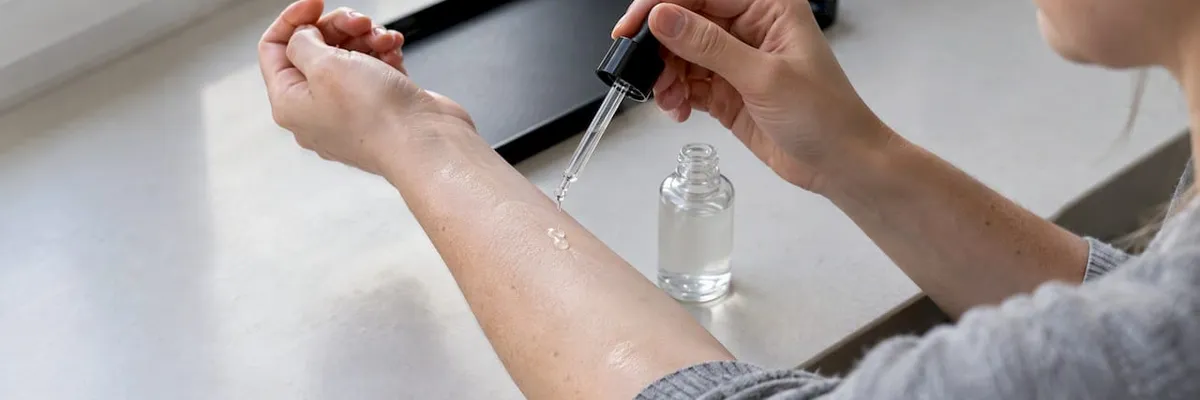
Beta-Glucan soothes sensitive skin, provides moisture, and strengthens the skin barrier. Clinical studies on Chitin-Glucan show measurable improvements in hydration and barrier function, even for sensitive skin. We recommend this ingredient as a reliable foundational step in moisturizing routines, especially after peels or retinoid applications when the skin needs extra calming.
In short:
- Beta-Glucan improves skin moisture and barrier function, especially for sensitive skin, without significant side effects for those prone to irritation.
- Clinical studies show measurable results in hydration and transepidermal measurement, but participant numbers are usually small and study quality varies.
- For dry skin, Beta-Glucan should be combined with lipid-containing ingredients like ceramides to achieve optimal protection and moisture levels.
- When purchasing, products labeled “Beta-Glucan,” “Sodium Carboxymethyl Beta-Glucan,” or “Yeast Beta-Glucan” from trustworthy sources are preferred.
- Beta-Glucan is considered a reliable foundational step in skincare but does not replace lipids or medical treatment for severe skin conditions.
Table of Contents
- Mechanisms and Scientific Evidence
- Who Beta-Glucan is Particularly Suitable For
- How to Properly Use Beta-Glucan: Forms, Concentrations, and Combinations
- INCI Check and Purchase Criteria for Beta-Glucan Products
- Safety, Allergies, and Common Myths
- Why Rammilav is Relevant as a Source for Beta-Glucan Care
- Our Assessment of the Role of Beta-Glucan in Skincare
- Suitable Categories and Products at Rammilav
- FAQ
- Sources
Mechanisms and Scientific Evidence
What actually happens on the skin when Beta-Glucan is applied? The ingredient forms a thin film on the skin surface and binds water, making the upper skin layers appear more hydrated.
Clinical double-blind studies on Chitin-Glucan showed measurable improvements in skin moisture and barrier markers in sensitive participants, as a study on Chitin-Glucan confirms. This is relevant because sensitive skin often reacts sensitively to new ingredients, yet significant side effects were absent here.
Further evidence is provided by a randomized study on xerosis: After 28 days, significant improvements in corneometry values (a measure of skin moisture) and a reduction in transepidermal water loss, or TEWL, were observed. These two measurements are considered standard in skin research to objectively capture hydration effects.
What the study situation indicates:
- Participant numbers in most studies are small
- Different Beta-Glucan derivatives do not automatically yield comparable results
- Calming and antioxidant effects are described in reviews but not confirmed for every formulation individually
Even in wound healing, a pattern emerges: A phase II study on soluble yeast Beta-Glucan for diabetic foot ulcers found shortened healing times and a good safety profile, highlighting the regenerative side of the ingredient.
Who Beta-Glucan is Particularly Suitable For
Sensitive skin benefits particularly strongly from Beta-Glucan because the irritation potential is low and the ingredient simultaneously soothes. Those who quickly react with redness or a feeling of tightness often find a well-tolerated entry into new care steps here.
For very dry skin, Beta-Glucan alone is usually not enough. The ingredient binds water but does not provide lipids, so it is worth combining with emollient ingredients:
- After peels or retinoid applications, Beta-Glucan helps stabilize the skin
- In cases of dryness, additional ceramides or other fats are needed
- As an intermediate step in the evening routine, it is well-suited for calming
Pro Tip: Apply Beta-Glucan products to slightly damp skin to improve distribution and noticeable effect.
How to Properly Use Beta-Glucan: Forms, Concentrations, and Combinations
The choice of texture depends on the skin condition. A serum absorbs quickly and is suitable for daily use, a toner provides a light initial moisture layer, and a cream seals at the end of the routine.
Here's how to build a routine with Beta-Glucan:
- Gently cleanse the skin without drying it out
- Apply a toner with Beta-Glucan or similar humectants to damp skin
- Follow with a serum that combines Beta-Glucan with hyaluronic acid or niacinamide
- Finish with a cream containing ceramides or other lipids if the skin is dry
Common concentrations in finished products are often in a low range, the exact specification depends heavily on the formulation and is rarely uniformly stated. More important than the exact number is usually the combination: Ceramides complement the missing lipid component, hyaluronic acid enhances water binding, niacinamide additionally supports the barrier function.
INCI Check and Purchase Criteria for Beta-Glucan Products
When looking at the ingredient list, a bit of practice is worthwhile. The following terms indicate Beta-Glucan:
- “Beta-Glucan” (native form, usually in creams)
- “Sodium Carboxymethyl Beta-Glucan” (water-soluble derivative, often in serums and toners)
- “Yeast Beta-Glucan” or “Oat Beta-Glucan” as an origin indicator
Native forms are less soluble and therefore less common in light textures, while modified derivatives are easier to incorporate into aqueous formulas. When purchasing, it helps to look for clear origin indications and choose products specifically labeled for sensitive skin, as such formulations often also avoid fragrances and alcohol.
Safety, Allergies, and Common Myths
A common misunderstanding concerns gluten: Beta-Glucans are sugar polymers, not gluten-containing proteins, even if they come from oats. Those who react to gluten do not need to fear cross-reaction with topical Beta-Glucan products.
Caution is advised, however, with known yeast or mold allergies, as Beta-Glucan is derived from these sources. A few practical tips:
- Test new products first on a small area of skin
- Pay attention to the indicated raw material source in case of allergies
- Consult a dermatologist if irritation persists or if unsure
Why Rammilav is Relevant as a Source for Beta-Glucan Care
Our range includes authentic Korean cosmetics, where we place special emphasis on originality and quality, which is crucial for ingredients like Beta-Glucan, where precise formulation is important. In our catalog, you will find serums, toners, and creams suitable for sensitive and dry skin and that combine well with Beta-Glucan-containing products.
Our Assessment of the Role of Beta-Glucan in Skincare
For us, Beta-Glucan is a reliable foundational step when it comes to calming and hydration, especially for sensitive skin. However, it does not replace lipids or medical therapy for pronounced skin conditions. Observe how your skin reacts and adjust the routine accordingly.
— Aleksejs
Suitable Categories and Products at Rammilav
Those looking to supplement a routine with Beta-Glucan will find several entry points with us:
- Calming creams like the I’m Sorry for My Skin Age Capture Skin Relief Cream
- Toners for sensitive skin like the Haruharu Wonder Black Rice Hyaluron Toner
- Calming gels like the Orchid Soothing & Moisture Aloe Vera 99% Gel
Delivery is prompt within Switzerland, and shipping is free above a certain order value. Browse directly in our catalog and find the right care for your skin.
FAQ
What does Beta-Glucan do for the skin?
Beta-Glucan provides moisture, soothes irritations, and supports the skin barrier. Clinical studies on Chitin-Glucan show improved hydration and barrier values with good tolerability.
Which vitamin makes the skin beautiful?
There is no single vitamin that alone ensures beautiful skin, as skin health depends on several factors. Vitamins like C and E are often used for their antioxidant properties, while Beta-Glucan works more through moisture and barrier function.
What is the healthiest oil for the skin?
There is no oil that is universally considered the healthiest, as suitability depends heavily on skin type. For dry or sensitive skin, light, emollient oils combined with moisture-binding ingredients like Beta-Glucan are often better than heavy oils alone.
Where is Beta-Glucan found?
Beta-Glucan is often found in serums, toners, and moisturizers, listed on the ingredient list as “Beta-Glucan” or “Sodium Carboxymethyl Beta-Glucan.” Natural sources include oats, yeast, and certain fungi like Sparassis crispa.
Sources
Beta-Glucans are polysaccharides, or sugar molecules, found in cell walls. They come from different organisms, and this influences how they behave in a formulation.
In cosmetics, three main sources appear:
- Chitin-glucan, a natural cell scaffold for skin moisturization and rejuvenation
- Efficacy of a Topical Formulation on Skin Hydration and Barrier Function in Individuals With Xerosis: A 28‑Day Randomized, Split‑Leg, Untreated‑Controlled Trial
- Macrophage stimulating agent soluble yeast β‑1,3/1,6‑glucan as a topical treatment of diabetic foot and leg ulcers: A randomized, double blind, placebo‑controlled phase II study
On the ingredient list, the ingredient usually appears as “Beta-Glucan” or in modified form as “Sodium Carboxymethyl Beta-Glucan.” Native forms are often less soluble, while modified derivatives are easier to incorporate into water-based formulas and are therefore widespread in serums and toners. A recent review confirms that this derivatization primarily serves cosmetic handling, not efficacy.


