
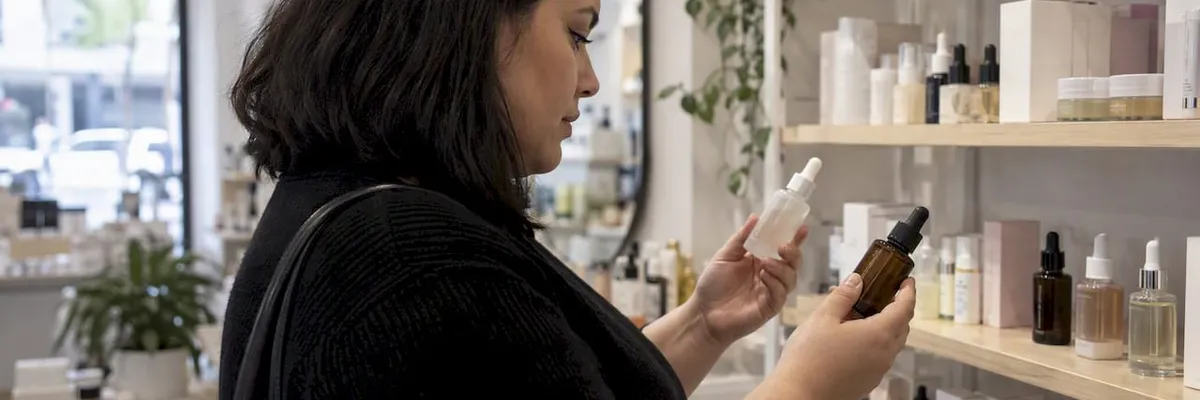
In K-Beauty, Bakuchiol is a gentle alternative to Retinol, which in a comparative study showed similar anti-aging effects but caused significantly less irritation. Visible changes in wrinkles and pigmentation were described after about 12 weeks. For sensitive skin or for those who do not tolerate Retinol well, Bakuchiol is therefore a well-founded option.
In short:
- The comparative study included 44 participants over 12 weeks; Bakuchiol with 0.5% was applied twice daily, Retinol with 0.5% once daily.
- 59% of the Bakuchiol group saw an improvement in pigmentation, compared to 44% under Retinol; due to the small study, this does not establish a general precedence.
- The serum is applied after cleansing and toner, before the cream; sunscreen is still necessary in the morning, even though Bakuchiol does not make the skin more sensitive to light.
- Initially separate Bakuchiol from acids, Vitamin C, and retinoids; introduce new products one at a time and test them on your forearm first.
- There are no clinical studies during pregnancy; Bakuchiol is not a derivative of Vitamin A, but discuss its use with your doctor if you are unsure.
Table of Contents
- What is Bakuchiol and why does the K-Beauty scene rely on it?
- Bakuchiol vs. Retinol: What do studies and dermatologists say?
- How to integrate Bakuchiol into your K-Beauty routine
- What to consider in concentration, formulation, and product choice
- Compatibility, patch test, and advice for pregnancy and breastfeeding
- Bakuchiol in typical K-Beauty routines: Essence, ampoule, and sheet mask
- Overview of typical K-Beauty products with Bakuchiol
- How to recognize authentic Korean Bakuchiol products when buying online
- Which ingredients complement Bakuchiol well in K-Beauty
- Why we consider Bakuchiol sensible in K-Beauty
- Discover gentle K-Beauty care for your routine
- FAQ
- Sources
What is Bakuchiol and why does the K-Beauty scene rely on it?
Bakuchiol is a plant compound obtained from Psoralea corylifolia, among others. Chemically, it is not a retinoid and does not have a Vitamin A structure. Nevertheless, it is often described in skincare products as a “plant-based Retinol.” This description is somewhat misleading because the compound has its own chemistry. It is valued in cosmetics for its effects on the skin, not for any relationship with Retinol.
Typical properties attributed to it:
- Antioxidant: It helps protect the skin against oxidative stress.
- Anti-inflammatory: This makes it interesting for irritated or redness-prone skin.
- Cell renewal: It supports the natural renewal of the skin surface.
- Skin appearance: It can reduce the appearance of fine lines and make pigmentation spots less noticeable.
K-Beauty formulators like to use Bakuchiol for two reasons. First, its tolerability is good, and this criterion is particularly important in Korean skincare because routines often consist of many steps and the skin should not be constantly irritated. Second, the “natural” positioning fits the zeitgeist: those who are attracted to plant-based active ingredients will find an alternative to classic retinoids here.
The specific skin goals can be quickly summarized. Do you want to address the first fine lines and loss of elasticity? Bakuchiol fits. Is a more even skin tone important to you? There are also indications from research for this. And if your skin reacts quickly to new things, the gentle action is a clear advantage. For mature skin, we also have a separate article on mature skin care that fits well with this topic.
Bakuchiol vs. Retinol: What do studies and dermatologists say?
The most important data basis is a randomized, double-blind comparative study over 12 weeks with 44 participants. Bakuchiol 0.5% (applied twice daily) and Retinol 0.5% (applied once daily) were compared. The study protocol is documented in the Clinicaltrials register; changes in wrinkle appearance and pigmentation were evaluated, supported by image analysis.
The result in one sentence: Both active ingredients improved wrinkles and pigmentation, and the reduction in wrinkle depth was at a similar level in both groups after 12 weeks. The difference was in tolerability. Retinol more often led to peeling and burning, as summarized in a publication in the British Journal of Dermatology. Bakuchiol showed a tendency towards fewer side effects there.
59% of Bakuchiol users showed an improvement in pigmentation, compared to 44% with Retinol (study on PubMed). This does not mean that Bakuchiol generally beats Retinol in pigmentation spots, but it shows that the gentler option does not have to be weaker.
Important for classification:
- Bakuchiol is not a retinoid, but it is said to partially address similar gene expression pathways. It works differently, but in a related direction.
- The number of participants is small, and the observation period is short. Long-term data is limited.
- Dermatologists see Bakuchiol as an effective option but warn against exaggerated healing promises. “Natural” is not a quality judgment, and Bakuchiol is not a miracle cure.
- If you tolerate Retinol well and are satisfied with it, there is no reason to switch. However, if you have given up due to redness and tightness, Bakuchiol offers a realistic second attempt.
If you are interested in how retinoids differ from each other, we explain this in our article Retinal vs. Retinol.
How to integrate Bakuchiol into your K-Beauty routine
The order is simple once you have internalized it. The rule of thumb in K-Beauty is: from thin to thick. Active ingredient serums come after cleansing and toner, before the cream.
- Cleansing: In the evening, first an oil or balm, then a gentle foam. How this works is described in our guide to Double Cleansing.
- Toner: It prepares the skin and provides initial moisture.
- Bakuchiol serum or ampoule: A few drops are enough, gently pat in and let absorb briefly.
- Moisturizer: A cream completes the care.
- Sunscreen in the morning: Always as the last step.
Regarding frequency: In the study, Bakuchiol was applied twice daily, i.e., morning and evening. This is possible because the substance is not photosensitizing. Those who want to get the skin used to it first start with the evening and add the morning after a few days.
Regarding sunscreen: Bakuchiol does not make the skin more sensitive to light, but sunscreen remains mandatory because it most effectively slows down premature skin aging. Why SPF is so natural in K-Beauty is explained in our article on SPF in K-Beauty.
Regarding combinations: There are usually no problems with hyaluronic acid, niacinamide, and ceramides. With acids (AHA/BHA), Vitamin C, or retinoids, caution is advisable. Use such active ingredients on separate evenings or at separate times of the day and observe your skin before increasing the dose.
Pro tip: Always introduce only one new product at a time and wait a while before adding the next one. This way, you can clearly see what your skin likes.
What to consider in concentration, formulation, and product choice
The concentration of the study serves as a guideline: 0.5% was investigated in a comparative study. A product with a significantly lower dose is not automatically ineffective, but you cannot refer to the study results. Many manufacturers do not specify the percentage. Then the overall formulation counts.
The most important selection criteria:
- Form of administration: A serum is light and easy to layer. A cream is richer and suitable for dry skin. An ampoule is usually more concentrated and is often used as a treatment over several weeks.
- INCI list: Bakuchiol is listed as "Bakuchiol." The further forward, the higher the proportion. If it is at the very end behind fragrances and preservatives, the amount is usually low.
- Marketing traps: Terms like "Retinol alternative" or "plant-based Retinol" say nothing about the content. Check the ingredient list, not the label on the front.
- Skin type: Oily skin gets along well with gel serums, dry skin with creamy textures. For very sensitive skin, it is best to avoid additional fragrances and essential oils.
- Goal: Is it about first lines, pigmentation spots, or generally calmer skin? This determines which accompanying active ingredients are useful.
A note on classification: In Switzerland, there is a declaration obligation for cosmetic ingredients. An overview of the legal situation for certain substances can be found at the Federal Office of Public Health. This does not replace a product review but explains why ingredient lists must be complete here.
Compatibility, patch test, and advice for pregnancy and breastfeeding
Even a gentle active ingredient can react in some individuals. Bakuchiol is generally well tolerated, even significantly better than retinoids. Contact allergies have been described in isolated cases. A patch test is therefore quickly done and is especially worthwhile for reactive skin.
Here's how to proceed:
- Apply a small amount of the product to an area on the forearm.
- Observe the area for a while.
- If redness, itching, or burning occurs, wash off the area and do not use the product on the face.
- If the skin remains calm, you can test the product on the face first in the evening and then slowly increase the application.
Regarding pregnancy and breastfeeding: Dermatologists see Bakuchiol as a possible alternative to retinoids because it is structurally not a Vitamin A derivative. However, clinical studies on pregnant women are lacking. Therefore, if in doubt, it is best to discuss with your doctor or dermatologist. More background is provided in our guide to K-Beauty during pregnancy. An article by Lunara Cosmetics on pregnancy-friendly K-Beauty can also provide additional suggestions.
Pro tip: Note the date of the patch test and the product name. If something reacts later, you can more quickly determine what caused it.
Bakuchiol in typical K-Beauty routines: Essence, ampoule, and sheet mask
K-Beauty care thrives on layering, and Bakuchiol can be well integrated if you combine the textures wisely. The basic idea: First comes the watery, hydrating care, then the active ingredient, then the sealing.
An essence brings moisture to the skin before the Bakuchiol serum follows. Well-hydrated skin generally absorbs active ingredients more pleasantly and reacts less irritated. How toner and essence differ is explained in the article Toner vs. Essence.
Ampoules are concentrated treatment care in K-Beauty. Whether serum or ampoule suits you better, you can find out in the comparison Serum vs. Ampoule. A Bakuchiol ampoule is best used in the evening for a few weeks, and the rest of the routine is kept deliberately simple.
Sheet masks are a nice finish if they are soothing and moisturizing. A hyaluronic sheet mask after the Bakuchiol serum supplies the skin with water and alleviates any feelings of tightness. Use them occasionally, not daily. How to layer multiple serums sensibly is shown in the guide Layering Serums.
An example routine for the evening: Balm, foam cleanser, essence, Bakuchiol serum, cream. On days with a mask, it does not replace the cream but comes before it, and the cream seals everything afterward.
Overview of typical K-Beauty products with Bakuchiol
What characterizes a typical K-Beauty product with Bakuchiol? It is usually a light serum or ampoule, often combined with soothing additives like Centella, Panthenol, or Hyaluronic Acid. The concentration is not always specified, and the texture is usually watery to slightly gel-like, so it can be worn well under cream and sunscreen.
When evaluating such a product, you should check five things:
- Placement in the INCI: Is Bakuchiol far forward or only on the edge?
- Accompanying substances: Are there fragrances or essential oils that could irritate sensitive skin?
- Texture: Does the product absorb quickly without sticking?
- Packaging: Pump dispensers or dark bottles protect the active ingredient better than open jars.
- Fit to the routine: Does it replace an existing serum, or does the routine become too long?
Honestly, there is not one Bakuchiol product that fits everyone. Which specific products are currently available with us, you can best see directly in our catalog. There you can filter by category, such as serum or moisturizer, and read the ingredient lists yourself. This is the most reliable assessment because you can see exactly what is in the bottle.
How to recognize authentic Korean Bakuchiol products when buying online
When buying cosmetics online, a close look is worthwhile, as there are unfortunately counterfeits and gray market goods. The following points help you with the assessment.
Check the retailer. Reputable shops name their sources and explain where the goods come from. We source our products directly from verified suppliers. This is the basis for you to get original goods.
Assess the price. A price that is far below the usual level is a warning signal. Original products have a calculation that cannot be arbitrarily reduced.
Check the packaging. Check the batch number, expiration symbol (the small jar symbol with month indication), and the writing on the packaging. Unclean prints, spelling errors, or loose seals are suspicious.
Compare the ingredient list. The INCI list on the packaging must match the information in the shop. If it differs, caution is advised.
Observe delivery conditions. For purchases in Switzerland, short delivery times and clear return policies are a good sign. With us, your order usually reaches you within 2 to 3 days, and we ship for free from an order value of 80 CHF.
Read reviews. Pay attention to reviews with specific information about the skin and application, not just stars.
Which ingredients complement Bakuchiol well in K-Beauty
K-Beauty formulations are rarely lone fighters. This also applies to Bakuchiol, which is often combined with other substances to ensure the skin is comprehensively cared for.
- Hyaluronic Acid: It binds water and balances out if the skin appears a bit dry at first.
- Niacinamide: It supports the skin barrier and can even out the skin tone. Together with Bakuchiol, it results in a combination that targets pigmentation and skin appearance.
- Centella Asiatica: The classic of Korean care has a calming effect and is suitable for sensitive skin.
- Ceramides: They strengthen the skin's protective barrier and make the skin more resilient.
- Peptides: They are often used in anti-aging serums. More about this can be found in our article on the effect of peptide serums.
- Panthenol: It soothes and cares for stressed skin.
Less favorable is the combination with several strong acids or highly dosed retinoids at the same time. The goal of Bakuchiol is precisely good tolerability, which you should not undermine with a cocktail of active ingredients. If you are plagued by a lack of moisture, our guide to moisture-deficient skin helps with the selection.
Why we consider Bakuchiol sensible in K-Beauty
I consider Bakuchiol one of the more sensible ideas in the anti-aging sector. Not because it would make Retinol superfluous, but because it fills a real gap: Many people give up on Retinol after redness and peeling and then remain without an active ingredient. For them, a gentle start is an opportunity. At the same time, I remain critical. The study situation is solid but small, and “natural” is not an argument for effectiveness. Those who use Bakuchiol should be patient, observe the skin, and start with the patch test. With us, you get verified original products, and that's exactly why we like to try such active ingredients with you.
— Aleksejs
Discover gentle K-Beauty care for your routine
With us, you will find authentic K-Beauty products from verified suppliers, suitable for serum, moisturizer, and more. We deliver quickly throughout Switzerland, usually within 2 to 3 days, and shipping is free for you from an order value of 80 CHF. Browse our range and find care that suits your skin.
FAQ
Is Bakuchiol really effective?
Yes, in a randomized comparative study, Bakuchiol improved wrinkles and pigmentation similarly to Retinol. The study lasted 12 weeks and included 44 participants, details are available on PubMed. Long-term data is still limited.
Is Bakuchiol better than Retinol?
Not fundamentally, but usually more tolerable. The effect was comparable in the study, but Retinol more often caused peeling and burning. For sensitive skin, Bakuchiol is therefore often the more pleasant choice.
When should you apply Bakuchiol?
You can use Bakuchiol in the morning and evening as it is not photosensitizing. Apply it after cleansing and toner, before the cream. In the morning, always follow with sunscreen.
Which Korean cosmetic brand is the best?
There is no single best brand, as the choice depends on skin type and goal. Pay attention to the ingredient list, tolerability, and origin of the goods. In our catalog, you can directly compare products and ingredients.
Can I use Bakuchiol during pregnancy?
Dermatologists see Bakuchiol as an alternative to retinoids because it is not a Vitamin A derivative. However, clinical studies on pregnant women are lacking. Seek medical advice if you are unsure.
Sources
- Prospective, randomized, double‐blind assessment of topical bakuchiol and retinol for facial photoageing
- Assessment of topical bakuchiol and retinol for facial photoageing
- Comparison of the Cosmetic Effects of Bakuchiol and Retinol
- Nanomaterials: current law, Switzerland


