
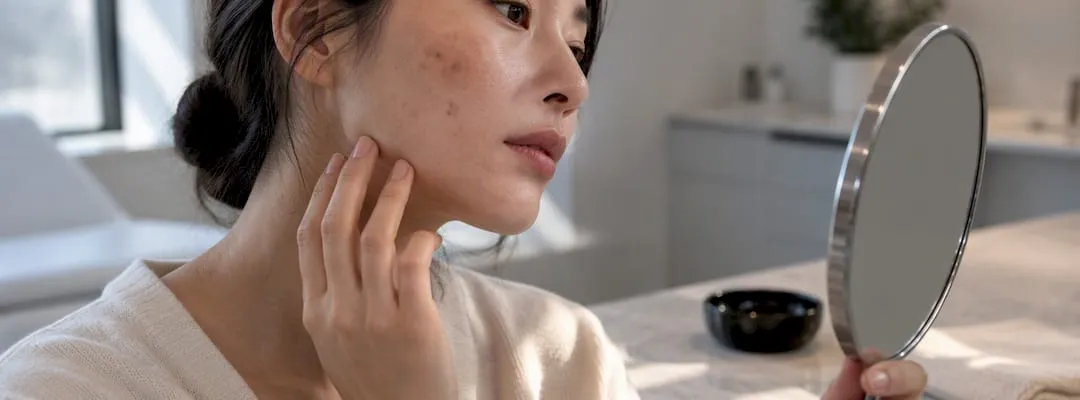
In short: Acne scars and dark spots can be most effectively reduced with daily SPF 50+, targeted brightening ingredients like Niacinamide, Azelaic Acid, and stable Vitamin C, along with a gradual introduction of exfoliation or retinoids. For deeper, sunken scars, this routine reaches its limits, and microneedling or a peel can be a sensible addition. There are product categories that allow you to implement this approach at home.
In short:
- For superficial pigmentation spots and mild acne scars, the skin can be effectively improved with SPF 50+ and brightening ingredients like Niacinamide or Vitamin C.
- Deep, sunken scars hardly respond to creams and usually require professional treatments like microneedling or chemical peels.
- The gradual introduction of acids, retinoids, and brightening ingredients should take at least two weeks to avoid skin irritation.
- Professional procedures like laser or peeling are advisable for deep scars, especially for darker skin types, to avoid hyperpigmentation.
- A consistent K-Beauty routine with cleansing, serum, sunscreen, and possibly acids shows visible improvements after eight to twelve weeks.
Table of Contents
- Which Ingredients Actually Brighten Acne Scars?
- What Does a K-Beauty Routine Against Acne Scars Look Like?
- When Are Microneedling, Peeling, or Laser Worth It?
- What Applies in Switzerland for Laser and IPL Treatments?
- Editorial Perspective: Why the Gentle Way is Often the Wiser Choice
- Where to Find the Right Products to Start?
- Sources
- FAQ
Which Ingredients Actually Brighten Acne Scars?
Before we talk about products, it's worth making a brief distinction: What you often refer to as an "acne scar" is usually post-inflammatory hyperpigmentation, a dark spot left behind after an inflamed pimple. True scars, whether sunken (atrophic) or raised (hypertrophic), are a structural change in the skin and respond differently to ingredients than pure pigmentation spots. This distinction determines how realistic your expectations of a cream can be.
Niacinamide inhibits the transfer of melanin from pigment-producing cells to the skin surface, counteracting the darkening of spots without irritating the skin. Our guide to Niacinamide explains its application in detail.
Azelaic Acid has both brightening and mild anti-inflammatory effects, making it particularly suitable for skin that is still prone to impurities. Concentrations of 10 to 20% are common in K-Beauty formulations, and a gentle introduction every other day protects against dryness. More on this in the article on Azelaic Acid.
Vitamin C, especially stabilized forms like Ascorbyl Glucoside or Sodium Ascorbyl Phosphate, further supports brightening and provides light antioxidant protection against further darkening from UV exposure. Unlike pure L-Ascorbic Acid, it is less irritating and combines well with Niacinamide.
AHA and BHA like Glycolic or Salicylic Acid remove dead skin cells, accelerating the shedding of pigmented cells. Retinoids, from gentle Retinol to prescription Tazarotene, additionally stimulate collagen production. A split-face comparison showed that topical Tazarotene at 0.1% concentration achieved similar improvements in atrophic scars as professional microneedling, albeit over a significantly longer application period.
Important is the order of introduction:
- Start with one active ingredient, not three at once.
- Never introduce acids and retinoids on the same evening.
- Observe for at least two weeks before increasing the concentration.
- Immediately reduce frequency if redness or tightness occurs.
Pro Tip: Apply new active ingredients only along the jawline first and observe for three days before treating the entire face. This way, you can identify intolerance without risking the entire skin.
What Does a K-Beauty Routine Against Acne Scars Look Like?
A routine that actually brightens pigmentation spots needs structure instead of randomness. Here's how your daily routine might look:
- Morning: Gentle cleansing, then an alcohol-free toner, followed by a Niacinamide or Vitamin C serum. Always finish with a broad-spectrum sunscreen with SPF 50+, like the Enough Collagen 3x Moisture Sun Cream. Without this step, existing spots will darken with every sun exposure, undoing all brightening efforts.
- Evening, most days: Cleansing, toner, a hydrating serum, and a cream that supports the skin barrier.
- Evening, on acid nights (2 to 3 times a week): After the toner, an AHA/BHA product, followed by soothing care. Do not combine this with retinoids on the same night.
- Evening, on retinoid nights (2 times a week initially): Retinol or a prescription product after cleansing, followed by a rich moisturizer.
Over the weeks, gradually increase the frequency of active nights as soon as the skin shows no irritation. After eight to twelve weeks, you can usually assess whether the pigmentation is lightening or if professional supplementation is necessary.
If you plan on microneedling or a chemical peel, a break is needed before the appointment. Irritating acids in high concentrations and retinoids should be discontinued at least a week prior to ensure the skin barrier is stable enough. This lead time reduces the risk of additional irritation and significantly improves healing after the procedure.
When Are Microneedling, Peeling, or Laser Worth It?
Home routines reach a limit with deeper atrophic scars that creams alone rarely overcome. This is where professional procedures come into play, but not every method suits every type of scar.
- Microneedling is particularly suitable for atrophic scars and is usually the most tolerable choice among professional options. It stimulates collagen remodeling of the dermis through controlled micro-injuries, typically over three to four sessions spaced four to six weeks apart.
- Chemical Peels with Glycolic or Salicylic Acid in higher concentrations are mainly suitable for superficial pigmentation spots and slight texture irregularities, less so for deep scars.
- Laser Treatments, especially in combination with other procedures, are among the most effective options according to a network meta-analysis of 68 randomized studies with 4,480 patients. Laser combined with chemical peeling achieved the highest patient satisfaction in this evaluation, while laser with PRP or filler also performed well in objective scar reduction.
A meta-analysis with a systematic review also confirms that microneedling alone, without additional radiofrequency, brings noticeable and well-tolerated improvement. No single procedure works equally well for every scar type, so the choice depends on what is actually present on the skin.
For darker skin types, caution is particularly important. High-energy laser can itself trigger new post-inflammatory hyperpigmentation, while microneedling is often considered a gentler option due to the lower thermal load. Those prone to pigmentation disorders should discuss treatment intensity with the treating professional and never decide based solely on price or appointment availability.
What Applies in Switzerland for Laser and IPL Treatments?
Those who opt for microneedling, laser, or IPL should know that these procedures are not unregulated in Switzerland. The V-NISSG regulates the use of non-ionizing radiation and sound, and from 2024, providers will need proof of expertise for many of these treatments. Some applications are also reserved for medical professionals, especially at higher energy densities or for medical indications.
Before an appointment, a quick checklist is worthwhile:
- Actively request proof of expertise from the provider, do not just assume it from the website.
- Request a test pulse or patch test, especially for darker skin.
- Demand information about the risk of PIH before confirming the appointment.
- Clarify aftercare questions: How long without sunscreen, which products to pause afterwards.
Pro Tip: A reputable provider will show proof of expertise without hesitation. If they hesitate, it's a clear warning signal, not a coincidence.
Editorial Perspective: Why the Gentle Way is Often the Wiser Choice
I often see people reaching for the laser directly before giving a consistent routine a fair chance. This is understandable but often unnecessarily expensive and riskier than necessary. A gentle, well-guided K-Beauty approach with sunscreen and the right ingredients achieves remarkable results for pure pigmentation, while true deep scars with volume loss indeed require professional help. If you're unsure about what's on your skin, have it honestly clarified, don't guess.
— Aleksejs
Where to Find the Right Products to Start?
For the daily routine against pigmentation spots and acne scars, one thing counts above all: Original products in the right concentration, reliably available, without weeks of waiting from the Far East. This is exactly what online shops are for, sourcing from verified suppliers and enabling fast delivery within Switzerland, so you don't have to wait months for the next serum while the routine stalls.
The easiest way to start is with a gentle cleanser, an alcohol-free toner, a Niacinamide serum, and a sunscreen with SPF 50+, such as from Cosrx, Beauty Of Joseon, or Purito. You can find the entire selection of cleansers, toners, serums, and sunscreens in our category overview. If you're unsure about your scar type, have it clarified by a specialist before starting an intensive active ingredient routine. Order your first three basic products and observe the skin over eight weeks, that's the most honest test there is.
Sources
- Optimal treatment options for acne scars in patients with historic acne: a systematic review and network meta-analysis - PubMed
- Microneedling mechanism and evidence - PMC
- Topical Tazarotene vs Microneedling RCT - PubMed
- Microneedling Monotherapy for Acne Scar: Systematic Review and Meta-Analysis - PubMed
- BAG: Behandlungen mit nichtionisierender Strahlung und Schall – Hinweise
FAQ
Is Korean Skincare Really That Good Against Acne Scars?
K-Beauty products often contain the same proven ingredients as classic dermocosmetics, such as Niacinamide, Azelaic Acid, and Vitamin C, usually in well-tolerated concentrations. The advantage lies less in a secret formula than in the consistent, multi-step routine with always integrated sunscreen.
Is Microneedling Suitable for Acne Scars?
Yes, especially for atrophic, sunken scars, RCTs show consistent efficacy over usually three to four sessions. For pure pigmentation without structural scars, a consistent active ingredient routine is often sufficient.
What is the Best Treatment for Acne Scars?
There is no single procedure that works best for every type of scar. A network meta-analysis shows that combination therapies like laser with peeling or laser with PRP are among the most effective options, while microneedling often remains the most tolerable single option.
What Do Koreans Do Against Pimples and Dark Spots?
The classic Korean routine relies on gentle double cleansing, brightening toners and serums with Niacinamide or Azelaic Acid, and consistent sunscreen to prevent darkening. Products from brands like Cosrx or Beauty Of Joseon, as also offered by Rammilav, combine these ingredients in targeted, coordinated steps.
How Quickly Do Acne Scars Brighten with K-Beauty Products?
Visible brightening of pure post-inflammatory pigmentation usually appears after eight to twelve weeks of consistent use. Structural scars change little with creams; realistically, professional procedures like microneedling or laser are needed here.


