
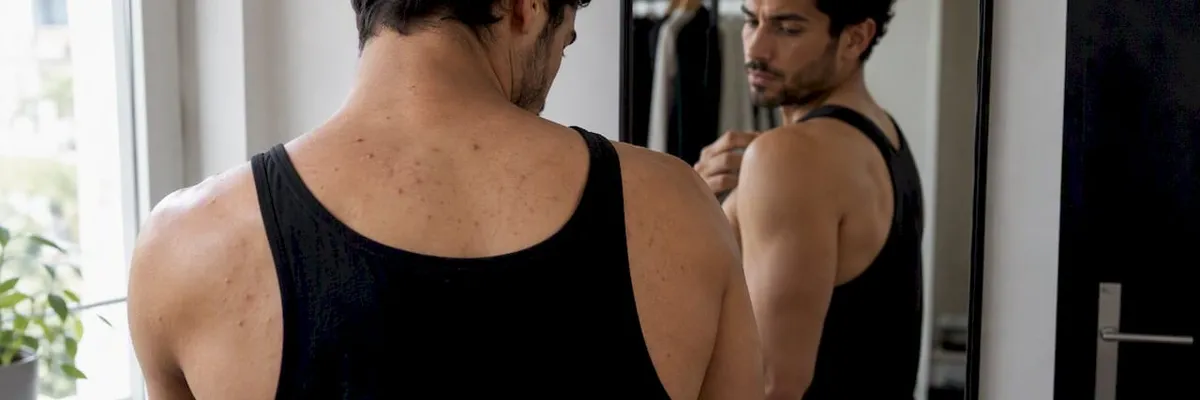
Back acne can be effectively managed with Korean skincare if you combine three things: gentle cleansing, regular exfoliation with salicylic acid (BHA), and a light, barrier-strengthening care with niacinamide or ceramides. Equally important are habits around showering, sports, and your clothing. K-Beauty does not replace medical treatment for inflamed nodules or scars, but it is a very good foundation and complements medical active ingredients sensibly. In this guide, we show you why the back reacts differently than the face, which ingredients have proven effective, and what a realistic routine looks like.
In Short
- Back acne is often more persistent than facial acne because the skin is thicker, has many sebaceous glands, and is constantly under clothing, backpacks, and sweat.
- Salicylic acid has proven effective against clogged pores, niacinamide against redness and sebum, and ceramides for a stable skin barrier.
- Less drying, more balancing: Too aggressive care irritates the skin and can prolong blemishes.
- Expect several weeks to about three months before you see a significant improvement.
- For painful nodules, beginning scar formation, or lack of improvement after about three months, the skin should be in the hands of a dermatologist.
Table of Contents
- Why the Back Reacts Differently Than the Face
- The Ingredients That Convince on the Back
- Your K-Beauty Routine for the Back
- Habits That Achieve More Than Any Product
- How Long It Takes and When You Need Medical Help
- Our View: Less Fight, More Care
- Suitable Care at Rammilav
- Frequently Asked Questions About Back Acne and K-Beauty
- Sources
Why the Back Reacts Differently Than the Face
Many people carefully care for their face and forget that acne does not stop at the jawline. The German S2k guideline for acne therapy describes acne vulgaris as a chronic inflammatory skin disease that almost always affects the face, but also the back and chest in a significant portion of those affected. On the back, the skin is thicker, the sebaceous glands are dense, and you rarely see the affected area directly. This makes care more difficult and explains why pimples often last longer there.
Friction, Sweat, and Residues
One factor is often underestimated: mechanics. Backpack straps, tight-fitting synthetic sports shirts, or a sports bra that stays damp all afternoon rub over the skin and trap heat and sweat. Experts refer to such cases as acne mechanica. Anyone who cycles to work in Zurich, stands on the slopes in Davos with a backpack in winter, or goes to the gym three times a week may know this pattern.
Then there are residues from the shower. Conditioners and hair masks contain nourishing oils and silicones that run over the back when rinsing out. We therefore recommend a simple trick: rinse hair care upside down or to the side and wash the back only afterwards. This way, no nourishing film ends up on the pores.
Hormones, Diet, and Stress
Hormones play a central role in acne, especially during puberty, but also in adults. The current guideline for acne therapy also addresses the influence of diet, particularly foods with a high glycemic load and dairy products. This does not mean you have to give up everything. However, it is worth honestly checking whether a lot of sweets, white bread, or milk-based protein shakes coincide with your breakouts. Stress and lack of sleep can also visibly throw the skin off balance.
What Deficiency Can Play a Role?
In conversations with our customers, the question of a vitamin deficiency often arises. The best studied is vitamin D3. In a study on vitamin D3 and acne from 2023, people with severe acne had a median calcidiol level of 7.09 ng/ml, with moderate acne 13.7 ng/ml, and healthy controls 21.6 ng/ml. This shows a connection, but not proof that vitamin D cures acne. If you suspect a deficiency, have the value measured by your general practitioner before supplementing at high doses.
Pimples or Something Else?
Not every blemish on the back is classic acne. Many small, similar-looking pustules that itch intensely and worsen after heat or exercise may also indicate inflammation of the hair follicles caused by yeast fungi. This reacts differently to care than acne. If your pimples itch instead of hurt and there are hardly any blackheads visible, have it medically clarified before building an entire routine.
The Ingredients That Convince on the Back
K-Beauty focuses less on drying out impure skin and more on balance: one active ingredient dissolves keratinization, another soothes, a third strengthens the barrier. This approach fits with what dermatologists recommend today. A study on a dermocosmetic cream with salicylic acid, niacinamide, and zinc PCA examined exactly this combination as an adjunctive care for mild to moderate acne. The idea behind it: if the skin is dried out too much, it reacts irritated, and the treatment is less well tolerated.
| Ingredient | What It Does | Typical Form in K-Beauty | Good to Know for the Back |
|---|---|---|---|
| Salicylic Acid (BHA) | Dissolves sebum and keratin flakes in the pore, mildly anti-inflammatory | Toner, pads, body lotions, cleansing | Ideal for blackheads and small pimples, start 2 to 4 times a week |
| Niacinamide | Regulates sebum, reduces redness and red spots after pimples | Serums, toners, light creams | Well tolerated, even daily |
| Ceramides | Strengthen the skin barrier, reduce tightness | Creams, lotions | Important if you use acids or medical active ingredients |
| Centella Asiatica (Cica) | Soothes irritated, red skin | Creams, serums, toners | Helpful after sports or friction |
| Tea Tree Oil | Antimicrobial, clarifying on spots | Spot products, gels | Only diluted and not on irritated skin |
| Zinc | Regulates sebum and soothes | Toner, creams | Complements BHA and niacinamide well |
How well such a combination can work is shown by a study with Japanese women with mild acne: a serum with an acid complex and niacinamide improved both blemishes and the overall skin appearance within a few weeks. The study concerned the face, but the principles of action can be well transferred to the back.
More about the background of these active ingredients can be found in our guides on the effects of niacinamide and on ceramides in cosmetics.
BHA or AHA?
For the back, we recommend salicylic acid in most cases. It is fat-soluble and therefore penetrates sebum-rich pores, while glycolic acid (an AHA) mainly works on the surface and smooths the skin structure. A good overview of the differences is provided by the article comparing glycolic acid and salicylic acid. For the back, this means: BHA for pimples and blackheads, AHA rather if rough spots and dark spots bother you more than fresh blemishes.
Your K-Beauty Routine for the Back
A back routine doesn't have to have ten steps. More important is that you really stick to it every day. Here's how we proceed:
- Wash hair first. Rinse out shampoo, conditioner, and hair mask, pin up hair or take it forward. Only then does the back come.
- Gently cleanse. A mild, pH-balanced shower gel or cleansing foam is sufficient. If you wear sunscreen or body oil, you can use an oil-based cleanser beforehand, as on the face. We explain how double cleansing works separately.
- Apply BHA. After drying off, apply a toner or lotion with salicylic acid to the entire affected area, not just individual pimples. Start with two to three evenings a week and gradually increase. For hard-to-reach areas, a spray bottle or applicator with a long handle helps.
- Soothe and balance. On the other evenings, use a serum or toner with niacinamide or cica.
- Lightly moisturize. A non-comedogenic, light moisturizer with ceramides or hyaluronic acid protects the barrier. Gel creams absorb quickly and don't stick under the shirt.
- Protect during the day. If your back gets sun in the summer, at the pool, or while hiking, use a light sunscreen. UV radiation can make red and brown spots after pimples visible for longer.
If you want to apply the same philosophy to your face, you can find a step-by-step guide in our Korean acne routine.
And If You Are Already Using Medical Active Ingredients?
The Swiss practice recommendations for acne treatment name topical retinoids, possibly combined with benzoyl peroxide, as preferred active ingredients for maintenance therapy. Both can dry out and irritate the skin. Here, K-Beauty shows its strength: gentle cleansing and ceramide-containing care make it easier to stick to the therapy. However, do not combine BHA products with prescribed retinoids on your own, but ask your dermatologist how you can alternate both. And remember: benzoyl peroxide can bleach towels, bed linen, and dark shirts, light textiles are the better choice during this time.
Habits That Achieve More Than Any Product
Sometimes the biggest lever is not in the bathroom cabinet. These points often make the difference with back acne:
- Shower immediately after sports or at least change the sweaty shirt. Damp clothing on the skin is one of the most common triggers.
- Choose breathable clothing. Cotton or functional materials that wick moisture away rub less than tight synthetic shirts.
- Change bed linen and towels regularly, about once a week, more often during severe breakouts.
- Check backpack and straps. Wide, padded straps distribute pressure better. If the pimples sit exactly where the strap is, you have an important clue.
- Don't squeeze. On the back, you can hardly see what you're doing, and the risk of inflammation and scars increases.
- Don't scrub too much. Coarse body scrubs and hard brushes irritate inflamed skin. Chemical peels with BHA are much gentler.
- Avoid perfumed body lotions and heavy oils as long as the skin is unsettled.
How Long It Takes and When You Need Medical Help
Patience is not a cliché with back acne, but part of the treatment. The skin renews itself in cycles of several weeks, and blemishes you see today often developed a long time ago. The Swiss practice recommendations from 2025 state a short-term therapy goal of reducing inflammatory lesions by about 50 percent within three months. This is a realistic benchmark for your care as well: improvement yes, flawless skin after two weeks no.
The Acne Working Group of the Swiss Society for Dermatology and Venereology, whose guidelines are published on derma.swiss, emphasizes that acne should be treated early and consistently to avoid scars. Therefore, see a dermatologist if:
- you have deep, painful nodules or cysts,
- scars or sunken areas are already forming,
- the pimples do not significantly decrease after about three months of consistent care,
- the blemishes itch intensely or suddenly appear after taking new medication,
- the skin is psychologically burdensome, for example, because you no longer go to the pool in summer.
When the pimples have healed, red or dark spots often remain. We have written our own guides on redness after acne and on lightening acne scars.
Our View: Less Fight, More Care
At Rammilav, we often see that people with back acne first reach for the strongest remedies they can find: harsh scrubs, drying cleansing gels, everything at once. The skin often responds with tightness, redness, and new blemishes. This is where we find the Korean approach convincing. It doesn't treat the skin on the back as an opponent but strengthens its barrier while targeted active ingredients like BHA and niacinamide do their work.
Our experience is: the best routine is the one you stick to for three months. That's why we recommend fewer, well-tolerated products rather than an overcrowded shower caddy. Those with sensitive skin should start with cleansing and moisturizing and add BHA only after one to two weeks. And if the skin doesn't calm down despite good care, going to the dermatologist is not a failure but the next sensible step. K-Beauty then accompanies a medical therapy very well. More about how to bring stressed skin back into balance can be read in our article on repairing the skin barrier.
— Aleksejs
Suitable Care at Rammilav
In our shop, you will find Korean care from brands like Cosrx, Beauty of Joseon, and Purito, sorted by categories such as cleansing, toner, serum, moisturizer, and sunscreen. We source all products directly from verified suppliers so you receive original goods. Within Switzerland, your order usually arrives in 2 to 3 days, and shipping is free for orders over 80 CHF. For the back routine, it's worth taking a look at light gel creams like the Lebelage Super Aqua Moisture Cream or directly in our K-Beauty catalog, where you can find cleansing, toners, and serums for impure skin.
Frequently Asked Questions About Back Acne and K-Beauty
What Really Helps Against Back Acne?
The most effective is a combination of gentle cleansing, regular BHA exfoliation, and light, barrier-strengthening care, complemented by fresh clothing after sports and hair care rinsed upside down. For moderate to severe acne, medically prescribed active ingredients like retinoids or benzoyl peroxide are added. The care makes these active ingredients more tolerable.
How Quickly Do Pimples on the Back Disappear?
You often see the first improvements after four to eight weeks. As a realistic goal, the Swiss practice recommendations mention about half fewer inflamed pimples within three months. Red or dark spots usually take a few weeks longer to fade.
Is Korean Skincare Really That Good?
K-Beauty is not a miracle cure, but its approach fits well with impure skin: mild formulations, proven active ingredients like salicylic acid, niacinamide, and centella, and a strong focus on the skin barrier. Especially with sensitive skin, it is often better tolerated than highly drying products. It is crucial that you use original products and consistently apply the routine.
Can I Use Facial Products for the Back?
Yes, many toners, serums, and light creams are also suitable for the back. Because the area is much larger, you will use more product, so larger containers or spray bottles are practical. The skin on the back is more robust than on the face, but you should still test new acids on a small area first.
Sources
- Updated Swiss Practice Recommendations for the Treatment of Acne (2025)
- S2k Guideline Therapy of Acne (AWMF, 2026)
- Guidelines & Recommendations, derma.swiss
- What Role Does Vitamin D3 Play in Acne?
- Effectiveness and Safety of a Dermocosmetic Cream as an Adjuvant Treatment for Acne (JAAD, 2024)
- Evaluation of a Dermocosmetic Serum Containing a Multi-acid Complex and Niacinamide (PMC)
- Glycolic vs Salicylic Peel


